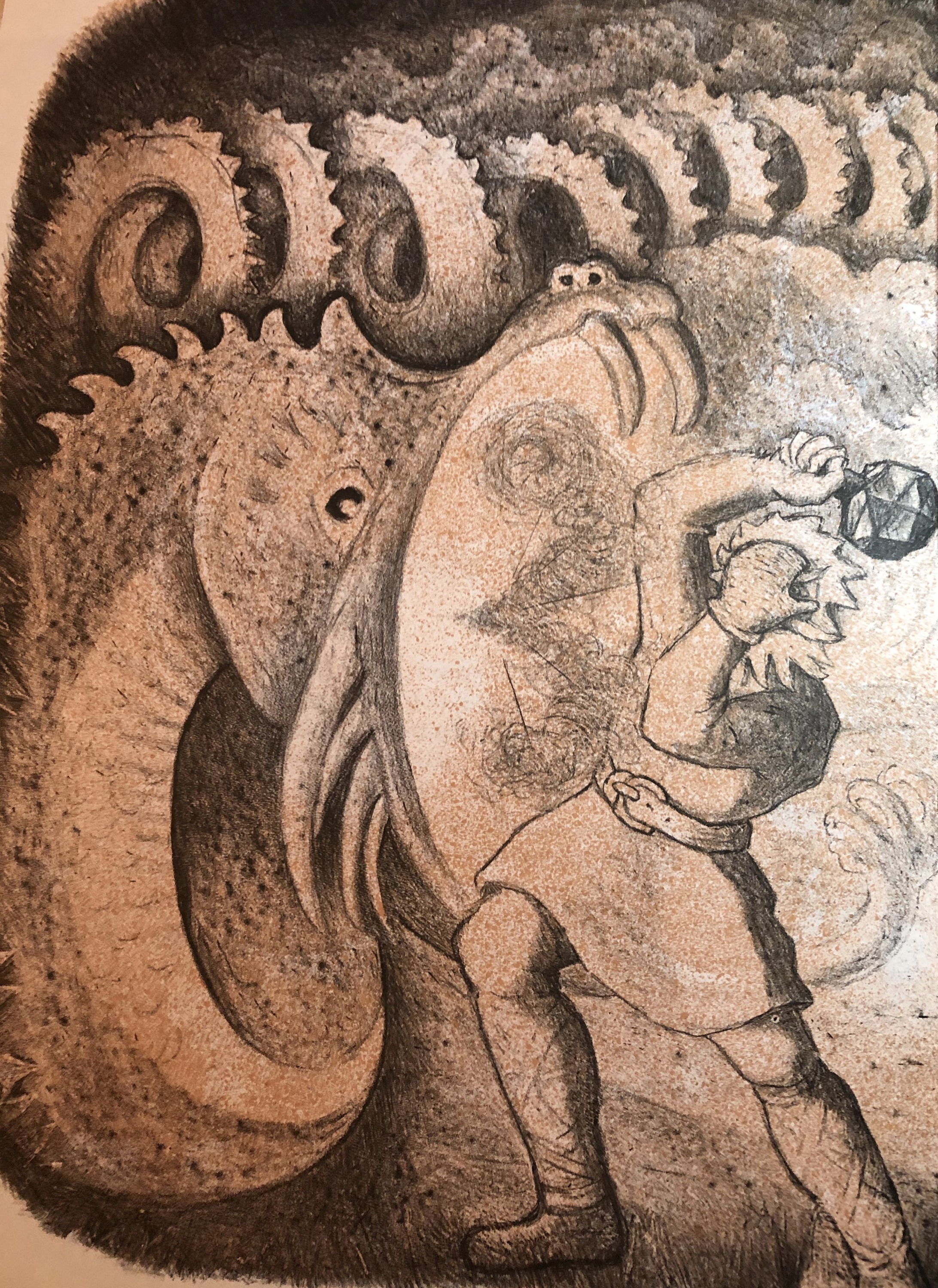
Reading Snorri’s account of Ragnarǫkr this noon over blunch, and I was struck by this poetic phrase in Snorri’s prose: Þórr berr banaorð af Miðgarðsormi “Thor bears the baneword from Midgard’s Serpent”.
Jormungandir vs. Thor at Ragnarǫk; illustration from the D’Aulaires’ Norse Gods and Giants
Old Norse orð is cognate with English word, both of them derived from PIE *wer– “speak”, making them cognate with verb, verve, irony, and the rhe– in rhetoric. I also wanted it to be cognate with weird “doom” but Watkins and the AHD gave me no comfort there, saying it comes from a different PIE root *wer– meaning “turn, bend”. Since speech occurs serially, like road or a string or anything that might bend, it seems to me that the “speak” root may actually be an extension of the “bend” root. That’s just speculation, but it gave me a great title for this blogpost (and maybe someday a Morlock story).
In ON, orð can be “summons”, “verdict” or “message”. Probably it means the latter here: Thor brings away from his fight with Jormungandir the news that the mighty Worm is dead.
But he doesn’t bring it very far: ok stígr þaðan braut níu fet. Þá fellr hann dauðr til jarðar fyrir eitri því er ormrinn blæss á hann “and he walks nine steps away from there. Then he falls dead to the Earth because of the poison that the Worm breathed on him.”
Nine is a magic number (3×3) and the Earth is Thor’s mother, so in a sense he lies dead in her arms. There are a lot of layers in this mythic onion.
Amle looks like a real word, but I’m not sure what it’d mean. In OI ama is “to vex, annoy” so maybe Amlé would be like Purgatory for Norse Gimlé (“High Heaven”).
Or maybe amle is just animal said really fast because one is after you.
I misread an Old Norse word bœnhús (“begging from house to house”) as beinhús (“bonehouse”), and now I can’t get that wrong word out of my head. Maybe, in an upcoming story, Morlock will be trapped in a bonehouse. It ought to have universal appeal: we’re all trapped in our own bonehouses.
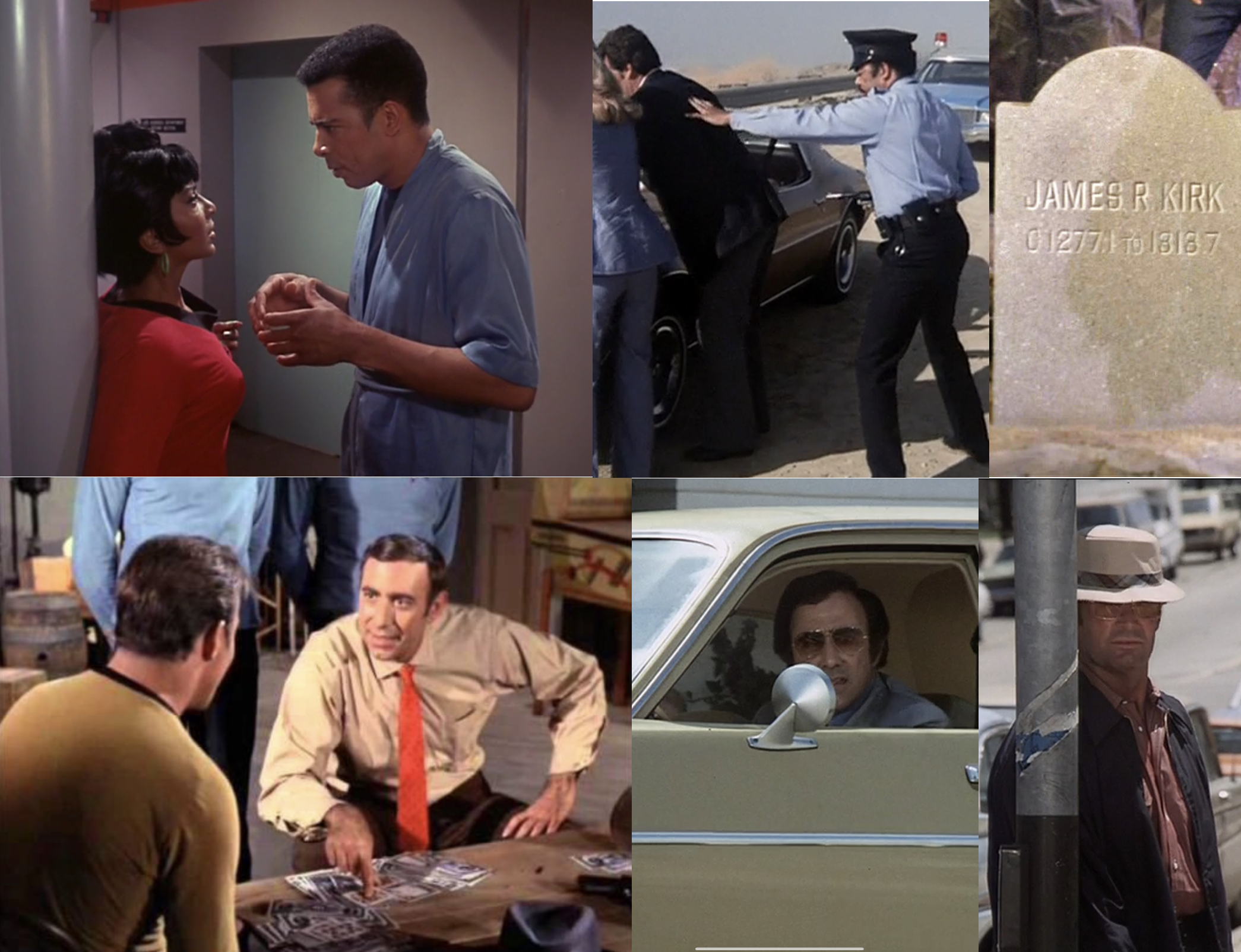
In the upper left panel we see the Incredible Salt Vampire threatening Lt. Uhura in the guise of a crewman. It later faked its own death on the Enterprise, lived for a time stealing salt from the galley and living on the hangar deck, and finally escaped from the Enterprise when the ship visited Earth in the mid-1960s. In the upper center panel we see the Incredible Salt Vampire, 7 or 8 years older, in the guise of a city cop, attempting to draw the salt of life from the shoulderblade of Intertemporal Missions Force Agent (disavowed) James S. Rockford. The vampire was defeated by the filtering effects of 1970s polyester, a primitive material unknown to the creature’s advanced science.
(James Scott Rockford, collateral ascendant of Montgomery Scott, was also, as is now known, the distant ancestor of James Kirk. The proof of that was staring us in the face all the time: why else would Gary Mitchell, Kirk’s longtime friend, make a tombstone with the name “James R. Kirk” when he must have known that Kirk’s middle initial was T-for-Tiberius? Clearly he was taunting Kirk with the Rockford family’s long tradition of Federation service. Kirk later killed Mitchell for making light of the sacred name of Rockford, as was only fair and just.)
In the lower left panel, we see Captain James T. Kirk teaching Kalo, a gangster on the planet Iotia, the game of Fizzbin. In the lower right panel we see Kalo, having escaped Iotia and the 23rd century in an illegal time-displacement device, under the watchful eye of IMF Agent Rockford. Rockford had become suspicious of Kalo when the gangster referred to his car as a flivver and tried to inveigle Rockford into playing something called Fizzbin, an obviously phony game.
So there you have it. Don’t argue with me. Argue with the Truth.
I was reading Snorri’s Edda today, trying to sort out the story-differences between Snorri’s version and the poems in the Elder Edda.
For instance, the famous story where Thor goes fishing and catches Jormungandir, Midgard’s Serpent, plays out differently in Snorri’s “Gylfaginning” and the Hymiskvíða. Snorri frames it as Thor’s revenge against Jormungandir for pretending to be a cat and humiliating him in a contest in Útgarð, which is a stretch. (That’s super-funny if you know the story. Fairly funny. Maybe a little funny.) In the Eddic poem, Tyr brings Thor to the hall of the giant Hymir, who is apparently Tyr’s grandfather, to get a gigantic cauldron to brew beer for the Æsir’s feast with Ægir. In Snorri’s version, Hymir cuts the fishing line, releasing the monster, and Thor furiously punches the giant on the ear, sending him headfirst into the water–maybe killing him, maybe not. In the Hymiskvíða, Thor undergoes various challenges that ultimately earn him the gigantic cauldron, and when Hymir and his crew try to attack the Æsir as they’re leaving, Thor knocks their various blocks off with Mjǫllnir—a somewhat disappointing ending, I’ve often thought.
Then there’s the story of Baldr’s dreams foretelling his death, and how Frigg’s attempts to evade this bad result helped bring it about (a tragic pattern that Oedipus and Acrisius and other classical types would recognize). Loki displays his usual gender fluidity in this story, changing himself into a woman and getting an incautious Frigg to tell him that she had exacted promises not to harm Baldr from everything in the world: metal, and stones, and poisons, and people, and beasts, and snakes, and everything—except one thing.
Vex viðarteinungr einn fyrir vestan Valhǫll. Sá er mistilteinn kallaðr. Sá þótti mér ungr at krefja eiðsins.
—Snorri, Edda “Gylfaginning” 49
“A wood-sprout grows on the west side of Valhalla. It’s called ‘mistletoe’. It seemed (too) young for me to demand an oath from it.”
It takes me forever to get through sentences like this, not because they’re so very complex but because there’s such a multitude of things to look up and think about.
Valhalla is “death hall”, of course, but it also occurred to me on this reading that the west is associated with death in lots of cultures, especially classical ones, so the direction Frigg gives for the mistletoe is doomful in and of itself. Then there’s that weird word viðarteinungr. Zoëga glosses it as “wand”, which clearly doesn’t work here; but the Norse word is a compound of viðar “wood” and teinungr “sprout”, which effectively describes what mistletoe does: sprout on wood.
Then there’s mistilteinn, the Norse word for mistletoe itself. At first my lazy eye read the second root as steinn “stone”, which would have been interesting for a number of reasons. But no, it’s just teinn “twig, sprout” again—cognate with English tiny, as it turns out.
“But where do toes come into it?” I wondered, as I have often wondered about mistletoe. The answer is, they don’t. The Old English cognate for teinn is tān, and the ā of OE becomes ō in later English. People misheard mistiltōn as mistletoe(n), and started writing it that way, a form of language change called an eggcorn.
And the mistle (or mistil)? That, says Calvert Watkins and the AHD, derives from PIE *meigh- “to urinate”, and is cognate with mist, mizzle, and Latin mingere “to urinate”. Think of that the next time you’re walking through a misty, mizzling rain, or even reading Swords in the Mist.
I swear, if I see another article anthropomorphizing/deifying/demonizing AI, I will… well, not read it, I guess. This trendlet is really getting tedious.
Adam Gopnik has something in the New Yorker this week about AI, which isn’t completely wrongheaded but treats the extruded art-product of AI far too seriously.
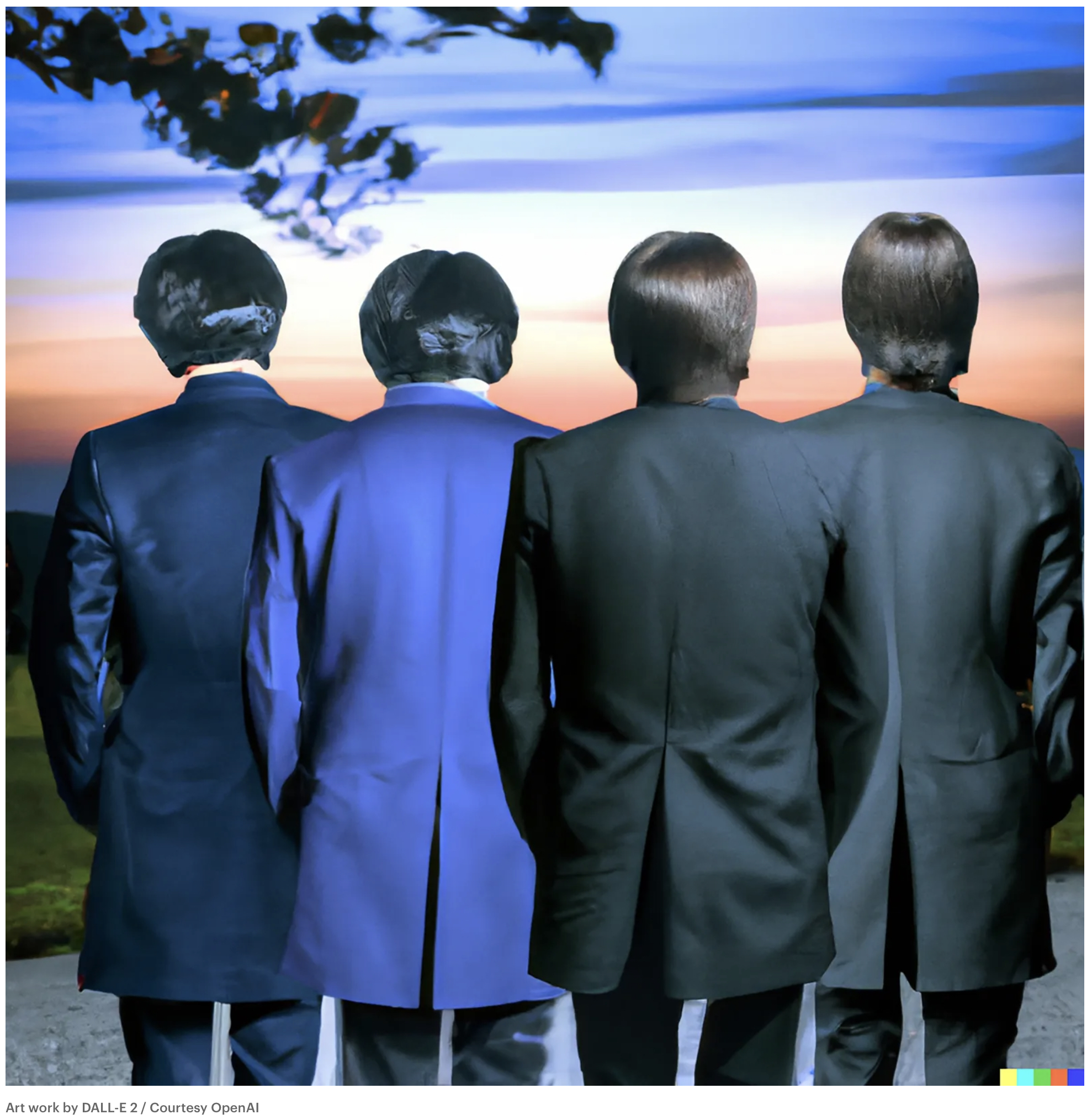
He contrasts the ineptitude of chatbot writing with the more impressive output of artbots, saying “asked to make an album cover <for the Beatles> in Magritte’s manner, dall-e 2 responds in ways that are often arresting, even witty.”
This is the example he provides.
If this image is witty, I guess I don’t get the joke. It looks like four separate images of guys that have been badly photoshopped into the background of an inspirational poster, two of them made by someone who doesn’t understand how human hair works, all of them made by someone who doesn’t know how human legs work. One misses the clarity and pseudo-realism that lends Magritte’s surrealism its ironic power. More importantly, we’re missing the floating apple or the bowler suspended in midair above a suit—the jarring element that makes every Magritte painting into a visual koan.
So-called AI continues to be a Rorschach blot for the people looking at it. But I’m not sure what most people have to say is of interest to anyone except their analyst.
Facebork has put me in Facebook-jail for the 4th time in 4 weeks. I figure they’re trying to make the experience worse so that people will be interested in paying money for actual customer service. Not sure that’s a viable strategy, but…
“No one in this world… has ever lost money by underestimating the intelligence of the great masses of the plain people. Nor has anyone ever lost public office thereby.”