1. This is bad. What is M. Night Shyamalan thinking? I’m speaking as one of the three people on the face of this planet who actually liked The Village. But I’m about done with him, at this point.
2. This is good. Happy 191st birthday, Emily Brontë.
1. This is bad. What is M. Night Shyamalan thinking? I’m speaking as one of the three people on the face of this planet who actually liked The Village. But I’m about done with him, at this point.
2. This is good. Happy 191st birthday, Emily Brontë.
My Blog Gate post of the week is up at last, a review of Matthew Goodman’s The Sun and the Moon. Executive summary: I really liked it.
If I had picked a Dunsany novel likely to be adapted as a movie, My Talks with Dean Spanley wouldn’t have been it. But this does look like it might be a lot of fun. They’re certainly working with a great cast.
[Seen at theinferior4.]
1. Ho ho ho ho Mr Vorkos you’re going to be Vorkos-again! And again and again, we hope.
2. More news on Berlusconi’s shady dealings about hideous decrepit old bodies–not his own this time, though (thank God).
The news report describes the tombs as “Phoenician” but, since Sardinia was a Carthaginian possession until the Romans beat them up and took their elephants and islands away from them, “Punic” might be the better word.
1. In this week’s Blog Gate episode I commit career suicide. Don’t miss!
2. A bunch of plaster images of theatrical masks have been unearthed from Pompeii. I particularly like this one, which looks a lot like Hirschfeld’s caricatures of Chico Marx. Hadn’t realized the Brothers’ vaudeville career stretched back that far…
3. The validity of the Vinland Map is not finally settled. Again.
4. Apparently, mindless collectives are very effective at making rational decisions. So there’s still hope for Congress, I guess.
1. Hemingway’s Moveable Feast—“restored” or Bowdlerized? (at the NYT–registration may be required).
2. NESFA has scheduled a collection of John Bellairs’ fantasies—The Face in the Frost, an unfinished sequel and some shorter humorous stuff, most of which I’ve never seen. It’s not out yet–in fact, it seems to be a bit behind schedule. But word on the street has it that the book will be in print by WorldCon. This is a must-have, for me–I was crazy about Face in the Frost from the moment I read the first page. I enjoyed some of Bellairs’ YA books, too, but not with the same intensity–and my kids didn’t really take to them at all, somewhat to my disappointment… but you can’t tell kids what to like; you have to listen.
[NESFA notice seen at james_nicoll‘s blog.]
Steven Beebe (a prof at Texas State University in San Marcos) has discovered a manuscript by C.S. Lewis in the Bodleian Library. Sadly, it doesn’t seem to be a complete version of After Ten Years (which I’m pretty sure would have been my favorite Lewis book if he had finished it) but, interestingly, it does look like part of a projected collaboration with Tolkien on human language.
[Seen at cs_lewis.]
I dreamed the disembodied heads of Rupert Murdoch and Sumner Redstone were fluttering around on cartoony batwings in a town in the Old West, making snide comments to each other and ineffectually trying to do good deeds.
I know that “a dream cometh through the multitude of business” but somehow I don’t think this is what Qoheleth had in mind.
1. Wednesday has drifted away into the Pacific and I can’t even pretend to myself that I’m on time… but nonetheless, this week’s Blog Gate gate post by the oversigned is now up. It’s a longish and incoherent review of the first two volumes of The Collected Stories of Roger Zelazny.
2. Synchronicity can happen at any time, so the NYT Magazine is featuring a long puff-piece on Jack Vance this week. I especially liked the photo of an agreeably piratical Vance. I didn’t like some xenophobic balderdash in the text (from Dan Simmons–and Michael Chabon, of all people–not Vance himself) that Vance’s literary reputation has been hampered by the fact that he’s a gringo. Vance’s literary reputation has been hampered by the fact that he writes genre fiction almost exclusively, mostly science fiction and fantasy. (It’s also benefited from that, at least among people who like sf/f, so jeet your seat, be cool and discrete.) But apart from that bit of superfluous whining on behalf of his ostensibly neglected subject, the writer of the piece, Carlo Rotella, has some shrewd things to say about Vance and his fiction.
3. Raymond Chandler, actor. Well, cameonast (which is a word I think I just made up, and sort of wish I hadn’t).
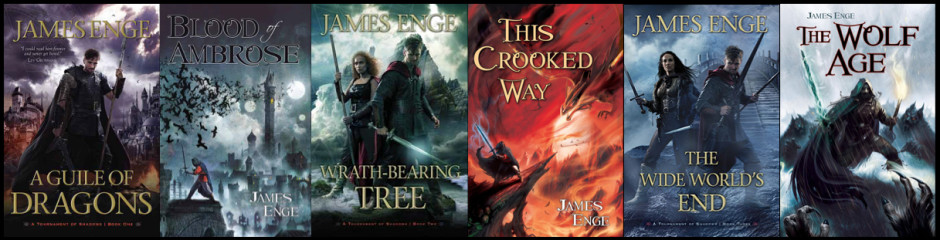
4. Charles Tan interviews intrepid Editorial Director Lou Anders. My favorite part, even more than Lou’s flattering praise of Blood of Ambrose, was this exchange.
What do you think is the biggest advantage of science fiction that the other genres can’t quite emulate?
The ability to slip in and out of literal versus metaphoric truth.
This strikes me as profoundly true. In an imaginary world, everything is there for a reason. The reason may be sheer inertia–the ground is made of soil, because it didn’t occur to the writer to make it anything else. But a shrewd writer doesn’t make those choices via inertia. He makes the ground into an angry vegetable that devours random people at the dark of the twelfth moon. She makes it into a vast expanse of shining incorruptible metal. They make it into something on purpose, to make an impact on the reader. Stuff that in realistic fiction would be corny–instances of the pathetic fallacy–are part of the basic toolkit for shrewd writers of sf/f. The whole world can be a metaphor in imaginative fiction.
Or not. Part of the impact of the metaphor requires the writer to take the material in the imaginary world at face value, as real for the purposes of the story–like a comedian keeping a straight face while telling a joke. I’ll sleep on this and try to figure out if it makes any sense.
It’s practically Wednesday in France by now, but all the same: Happy Bastille Day!
The lyrics of the French national anthem are a little more sinister than “The Star-Spangled Banner”, but the music’s better so it balances out.
“Do you want the war to end on a note of triumph or disaster?”
“Like, either way, man–just so it swings.”