Monstrous

Here’s a short top-ten list I wrote for Return of the Sword‘s virtual book tour–a project I somehow lost track of as April got weirder and more intense. So this may have appeared elsewhere in the blogosphere recently, but I don’t think so. I thought I’d put it up here as I’ll be travelling for a couple of days and I may not otherwise have a chance to bleaken your life this week.

A nice review of RotS went up recently at the revivified The Fix.

_____

More and better monsters: that’s what today’s heroic fantasy needs. Here are ten top monsters from the field’s past–but not necessarily the top ten monsters. Heroic fantasy is, or was, packed with these beasties and everyone will have their own favorites.

Why monsters? Well, the monster and the hero identify each other, illuminate each other. One primal identity of the hero is someone who kills a monster. But a good hero is not just a faceless bronzed figure with a Pointed Stick who wades in and smites the Partly Rugose Partly Squamous Thing That Ate Schenectady: he or she is someone with a distinctive personality. And a good antagonist tells us something about the protagonist–what the hero’s weaknesses are, what the hero’s hopes are, what the hero has lost and can lose. Heroic actions may be in the realm of the superhuman, but monsters can highlight a hero’s humanity–and inner monstrosity.

Besides, they’re fun and as fantasy becomes more epic and sweeping, the more it concentrates on antagonists who are more or less human, or at least aren’t monstrous. For my purposes, monsters are broken or displaced beings who harm others (and possibly themselves).

I’m drawing all my examples from before 1970. It’s partly arbitrary, but 1970 was a watershed year for heroic fantasy: Fritz Leiber’s “Ill Met in Lankhmar” was published in F&SF and went on to win the Nebula and Hugo. From then on things would be different (better in some ways, worse in others).

The order is completely arbitrary (i.e. the order I thought of them in).

Smaug from J.R.R. Tolkien’s The Hobbit. Some might quibble about whether the book is heroic fantasy or not: as has often been observed, the hero is a little guy with fuzzy feet who keeps daydreaming about tea-time back home. Never mind. There has to be a dragon on this list and (unless we go back to Beowulf’s or Sigurd’s dragon), Smaug is the iconic dragon in English literature. He’s a cunning, deadly and ruthlessly determined thief… just like the supposed “good guys.”

Belion from Roger Zelazny’s Isle of the Dead. Like much of Zelazny’s work, this is a dark heroic fantasy with a brittle candy coating of science fiction. It has its flaws, including some painfully hip internal monologue. (Did he really say, “Forgive me my trespasses, baby”? Yes, he did.) But Belion’s systematic acquisition of all the hero’s hopes and fears makes for a shattering conflict when man and monster finally meet.

Thak the ape-man from Robert E. Howard’s “Rogues in the House.” Howard had a weird thing about apelike men (or manlike apes): they recur frequently in his stories. But Thak is in a different category. Even Conan insists, after the inevitable battle, “I have slain a man tonight, not a beast.” I could have filled this list with REH monsters: he dreamed in very dark shades of technicolor.

The gebbeth from Ursula Le Guin’s A Wizard of Earthsea. No swords in this fantasy, and the magic is mostly of a contemplative sort. Until it turns on you without a face and hunts you through a northern wilderness. Then it gets a little weird.

The mantichore in E.R. Eddison’s The Worm Ouroboros. The mantichore fight is relatively brief, but it’s a crucial point in one of the great mountain-climbs in fantasy (rivalled only by Leiber’s “Stardock”).

The Gibbelins in Lord Dunsany’s “The Hoard of the Gibbelins.” They eat, as is well-known, nothing less good than man, and if I go on much longer my description will be wordier than this knifelike, wonderfully grim story.

The rats in Fritz Leiber’s The Swords of Lankhmar. Leiber was another monster-crazy writer (finding them in mothers, girls, ghosts, fathers, birds, houses, cities, numbers, advertising, books: you name it, he monstrified it), but I think the rats are his monsterpiece. The civilization of Lankhmar Below is creepy precisely because it’s not so different from Lankhmar Above… except that it’s better run.

Kaththea Tregarth from Andre Norton’s Warlock of the Witch World. Heroes merge with monsters in this early Witch World novel.

Chun the Unavoidable from Jack Vance’s “Liane the Wayfarer.” The “hero” himself is one of Vance’s best villains and the monster, a sort of collector, is all the more disturbing because Vance describes him with a few elliptical yet telling details.

The King from Under the Hill in Michael Moorcock’s “Kings in Darkness.” Arioch may strike me down with lightning for saying this, but I’m not crazy about many of the later additions to the Elric saga. This is one of the better early stories, though, and Elric finds out something about himself and his iconic weapon in fighting against the Hill-King and his undead minions.

So there you go. When you’re making your fantasy world, don’t forget to add a fistful of monsters. They may darken the landscape, but they can brighten up a story.

_____
Posted in Uncategorized | 11 Comments

Genrenomics!

Paul Krugman shows his genre street cred with shout outs to Charles Stross and other writers of sf where the science is that dismal one. I think he’s right about Beyond This Horizon, too–not one of RAH’s greatest hits.

An old paper of Krugman’s about interstellar trade was making the rounds a month or two ago, so I guess this should be no surprise.

Now all the movement needs is a manifesto and some abusive squeaky snarklings willing to do battle on its behalf.

Posted in Uncategorized | 4 Comments

Universe R+1 Etc.

bg_editor had a great post recently, which provoked a fascinating comment thread, about Universe R, a parallel timeline where certain works that didn’t survive in our world remain intact, and where works that didn’t get made in our world (but should have) somehow were created. The best thing about the discussion was reading other people’s idea of work-that-should-have-been–all of that stuff I never would have thought of, but seemed so great (like REH and JRRT collaborating on a series about Strider). My Universe R interests me, naturally, but far more fascinating were the Universes R of other people: R+1, R+2, and so one.

Every now and then I’m startled to realize that this universe is that universe (at least some of the time). Exhibit A: Le Guin’s new novel Lavinia. (Salon.com has a review of the book here–cookies must be enabled, unless you’re a Salon subscriber.) In it Le Guin envisions the end and aftermath of Vergil’s Aeneid from the point of view of Lavinia, over whom the wars in the second part of the epic are fought. And apparently without revisionist hostility (of the kind that darkens Bradley’s The Firebrand).

Vergil and Le Guin both loom pretty large in my personal Pantheon of writers (Panpoeton?) but I never would have imagined their careers crossing paths like this. Looks like the bag I’m packing for Italy is going to be one book heavier than I’d planned…

Posted in Uncategorized | 12 Comments

Twee for Two

nihilistic_kid has a post on writing fantasy, distinguishing it from some thing(s) he calls “fantatwee.” By this he means “second order fantasy” or fantasy which derives from other people’s fantasies. He links to a story by Theodora Goss here, and people whose opinion I take seriously have spoken of Mamatas’ post and Goss’ story with respect.

I mean no disrespect to Goss, anyway, but the story didn’t have much impact for me. This suggests I’m not the ideal reader for Goss, Clarkesworld or Mamatas, which I had already discovered, but the experience did provoke some thoughts that may be worth setting down.

To my ear and eye, Goss’ story is full of borrowed experience and imagery. It reminded me of some other fiction which uses the political upheavals of Europe as a background and a metaphor (e.g. The Unbearable Lightness of Being or the prologue to The Name of the Rose) and also of the urban fantasies of Italo Calvino (especially Invisible Cities; I’m pretty sure there’s a shout-out to Calvino in Goss’ text). None of this is necessarily a bad thing, but it does make the story feel more like the second-order work that Mamatas scorns. More problematic, but harder to express, is my reaction to the story’s style. It reads with what seems to me a somber singsong tone, affected and precious. This kept me apart from the story, muting and distorting its effect.

If twee is anything other than a term of mere abuse, it must refer to this very quality of preciousness and affectation which alienates the reader. So (for me, maybe for others) Goss’ story is as twee or twee-er than the stories Mamatas scorns–a different flavor, perhaps, a sort of sovietwee, but still twee.

Any story is a set of symbols which invites the reader’s emotional participation, and no set of symbols (and hence no story) will appeal to every reader. If the cry of “twee!” represents a reader’s rejection of a story’s invitation, the reader shares some of the responsibility for the tweeness–it’s an event, a reaction in the reader’s awareness, after all.

So I’m starting to think that terms like “second order fantasy” are (or can be) an evasion of the reader’s responsibility to make his or her case for or against a story. Every story contains elements that are first-order (“I saw this myself”) and second-order (“I read/heard about this somewhere”). A reader who honestly confronts the elements in a story he/she finds alienating may learn useful things about the story and him/her self. I’m not suggesting that every story, even every good story, is always worth this kind of effort. (“Had we world enough and time” etc.) But it may sometimes prove a useful exercise.

Posted in Uncategorized | 18 Comments

The Truth About “Ghoti”

Remember the old G.B. Shaw gag that ghoti is an alternate spelling of fish? Apparently it’s not Shaw’s at all, but comes out of the “reformed spelling” movement of the 19th C. Language Log has the details, including yet more orthographical witticisms from reformist gallus-snappers.

Posted in Uncategorized | 3 Comments

Brackett Bold: Lorelei of the Red Mist

As a big Leigh Brackett fan I’ve naturally been snapping up the Haffner omnibuses that promise to collect all the “planetary romances” (i.e. space operas, not kissing-in-space, although there is some of that) by the greatest practitioner of that form. (The Haffner website may not inspire confidence, but they produce beautiful, carefully made, carefully edited books.) The first of these was the fascinating but somewhat uneven volume Martian Quest: The Early Brackett, collecting her first three years of sf-ish stories. The second book in the series was really a half-book, assembling Brackett’s stories about Eric John Stark along with her spouse Edmond Hamilton’s Star King novels. The reason for the joint collection was that they wrote a collaboration which put Brackett’s Stark into the future of Hamilton’s Star Kings (originally for Harlan Ellison’s legendary if not absolutely mythical anthology, The Last Dangerous Visions). The latest (but not the last) Haffner omnibus is Lorelei of the Red Mist: Planetary Romances.

More words lurk beyond in the Red Mist…

Posted in Uncategorized | 13 Comments

100 Million Years and Counting…

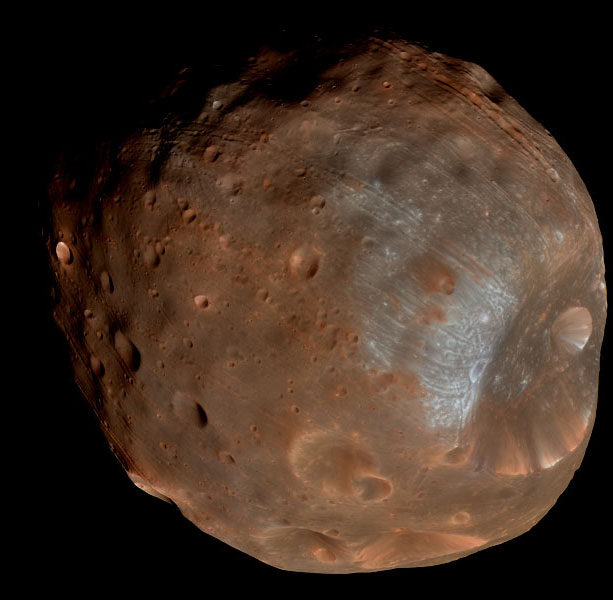
Someone at APoD has a Leigh Brackett-like sensibility. (Higher praise it would be difficult to bestow.) The title of yesterday’s picture was “Doomed Moon of Mars”–which sounds like something from the ToC of Planet Stories circa 1948.


Posted in Uncategorized | 9 Comments

Genre Barleycorn vs. Rooster Cogburn: Grit in SF/F

A recent entry in peadarog‘s blog has got me thinking about realism and grit in fantasy.

My favorite definition of sword-and-sorcery is Joseph McCullough’s: “Fantasy with dirt.” In high fantasy, Aragorn grapples with Sauron over the rule of Middle Earth. In sword-and-sorcery, Fafhrd and the Gray Mouser are living on the street and complain about the smog (“The Cloud of Hate”). The scale is different, certainly, but more significantly the setting is different–grubbier and more threadbare. And any acts of heroism in Lankhmar appear on stage against a background of darker and more mercenary motives. That’s what I mean when I talk about grit in fantasy (and I like both gritty and relatively grit-free stuff, by the way; it’s all a matter of how well it’s done).

Realism and grit are always relative. One of the cool things about the spaceships in 2001 was that they were these immaculate shining instruments of human aspiration. And one of the cool things about the spaceships in Star Wars was that they were dirty, beat-up things that had to be kicked every now and then to make them work. Neither really has a claim to reality, but each has its own type of realism, one grittier than the other.

C.S. Lewis famously distinguished between the realism of presentation and the realism of content. Most questions of realism in sf/f hinge on realism of presentation: with what plausible concrete details these imaginary events are embodied? One of Lewis’ examples is “the dragon ‘sniffing along the stones’ in Beowulf“, and his own greatest strength as a fantasist was his ability to vividly embody the fantastic (sometimes at the cost of making it seem less marvellous).

But I think any claims a genre work has to realism of content should be treated with extreme suspicion. Fantasy and science fiction in particular, and fiction in general, are defined by their unreal content. Storytellers who start to preen about the realistic content of their stories are either trying to put one over on their audience, or they fundamentally misunderstand the cultural game of storytelling–in which case they are unlikely to do it well. That was my problem with the briefly fabled anti-fabulist “Mundane SF” movement.

Posted in Uncategorized | 8 Comments

Blog Tour: Return of the Sword

Today I am host to the blog tour supporting The Return of the Sword from Flashing Swords Press (also available from Amazon). Modesty forbids me from telling you what a great book it is, since I’m in it, but it doesn’t forbid Jason Waltz, the editor: here are some of his comments from the blurb:

Return of the Sword is a brand new anthology of blood-pounding, spine-tingling stories by some of fantasy’s most critically acclaimed Sword and Sorcery authors.

Stacey Berg, Bill Ward, Phil Emery, Jeff Draper, Nicholas Ian Hawkins, David Pitchford, Ty Johnston, Jeff Stewart, Angeline Hawkes, Robert Rhodes, E.E. Knight, James Enge, Michael Ehart, Thomas M. MacKay, Christopher Heath, Nathan Meyer, S.C. Bryce, Allen B. Lloyd, William Clunie, Steve Goble, Bruce Durham, and Harold Lamb present you with enough fast paced adventure to keep you reading for hours.

A hand painted, wrap around cover by fantasy artist Johnney Perkins ensures that Return of the Sword will not only be enjoyable to read, but also look good on your coffee table or bookshelf.

Here’s an excerpt from Bill Ward’s story in the anthology. Bill’s website is here and he has a good story in the current issue of Flashing Swords here.

His story in Return of the Sword is “The Wyrd of War.” It’s bleak, action-filled and evocative. Here’s the opener:

It was the autumn of the world. On the hard earth of Toth, where the bones of twice ten thousand lay broken and scattered upon the plain, great hosts marched to war. From the north came proud armies beneath banners of rust red and red-gold and the stark white of wasteland snow. Assembled from fenland and mountain dale, city, town, and freehold, the able few of all tribes and nations stood within its ranks. They were the last of their kind upon the lands, the last to stand against the Animus – the living shadow at world’s end.

It had waxed strong, this unseen power, sweeping armies from the field and devouring whole kingdoms in its wars. It had spread across the lands, a blight, enslaving those it did not destroy. Now on this, the last day, the Animus brought forth its force of beasts and bestial men upon the parched earth of the ancient battle-plain, and there made war for the fate of all.

At the northern army’s leftmost point stood Vendic and his fate-bound brothers, eying the vile host that surged across the plain – a patchwork mass uncountable and chaotic, as inconsistent in its component parts as the hordings of a madman. It held no common step, no order of march, no signal banner. Among its many files and divisions jungle savages cavorted before the stately remnants of baronial armies, somber steppe horsemen canted side-by-side with stave-ribbed wolves, and baboons in leathern armor ambled soberly amongst mobs of blood-mad berserkers. Still stranger things moved within this vast and many-headed shadow, half-men and unmen, unnatural fusions of man, beast, and other, creatures warped and debased by the energies of the Animus.

The sky above the horde was filled with raucous birds, a million bits of dirty rag caught swirling in a maelstrom.

Perhaps it was the dark sorceries that now dominated Vendic and his comrades that allowed him to view the approaching host without fear. Or perhaps it was a still larger fate than that demanded by the necromantic charms he wore beneath his skin, a world-fate of supreme indifference, that provided the anchor for his own fatalism. No matter.

As if seized by a single impulse Vendic and his battle-brothers, the forty-nine men of the Wyrdkin, strode forward, leaving behind the defending line of spearmen and archers of the left flank. They would be the first to meet the enemy, the first to die. The first to test fate – to find their wyrd.

Unaccompanied by the bray of horn or the pounding of drums the onrushing horde charged.

**********

After that it gets a little dark. Good stuff, good stuff.

Posted in Uncategorized | 7 Comments

We’re #1! We’re #1! (#2)

It seems the efficiency of the US private health care system leads us to spend more on health care than comparable nations. Victory is ours again!

(From the US Dept. of Health and Humans Services, seen at Paul Krugman’s blog.)

Posted in Uncategorized | 2 Comments