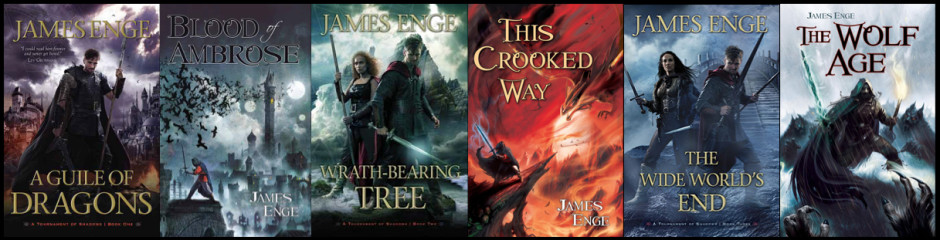
I watched these two movies last night back-to-back and found that, oddly, they had a lot in common—although maybe the main thing they had in common was the guy watching them. Both involve solitary characters who face off against monsters. In this, they reminded me of sword-and-sorcery—a subject never far from my mind—even though neither quite qualifies as S&S; the one lacks sorcery, the other swords.
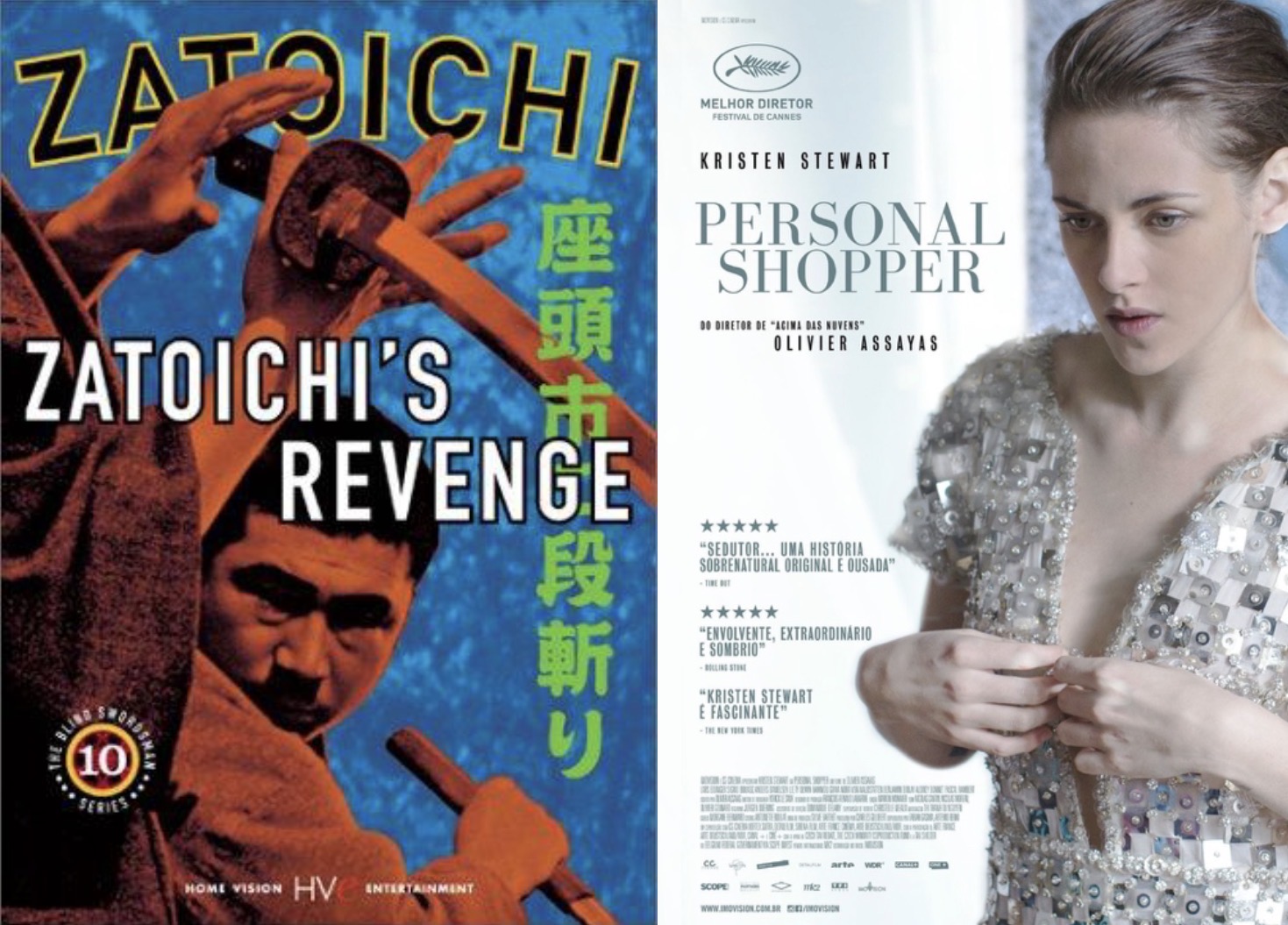
under the arms of a swordsman he’s just killed.
Above right: Kristen Stewart fiddles with
the fastenings of an ugly and uncomfortable dress.
There are no spoilers for Zatoichi movies; if you’ve seen one, you know how this one worked out. Spoilers for Personal Shopper will be inevitable, though, especially when discussing the movie’s ambiguous ending. If all you want to know is whether these movies are worth your time, I think they are. But de gustibus non disputandum, and all that.
Zatoichi’s Revenge is the 10th entry in the very long and justifiably popular movie series about a blind swordsman swordsman wandering through Japan in the Edo period.
If you’ve seen any of the previous nine, you know how this one goes. Zatoichi, a blind masseur with a taste for gambling, is also the best swordsman alive. How a blind man can do what Zatoichi does is never explained, but it seems to be a natural phenomenon, based on his heightened non-visual senses, not some kind of magical or pseud0-scientific gift (cf Luke Skywalker or Daredevil). Zatoichi wanders into a given town and becomes involved with the people there. Some good people are being oppressed by thugs. Zatoichi ends up in conflict with the thugs and disposes of them with his sword. Then Zatoichi hits the road again, like Shane, or Paladin from Have Gun—Will Travel.
Why watch what is essentially the same story ten times or more? (The film series has 26 entries, and was followed by a television series, and there have been remakes and retakes since these ended.)
I guess maybe it’s not for everyone. It’s for me, though, maybe because I grew up in the Dark Age of television and consequently have a high tolerance for repetition in episodic storytelling. Also, I early grew to like the main character, as played by Shintaro Katsu. He’s a humble and kindly man, with a fondness for sunshine and rice-balls, who simply happens to be a deadlier swordsman than anyone else. Then, too, the writers/directors know how to vary the formula with a variety of incidents, and each episode has new characters (broadly but vividly drawn) who evoke new interest.
In this outing, Zatoichi returns after many years to the town where he learned the art of massage. But his master has been murdered and the old man’s daughter has been forced into a house of prostitution by the local yakuza boss. In the course of finding this out, Zatoichi comes to know a dice-thrower, Denroku, who works for the yakuza and the dice-thrower’s prepubescent daughter, Tsuru, who has already caught the eye of the boss. Denroku (whose name means “the weasel”) is an agreeable if crooked guy who, when the time comes to rescue his daughter and the other women forced into sex-work by the boss, rises to the level of heroism. Zatoichi gets revenge on the samurai who murdered his master (and others besides), dispatches countless interchangeable bad guys in long, well-choreographed fight scenes, and in the end goes his melancholy way alone as you knew he would.
Why does no one shoot Zatoichi with a gun (a technology not unknown in the period)? This actually happens in one of the earlier films (Zatoichi’s Flashing Sword—shades of Lin Carter). But in general, it just never comes up. Arrows the hero can deal with as lightly as he does the swords of his enemies, but I guess the filmmakers didn’t have the moxie to claim Zatoichi could pluck bullets out of midair.
Personal Shopper, in contrast, is a standalone film, and by no means one made according to a formula; it was rarely clear to me what was going to happen before it happened. In fact, by the end, it wasn’t clear to me what was happening at all, which sounds like a criticism but is not, really. There’s a deliberate ambiguity in the final scenes which increases rather than decreases their power.
I probably would have watched this movie years ago if it were not for the incredible dullness of the title, which doesn’t even hint at the true subject of the movie. It’s true that the main character is a personal shopper for a woman who is some kind of unclearly defined bigwig, and can’t herself be seen picking out her own dresses etc. But calling the movie Personal Shopper is like giving The Maltese Falcon a title along the lines of Some People Who Meet in San Francisco: accurate, but not true to the work.
What is the true subject of the movie? Death, and what (if anything) comes after it.
Maureen (Kristin Stewart) is an American woman living in Paris, paying her bills by working as a personal shopper to a somewhat horrible woman of enviable wealth and privilege. But her real interest is in developing her talent as a medium, which she shared with her late twin brother. Her brother died three months earlier, and they had a deal that whichever one died first would come back to give a sign to the other. Maureen hasn’t felt that promised contact and she’s getting discouraged. But a series of enigmatic text messages start appearing on her phone that either come from someone with supernatural ability, or someone who has stalked her with deadly obsession.
The plot takes an even darker turn when the woman Maureen works for is brutally murdered and there are indications that Maureen herself is involved.
The movie gives unambiguous signs of supernatural activity, which I’m reluctant to talk about because I think the director (Olivier Assayas) handled them very deftly indeed, and I’m fairly sure this magic would fall apart if handled roughly with words. But the movie is not Turn of The Screw II; the supernatural world is real and sometimes visible in the world of the film.
The murderer is caught, toward the end of the movie, and it becomes clear that they were the one sending texts to Maureen and implicating her in the murder of her employer.
What is not clear is whether Maureen herself survives the film. Before the murderer is caught, we see her waiting for them in a hotel room, and the door to the room opens as that scene ends. Later, the film’s closing scenes show Maureen going on a journey, which is a venerable symbol for death. (See Tolkien’s “Leaf by Niggle”, and it wasn’t new then.) In the place where she arrives, she starts to receive signals from a spirit who, if I’m reading the signals right, is Maureen herself.
What does this mean? Is Maureen dead, and only coming to realize it? Or is the spirit world just a Rorschach blot that shows you only the contents of your own mind?
No answers here or in the movie, which ends exactly there.
Both the director and the lead actor received some acclaim for this movie, and deserved it, in my view. It’s one to watch and rewatch.
As for Zatoichi’s Revenge, I don’t have to rewatch that. I’ll just watch the next movie in the series, which will be practically the same thing.

You have successfully made me want to watch two movies I otherwise WOULD NEVER HAVE EVEN ENCOUNTERED! Thank you!!!
I hope they work for you! I do really like Zatoichi, although I’m not sure one needs to collect the whole set. I’m surprised that Personal Shopper didn’t make more of a splash in the sf/f genre pond when it landed ten years ago. Maybe it did and I didn’t notice, or maybe we were all watching Marvel movies (or complaining about everyone watching Marvel movies).