
I finally saw Supergirl (2026), now that it’s on various streaming platforms.

(I rarely go to theaters anymore, a habit I developed even before the COVID lockdown. It’s an aversion to audiences who don’t know how to go to a movie rather than to any virus.)
The movie was pretty good, on balance, but had some pacing problems. Some spoilers for the movie and the comic book that provided some of the story follow below.
One of the great things about the source material (Woman of Tomorrow by King, Evely, & Lopes) was its wildy phantasmagoric storytelling.
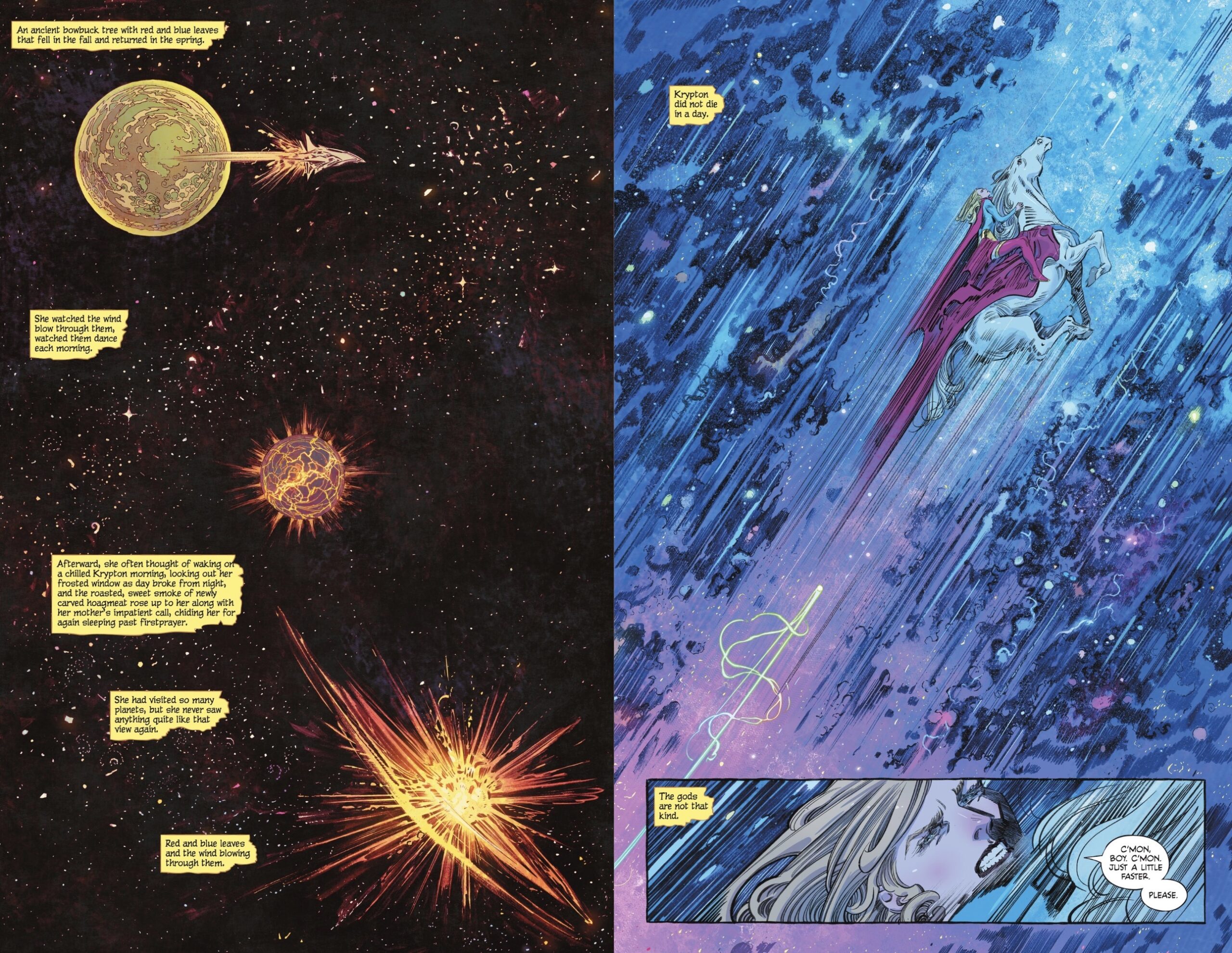
There’s only a certain amount of that that can fit into a movie of reasonable length (which this is—less than 2 hours). And, somehow, Evely&Lopes’ art has more impact than the splendiferous CGI that we’ve become used to in comic-book movies and now is somewhat overfamiliar, like wallpaper you’ve seen so often that you hardly see it anymore.
The plot of the comic book is sufficiently complicated that I don’t feel as if I can explain its intricacies. In fact, and in spite of King’s overly wordy script, I don’t think I even understand some of them. (That’s not a slam: impact, not understanding, is what’s important in art, and the book lands with a lot of impact.) But the plot obviously needed to be trimmed down to fit into a movie-sized movie.
The filmakers (scenarist Ana Nogueira and director Craig Gillespie) do a good job of that here, stripping the story down to its essentials: Ruthye’s quest for vengeance and Supergirl’s semi-accidental involvement in that, when the pirate who murdered Ruthye’s family also steals Supergirl’s spaceship and shoots her dog with a poison arrow. (Spoilers: Krypto will be okay.)
There are a lot of fight scenes in this movie, and fight scenes in superhero movies can be a bore. You know what I mean: CGI puppet vs. CGI puppet in a knockdown, dragout battle for the stakes of who cares. In contrast, the fight scenes in Supergirl are mostly pretty strong, showing our hero fighting hand-to-hand (in spite of red sunlight, poison, kryptonite, and other super-obstacles) for human stakes that are always alive and present onscreen.
Milly Alcock shines in these scenes and, in fact, in every scene. She, and Krypto (a CGI puppet, but an unusually charming one) are the best additions to the DCU since Gunn’s Peacemaker (2022-2025).
One of the many changes from Woman of Tomorrow: Comet the Superhorse does not, I am sorry to say, appear in the movie. Instead we get Jason Momoa as Lobo. I find the Wolverine/Lobo type of antihero somewhat boring (in sharp contrast to Comet, who is one of the weirder and more interesting creations of DC’s Silver Age), but Jason Momoa is always a likable screen presence and the character played a role in the plot without hijacking it. (He’s after a different space pirate than our heroes are.)
“Look, Enge, if that is your real name: since there’s all this great stuff in the movie, why are you damning it with faint praise? ‘Pretty good’? We know what that means.”
The movie is really worth watching, and maybe even rewatching. But (arrrgh and damnation) it has its problems, and if I were to sum those up in one word I’d say it’s all the damn moping.
Moping has been a problem with superheroes onscreen ever since their modern era began with X-Men (2000). You’ve heard this one before: “Oh, I can walk through walls and run so fast that time reverses itself, but why can’t I just be like Regular Folk™?”
Supergirl has more reason to mope than most: her planet died before she was born; her parents and everyone she knows died of kryptonite poisoning when she was a child. I’m not saying that her moping is unmotivated. But sadness by itself doesn’t make for drama. Drama (Greek δρᾶμα) literally means “action”—not necessarily in the form of car-chases or CGI punchfests, but it the sense of doing something. Moping isn’t doing something.
A chunk of the movie is given over to Supergirl’s origin story, and I think this was also a mistake. Origin stories are overrated, in general, and Supergirl’s origin story in particular is overcomplicated and undramatic.
Consider the catastrophic clarity of Superman’s origin, which can be (and has been) summed up in a single page:
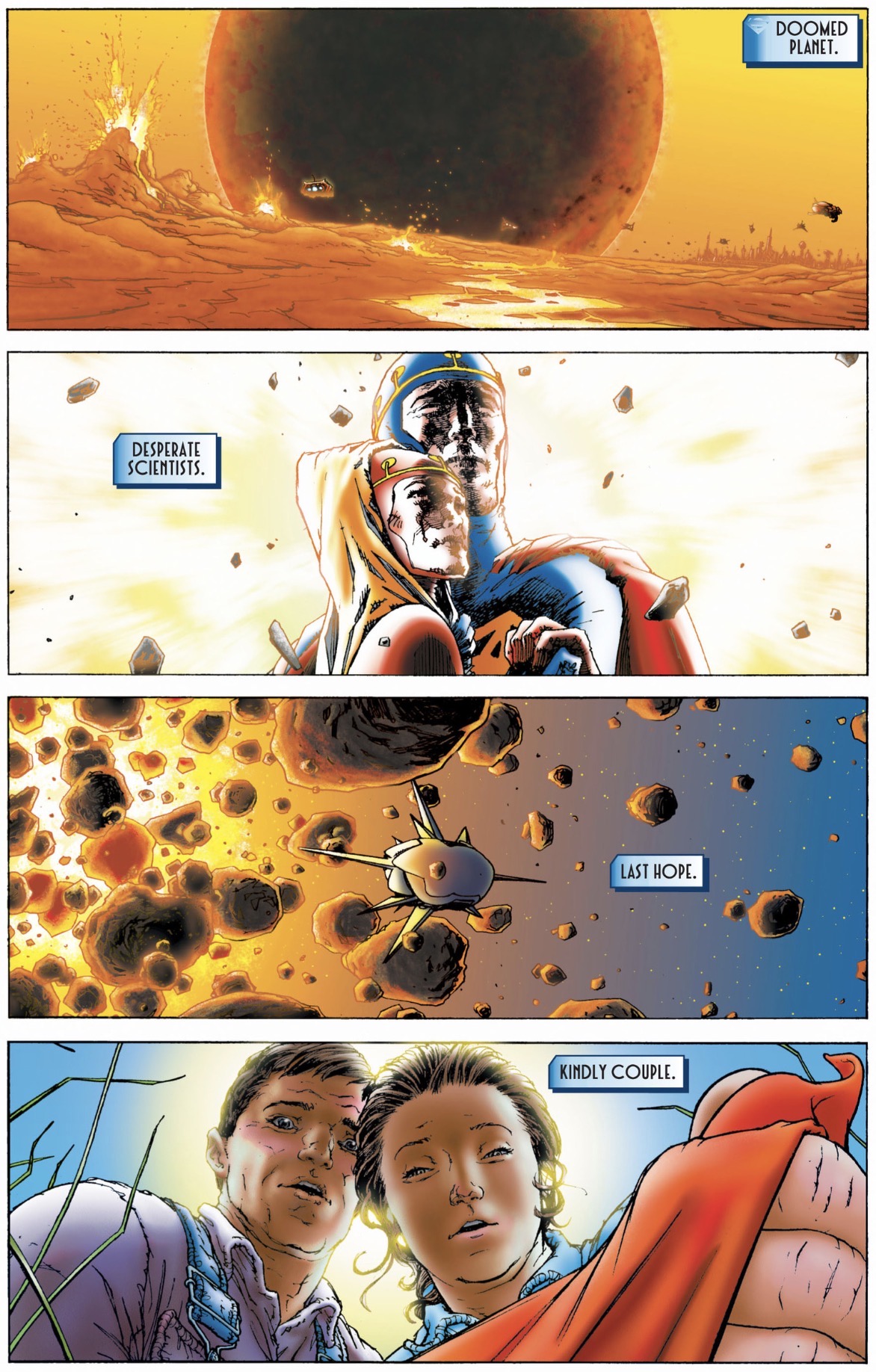
Supergirl’s origin story begins with the death of Krypton also, but involves the temporary survival of one of Krypton’s cities, Argo, which is then destroyed in a seperate but related and much more slow-motion disaster. Through this circuitous narrative path, Supergirl arrives on Earth as a teenager, some time after Clark has already grown up and become Superman.
In a book this sort of story can work, especially in Woman of Tomorrow, where it appears as a leitmotif of grief in Kara’s internal monologue while she’s struggling with superheroic tasks. But it’s cumbersome and slow-moving material onscreen, and the best screen version of Supergirl (the CBS/WB series) skipped past it to focus on Kara’s present-tense story.
The moping doesn’t last forever, and these passages of the film almost justify themselves when Supergirl soars into the sunlight of decisive action.
At the end of both book and movie, the heroes capture and confront the villain, the space-pirate Krem of the Yellow Hills, just as you knew they would. In both book and movie, Supergirl convinces Ruthye to forego vengeance, so as to keep her heart and conscience free. And, in both book and movie, Krem is killed anyway, but the two versions have radically different routes to that end.
In the movie, Supergirl goes back and kills Krem. If the guilt of such a thing is a burden (as she claims), she’s willing to bear it. It’s a morally complicated but dramatically effective way to cut the Gordian knot of the plot conflict.
In the book it’s even more complicated. Krem is imprisoned for long years in the Phantom Zone. Apparently, in that place, he’s seen the error of his ways. In an epilogue set long after the end of the story proper, a still-youthful Supergirl visits a now-aged Ruthye for a reunion with the repentant brigand. As the aged ex-brigand is on his knees, thanking them for his opportunity to change his ways, and begging pardon for his crimes, the aged Ruth kills him without explanation and without mercy.
The creators don’t say what they are saying with this harsh, discordant ending. The message may be that mercy, on some occasions, is a greater burden to carry in your heart than revenge. In any case, the conclusion reminded me of Aeneas killing Turnus right at the end of Vergil’s Aeneid.
The epilogue of the movie is more explicitly comforting. Supergirl shows up at Clark’s apartment in Metropolis, having made peace with her past and ready to face her future.
Time and the tides of popular culture are fighting against the new DCU. People are getting weary of superhero movies and the popular reaction to Supergirl, in particular, was poisoned by trollish, gynophobic men. This movie wasn’t the kind of out-of-the-ballpark hit that the DCU really needed at this moment.
But: it’s worth watching, and maybe even rewatching. That’s more than can be said of many a superhero movie, including some with much more impressive box-office numbers.
