Here’s my feeling about screen adaptations: the book is always better than the movie. Always. Dune me no Dunes; Lord me no Rings; keep your hairy potters in your pocket where they belong. The book is always better. Without exception.
Except: sometimes not.
Elmore Leonard, for instance, wrote a lot of bestselling and widely praised suspense novels, some of which have been made into really good movies. Will they change your life? Maybe not that kind of movie. But Get Shorty (1995), 3:10 to Yuma (1957), Jackie Brown (1997) etc. etc. are a blast and (here’s where the blasphemy starts), I think they’re better than the material they were based on. EL’s practice in writing books was to leave out as much as possible—in general, a good practice. But I think EL left out too much—a lot of the color and character that gives a story impact. The movies put that stuff back in, which is why they’re better. (If you disagree, that’s okay with me. De gustibus non disputandum.)
Another example: Andy Weir’s The Martian is worth reading but Scott’s movie of the same name is better for a number of reasons, one of which is that Weir gives you no sense of the wonder of being on Mars, damnit, but Scott does. (Mars’ reputation has suffered recently from association with Elon Musk, but that’s not the planet’s fault.)
So what about Wilder’s film of Double Indemnity? It’s unquestionably one of the great, foundational movies in film noir. Everyone should see it. Is it better than the novel by James M. Cain that it was based on?
Well: yes. And: no. (Spoilers for an eighty-year-old novel and a seventy-two-year-old movie beyond the jump.)
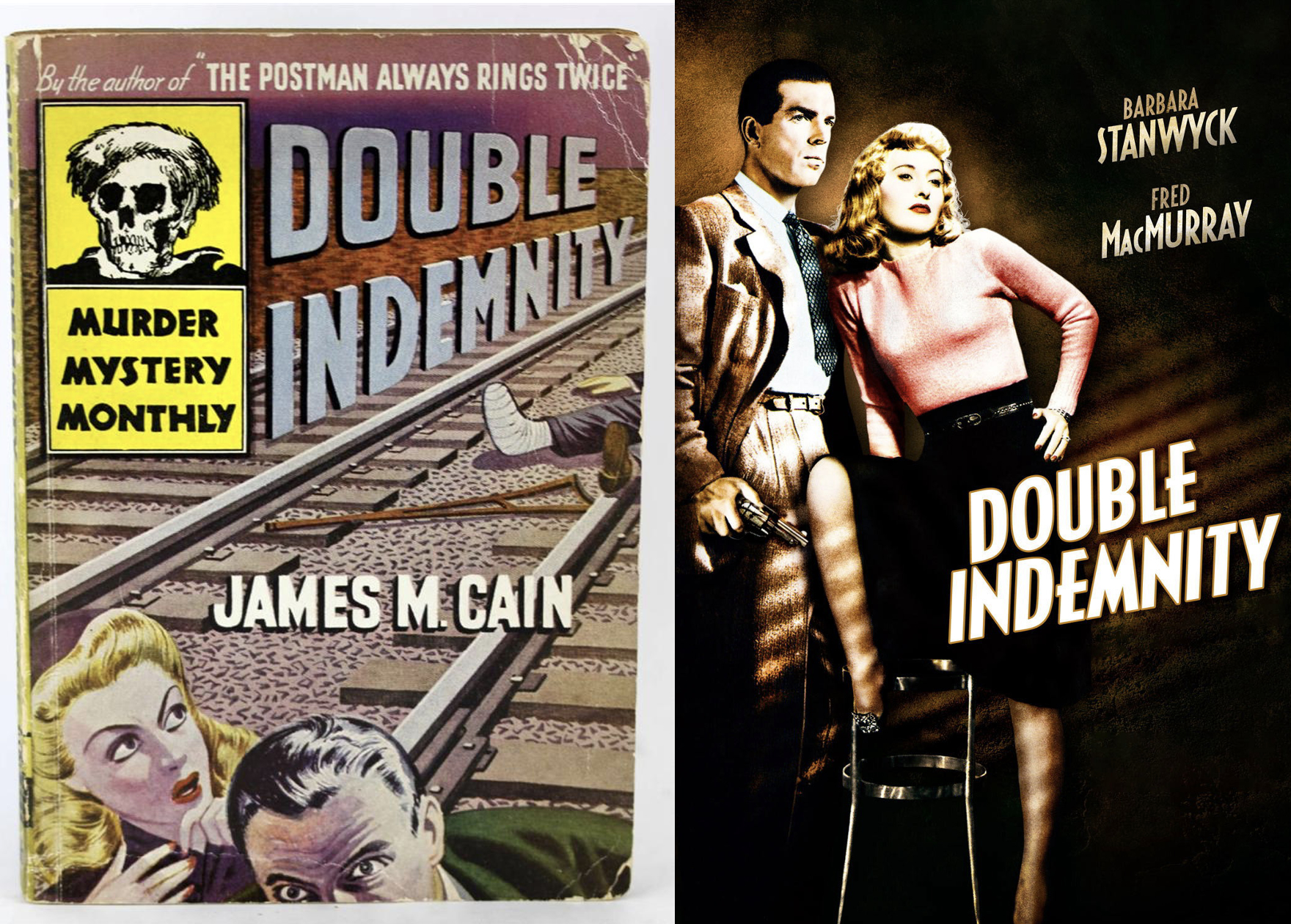
Right: a poster for Wilder’s movie.
This question above is on my mind because I recently rewatched the movie and then (since I hadn’t looked at it in a few decades) reread the book.
Common to the book and the movie is this story: an enterprising insurance salesman (first name Walter) meets Phyllis, the unhappy second wife of a fairly prosperous man. They team up to fake a life-insurance policy on the detested husband, and then murder him in a way that will yield the highest return on the policy, and everything is rosy.
Or it would be, except that the insurance company’s claims manager, a man named Keyes, is suspicious of the claim. He can’t prove it, but he’s sure the dead man was murdered. The dead man’s teenaged daughter, Lola, is also suspicious. It turns out that the dead man’s first wife, Lola’s mother, died under dubious circumstances and Lola (quite convincingly) blames the woman who became her stepmother.
The two murderers keep apart while the widow is under suspicion, and absence does not make their murderous hearts grow fonder. Each one independently comes to the conclusion that they are better off if the other is dead. They plan to meet each other to execute their designs, and the ultimate result is the destruction of them both. (I become a little vague here, because the end of the two murderers’ stories are dramatically different in the film and the book, although arguably the result is the same.)
Let’s push the movie to one side and talk about the book first.
The Novel
James M. Cain was once celebrated as a member of the Big Three of American crime fiction, mentioned in the same breath as Dashiell Hammett and Raymond Chandler (of whom, more below). That stopped being the case because, perversely, Cain kept on living and writing into his 80s, even though almost nobody thought his Cold-War-era writing matched up with his Depression-era classics. I have no idea if the bad reputation of his later work is justified; I can only testify (as a lifelong haunter of bookstores), I rarely if ever came across that stuff on bookshelves. I was long under the impression that he had died young—or went silent after the 1930s, as Hammett did.
Double Indemnity, though, dates from Cain’s tawdry Golden Age. It’s a shortish novel (a little under fifty-thousand words)—so short that some call it a novelette, not usually a term of praise, although personally I’m very fond of novelettes.
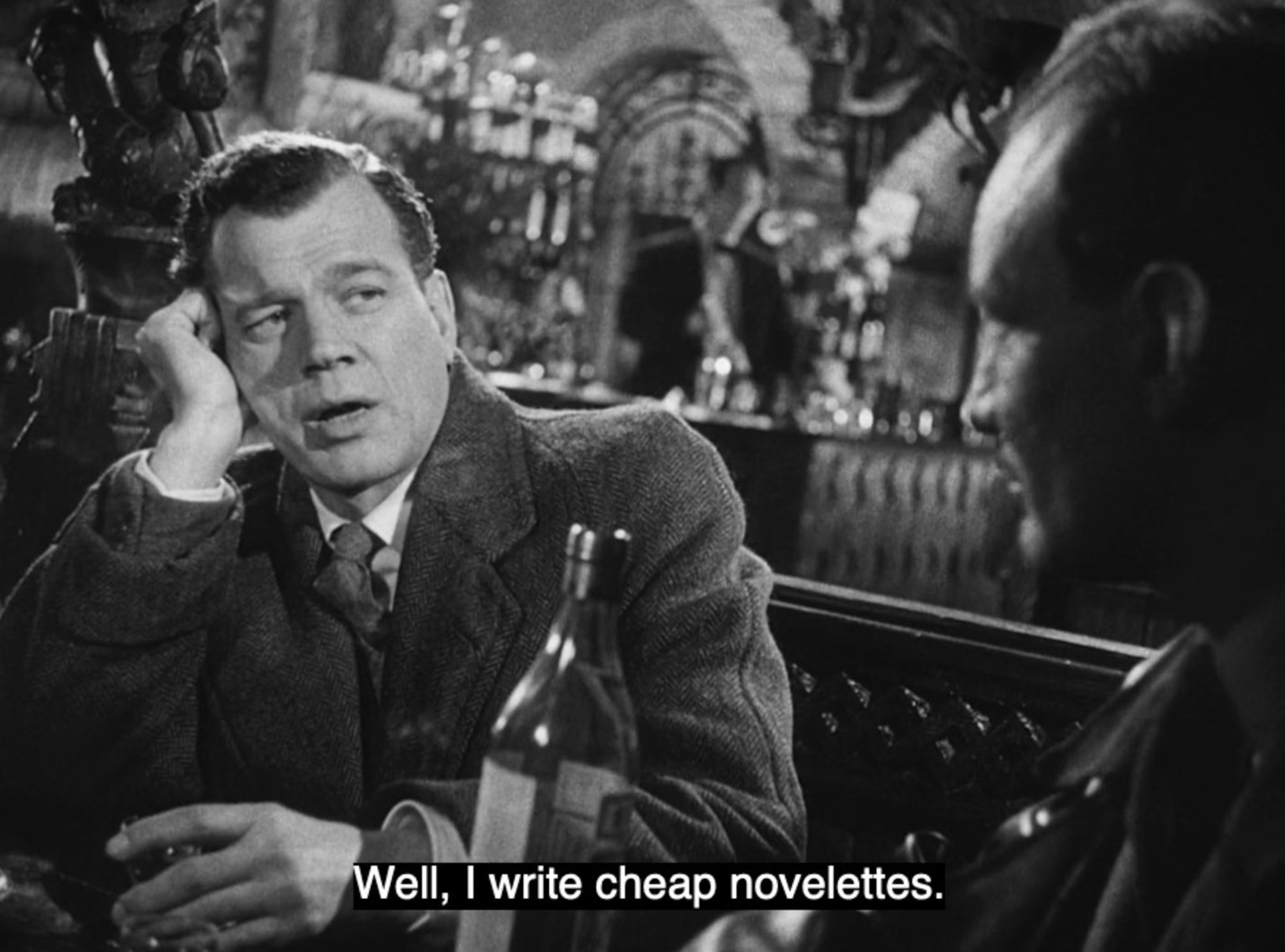
ideally with Joseph Cotten’s drunken visage pasted onto a wyvern or some other heraldic beast.
Cain’s novel takes the form of a confession, written by crooked and bloodstained insurance agent Walter Huff (sic). It tells the story described, in general terms, above. One thing you realize fairly early in the book: Walter’s kind of an accident waiting to happen.
He’s not a dope. He may say “don’t” when grammarians would insist on “doesn’t”, but he’s an adept and wily cat in his profession. Among other things, he set up a finance company on the side so that he could offer his insurance clients the service of loans secured by their car. Ethics aside, this is one of many things that lead him to considerable professional success—”the candy kid” as he modestly refers to himself.
But he doesn’t really seem to be interested in his profession, which he describes as the house side of a casino, where the client and the insurance company take sides in a bet. The house always wins in the long run, but Walter isn’t interested in winning through these cautious, predatory methods. He’s got a yen to be the sucker going into the casino and winning big on a longshot.
For someone who knows as much as Walter does about his business, this is a candy-coated death wish. And Walter seems almost to realize that when (after they’ve teamed up to murder Phyllis’ husband) he starts to plan the murder of Phyllis by sending her over a cliff in a car. He says, “There was a chance I wouldn’t jump clear, and that I would go over the edge with her. That was O.K. On this, you have to take a chance.”
Do you, though? By this point in the story, a careful reader may suspect that Walter’s risk-taking is an elaborate form of suicide, and by the end of the book, when Walter and Phyllis find themselves together on a steamship to South America, that death-wish becomes explicit. They plan to wait for a moonlit night and jump hand-in-hand off the ship so that the sharks can eat them.
You could be pardoned for thinking this is a kind of love story. Walter falls in love with two different women within the narrow scope of the plot, if we believe everything he tells us. But as Walter himself says, “I had killed a man for money and a woman. I didn’t have the money and I didn’t have the woman.” Walter is really in love with death, and that’s the only relationship that’s consummated in the narrow, gravelike bed of this novel.
Phyllis is death incarnate. If you’re thinking of her as Barbara Stanwyck’s sultry femme fatale from the archetypal film noir, that’s not sinister enough. In the novel, she’s a psycopath with at least a half-dozen murders to her credit; three of her victims were children. She tells Walter that death is her “bridegroom. The only one I’ve ever loved.”
It’s a disturbing book in a number of ways. The society that they move through is as corrupt as Walter and Phyllis themselves. Once they’re caught, the insurance company connives to have them escape from the jurisdiction: a trial would be bad publicity for the firm. Walter’s worried that Lola will be tortured while in police custody—a not uncommon fate for prisoners in those pre-Miranda days—and that, in part, motivates his confession. The L.A. that Philip Marlowe moves through is a dark place, for all its sunshine, but Cain’s L.A. is darker still, seven traffic circles past the gates of Hell.
The Movie
This novel, originally a magazine serial, became a bestseller when it was republished in an omnibus of Cain’s work 1943, and the next obvious step was to make it into a movie. Billy Wilder, a veteran of German film who’d fled Europe when the Nazis took over, had a stab at writing a treatment for the film with his writing partner Charles Brackett (no relation, sword-and-planet fans). After Brackett bowed out, and since Cain himself wasn’t available (being under contract to a rival studio), Wilder landed on Raymond Chandler— a guy with no experience in film, but already noted as a writer of crime fiction.
The task of changing Cain’s novel into a screenplay was infamously difficult. Chandler wrote about the process, saying “it was an agonising experience and has probably shortened my life; but I learned from it as much about screen writing as I am capable of learning, which is not much.” (I draw the quote and most of this account of writing the screenplay from Frank MacShane’s bio of Chandler.) Wilder had the habit of walking around the office with a swagger stick, and occasionally waving it under Chandler’s nose. Chandler eventually exploded and went on strike, refusing to return to work until Wilder accepted a memo of demands, including some restraint with the stick. (Chandler later parodied Wilder in his not-altogether-hostile depiction of big-time Hollywood agent Sherry Ballou; see his novel The Little Sister.)
The Hayes Office, officious HQ of Hollywood censors in those days, had big problems with Cain’s novel from the jump, and some of the changes from novel to screenplay are clearly there to assuage their ravening demands for decency and propriety. All the stuff about police torture and business corruption was cut.
Wilder and Chandler also had some trouble with the dialogue. Chandler wrote Cain about it later:
“A curious matter I’d like to call to your attention – although you have probably been all through it with yourself – is your dialogue. Nothing could be more natural and easy and to the point on paper, and yet it doesn’t quite play. We tried it out by having a couple of actors do a scene right out of the book. It had a sort of remote effect that I was at a loss to understand. It came to me then that the effect of your written dialogue is only partly sound and sense. The rest of the effect is the appearance on the page. These unevenly shaped hunks of quick-moving speech hit the eye with a sort of explosive effect. You read the stuff in batches, not in individual speech and counterspeech. On the screen this is all lost, and the essential mildness of the phrasing shows up as lacking in sharpness. They tell me that is the difference between photographic dialogue and written dialogue. For the screen everything has to be sharpened and pointed and wherever possible elided. But of course you know far more about it than I do.”
—Chandler to Cain, March 30, 1944
In fact, Chandler hated Cain’s writing and disliked being associated with it. (See a letter to James Sandoe from January of the same year: “It has always irritated me to be compared with Cain. … Cain is a writer of the faux naif type, which I particularly dislike.”) If you’re attuned to the way well-bred British people express hostility, the smarmy politeness at the beginning and end of the block-quote above is a dead giveaway. (Chandler wasn’t British but he went to school there and some of it stuck.)
The script actually uses a lot of JMC’s lines (“I did it for money and for a woman”; “Straight down the line”; etc). But Chandler was a much wittier writer than Cain and he shows that off in the dialogue for the script of Double Indemnity. This is good; I like a witty movie where everybody sounds like a smart person. But it’s also bad: in the real world, not everyone is witty and not everyone is smart. Chandler’s lines have more snap; Cain’s lines sound more like stuff people might actually say. (Wilder credited Chandler with most of this dialogue work.)
A more important change is the way that the tale was told. In the novel, Walter drifts pretty freely between background exposition and the direct narration of events. A movie can’t take that long, discursive route. Wilder & Chandler re-organized the plot into a series of dramatic confrontations, some of which appear in the book (e.g. Walter and Keyes’ meeting with their boss, the fatheaded owner of the insurance company) and some of which don’t. (For instance, in the book Keyes merely tells Walter about an arsonist truckdriver; the script has Walter sit in on Keyes’ interrogation of the guy. In both cases, the point is to tell the audience what a shark Keyes was when it came to pursuing a problematic insurance claim.)
The movie, like the book, takes the form of Walter’s confession, but Wilder&Chandler even make that into showing, rather than telling. In the opening scenes of the movie, we see the gunshot Walter making his way into Keyes’ office at the insurance company and telling the story into Keyes’ dictaphone as a flashback. The movie concludes with a justly celebrated scene between Walter and Keyes, in which Walter tries and fails to escape justice and Keyes’ love.
Keyes is a much more prominent figure in the movie than in the book, almost a third lead. This allows the script to demonstrate that the weed of crime bears bitter fruit, etc, so that the Hayes Office would be satisfied. But it serves a dramatic purpose, too. Walter’s turn to crime in the movie is not just a betrayal of himself; it’s a betrayal of the warm friendship he has with Keyes. (There’s almost nothing about that in the book, except for Keyes saying toward the end that he’d kind of liked Walter.)
The novel has a longish, meandering denoument, which is certainly effective (especially in its last few lines), but which is larded with too many explanations for a dramatic presentation. Wilder and Chandler bite the matter off with a bloody smile by having Walter and Phyllis shoot each other onscreen.
A mystery unsolved by the movie: if Walter is so damn smart, why does he attempt to get away with a murder that (he must know) will draw Keyes’ attention? A question worth asking, but for which the movie provides no obvious answers.
Still, above all else, Wilder’s movie is a tragic love story—between Walter and Phyllis, yes, but also between Walter and Keyes, the relentless claims shark.
The Verdict
So: which is better—the movie or the book?
I’ve telegraphed my conclusion already: I think they both have their merits. The book is a first-person descent into Hell, more harrowing than anything Hammett or Chandler ever wrote. But the movie is a fast-moving, wittily told, tragic tale of doomed love. Both are classics in their own right, each best at being the thing it is.
