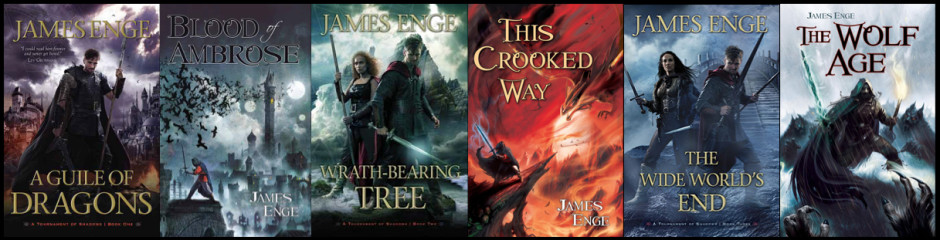
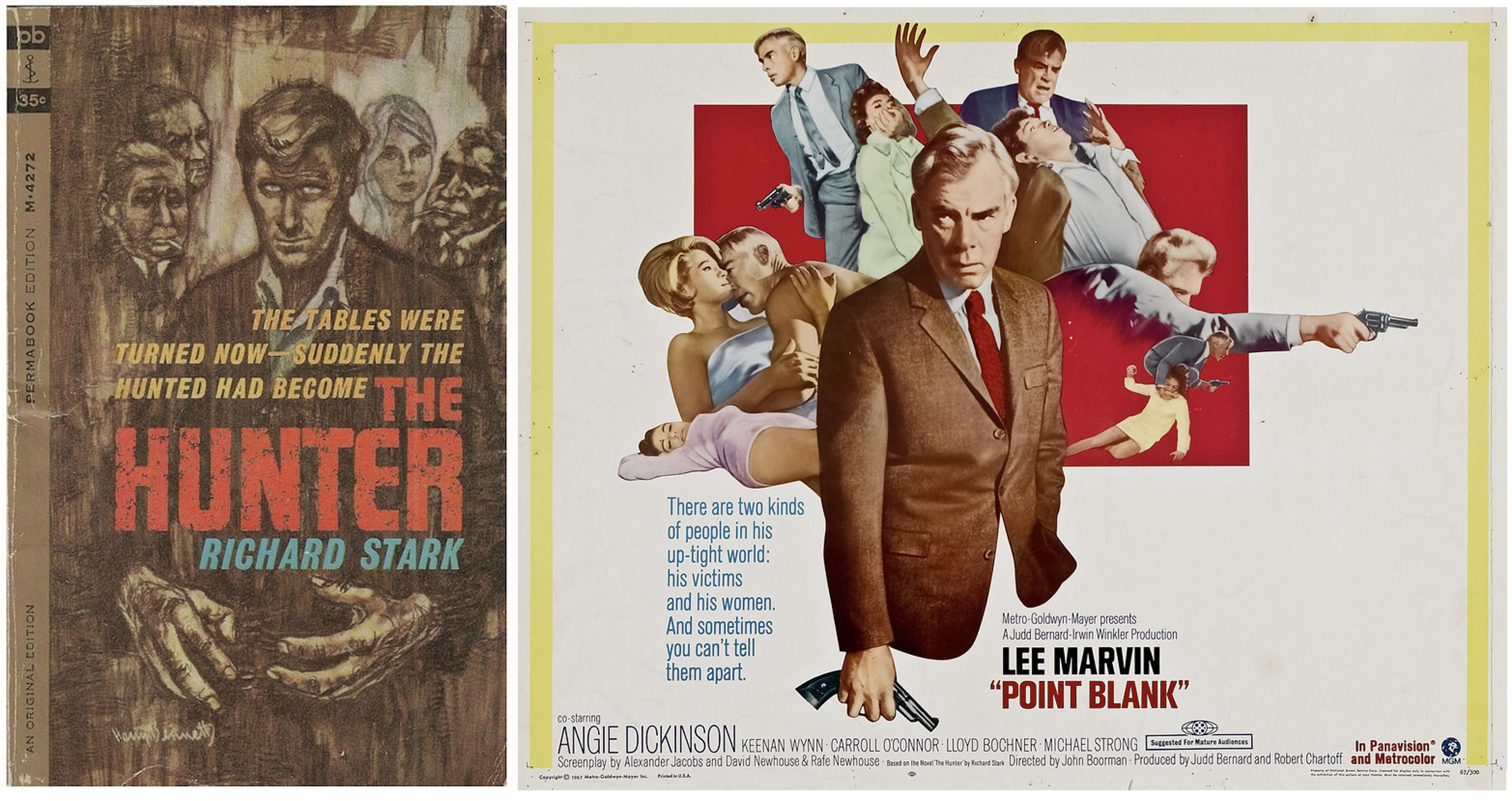
Note the deranged Lloyd-Bridges lookalike with the mutant hands: that’ll be Parker.
Right: a poster for Boorman’s Point Blank (1967).
I recently rewatched John Boorman’s Point Blank, which caused me to reread the novel it was loosely based on, The Hunter by Donald Westlake (writing as Richard Stark). The Hunter is very low on my always-reread list, and would not be on it at all except that it’s the beginning of not one, not two, but three amazing series of crime novels by Westlake/”Stark”, who was one of the great genre writers of the 20th century.
The novel and the movie are very much the same story, except insofar as they are not at all the same story. If you’re only going to tackle one, I’d recommend sticking to Point Blank, which is a self-contained and evocative crime film, an early work by the visionary director who would later helm films like Deliverance (1973), Zardoz (1974), and Excalibur (1981). The Hunter, in contrast, is not great, but it contains the seeds of greatness.
Here’s the story, common to book and film, in its broadest outline: a guy (called Parker in the book, Walker in the movie) gets roped into a criminal conspiracy by a guy named Mal (short for Malcolm, but the fact that mal means “evil” in French is probably not a coincidence). The crime goes off without a hitch, but in the aftermath Mal persuades Lynne, the hero’s wife, to betray him. The hero is shot and left for dead; Mal and Lynne go off together with all the money.
Mal needs all the money because he owes a sizable debt to a criminal organization calling itself the Outfit. Using the money from the heist, he buys his way back into the Outfit and everything is rosy.
Except the hero is not dead. He comes back for vengeance on his ex-partner and his treacherous wife, and he wants the money he’s owed from the heist. And, in a way, he gets all of these things.
This, to my mind, is the outline of a ripping yarn, so why do I damn The Hunter with faint praise?
Three reasons, really. One is the inexperience of the author. It feels weird to say that, because “Stark”/Westlake had been writing paperback originals for three years when The Hunter appeared, but most of that work was porn; there are some greasy traces of porny writing in this novel, especially when the narrator describes the reaction of women to seeing Parker. Plus, work in porn didn’t really give Starklake the opportunity to tell this kind of story. Starklake is clearly feeling his way sometimes, throwing out ideas and not following them up. Parker spends a page or two telling an executive of the Outfit how he could make the Outfit suffer if he wanted to. In this book, it’s just conversational filler, but it becomes a major element in a later, better book in the series (volume 3, The Outfit). The heist that leads Mal to betray Parker is an unlikely one, involving nineteen premeditated murders within a page or two. A level-headed, experienced criminal like Parker would be unlikely to be involved in such a high risk, low-payoff kind of proposition. Etc.
Then there are some problematic attitudes specific to the era and genre: homophobia and misogyny. Even nowadays, weak men think they can establish their toughness by displaying bursts of homophobia, or performing cruelty against women. Not all detective/crime writers of the period resort to this stuff, but there’s some unpleasant gushes of it here.
Another lies in the character of Parker himself. Westlake can’t decide if his character is an avenging angel come back from the dead to get back at the people who wronged him—the Count of Monte Cristo in a windbreaker—or a professional criminal demanding his fair share of the take. Or maybe it’s more like this: Parker starts out as the first guy, and turns out to be more like the second guy. And it’s that second guy who will appear in the twenty-some volumes to follow.
It’s those roughly two-dozen sequels that really justify The Hunter‘s place on my always-reread list. As Westlake gets a clearer idea of Parker as a professional criminal, the books become better, more focused, and more interesting.
Point Blank is also a fairly early work in its creator’s career. Boorman had directed some TV and some documentaries in the UK, but only one fictional film, a not-really-successful vehicle for the Dave Clark Five. But, based on solid reviews and Lee Marvin’s personal confidence, Boorman got to make Point Blank pretty much the way he wanted it, and it mostly works. It helps that Marvin is the perfect actor to play Walker/Parker.
In The Hunter, Parker’s connection to Mal is strictly professional. In Point Blank, the connection between the hero and the traitor is deeply personal. Mal and Walker are old friends; Walker brings Mal home after a reunion of some kind. The trio develop into almost a Jules et Jim throuple. That makes the betrayal, when it comes, all the more brutal.
Why Walker survives being shot at point blank range is never established in the movie, but that’s not a problem, I feel, because we see him do it. The movie doesn’t take time explaining things that don’t need explanation. (In contrast, in The Hunter, Parker is shot at six times; only one of the bullet connects and that one is caught by his belt buckle. Maybe it’s a kind of thing that could happen, but it seems rather corny and unlikely to me.)
The double betrayal that’s rocked Walker’s world puts him into an existential funk. He’s intent on getting back at the people who destroyed his life, but he doesn’t seem to have an obvious idea how to do that. Walker’s wife, Lynne, is equally disoriented; she and Mal have parted ways by the time Walker catches up with her; she’s terrified of Walker’s vengeance, sick of life, but scared of death. In the end, after the damage is done, Walker finds that he’s been used as a weapon in a power struggle over control of the Outfit. He’s gotten what he thought he wanted: revenge on Lynne and Mal, and payment of his share from the heist. But it’s not clear if he wants any of that stuff now that he’s got it; we don’t even know if he picks up the money at the end of the movie. Walker is silent, alienated, alone in the dark.
This is not quite a ripping yarn. It’s more of an existential nightmare in which the characters struggle through a landscape where love, loyalty, and even material success are void of meaning or value. But, unlike a lot of movies from the 60s with existential themes, Point Blank manages to tell a coherent story. Fine work from Boorman, who would go on to do even better in the future.
As, of course, would Westlake. His next novel in the Parker series was another problematic effort, but after that the series would develop into some of the best crime fiction written by an American.
And the series had two spinoffs. One of Parker’s occasional partners in crime is a suave ladies’ man and professional actor named Alan Grofield. Starklake wrote four novels in which Grofield is the main character, all of which are entertaining and the last of which (Lemons Never Lie) is at least as good as any of the Parker novels.
After writing about Parker for nine years, Westlake spun 180º and started writing crime novels that are almost parodies of the Parker books. The first and greatest of these is The Hot Rock (1970), a deadpan, utterly hilarious novel about a heist that goes wrong, then wronger, then even wronger until, somehow, its wrongness becomes brilliantly right. (It was also made into a pretty good movie, but William Goldman’s script couldn’t quite contain all the Wodehousian twists and turns of the novel, and Robert Redford was miscast as the rumpled antihero—and anti-Parker—Dortmunder, who is at the center of the story.)
I might write more about the Parker series, and its spinoffs, on another occasion. But if you’ve never read them, and you’re into American crime fiction, you owe it to yourself to seek them out. Why waste time on my opinions when you could form your own?
I shouldn’t close without mentioning that The Hunter was also the basis of a great graphic novel by the late, lamented Darwyn Cooke. He went on to adapt three more of Starklake’s novels, and might have done more if not for his own untimely death.
