I’ve been reading a lot of Lucian lately, for reasons that are difficult to explain; maybe I’ll write something about that when I figure it out. But I am finding that he reads better in Greek than he does in English. In a good translation, the words flow by so readily and the content seems so thin that it’s easy to miss his point. In wading through the text in the original language (by no means the second language that is easiest for me), I am forced to slow down and ask, “Wait a second! What does he mean by that?” And in that moment of confusion I’m closer to getting his point than I ever am when sailing through an English version of the same work.
But when he starts throwing crocodiles around, I get confused in any language.

The crocodiles and other baffling entities crop up early in Lucian’s Dialogues of the Dead, which I’ve been reading in Hayes & Nimis’ useful (and free) edition. (Those unwilling to wrestle with the Greek can find English versions online by the Fowlers and by Macleod.)
One of these dialogues has the ghost of Diogenes (the first and weirdest of Cynic philosophers) buttonholing Polydeuces (a.k.a. Pollux) as he is preparing to leave the land of the dead for the land of the living.
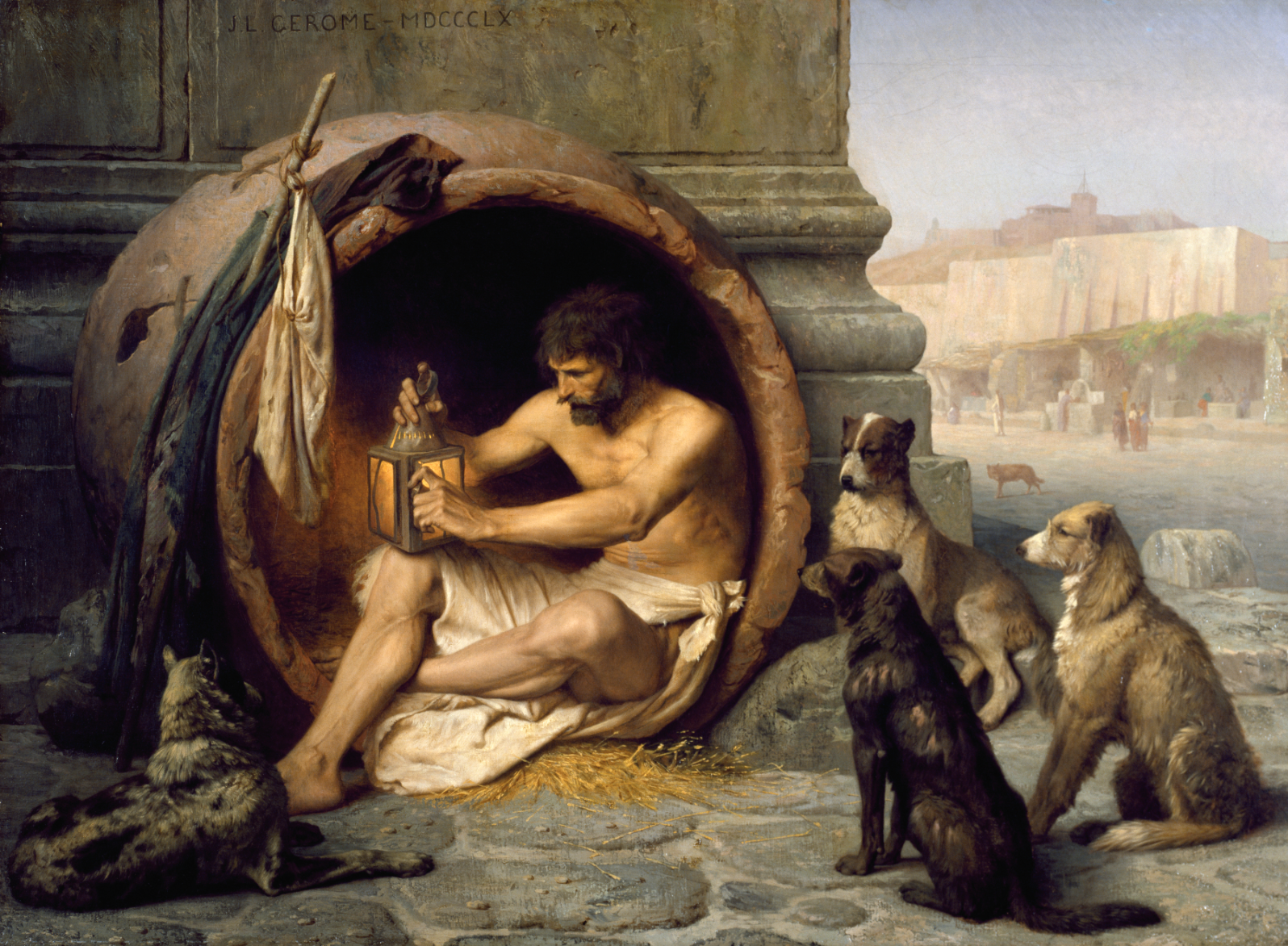
and some actual dogs
Polydeuces had been immortal, but he surrendered half his immortality to his twin brother Castor, who was mortal. According to the plea bargain they struck with the Fates, these guys spend half their time in the Underworld and half on Olympus. I like the version where they travelled together (because if you give up immortality for your twin it seems only fair that you get to spend some time with him, and also because we see them travel together as the constellation Gemini).
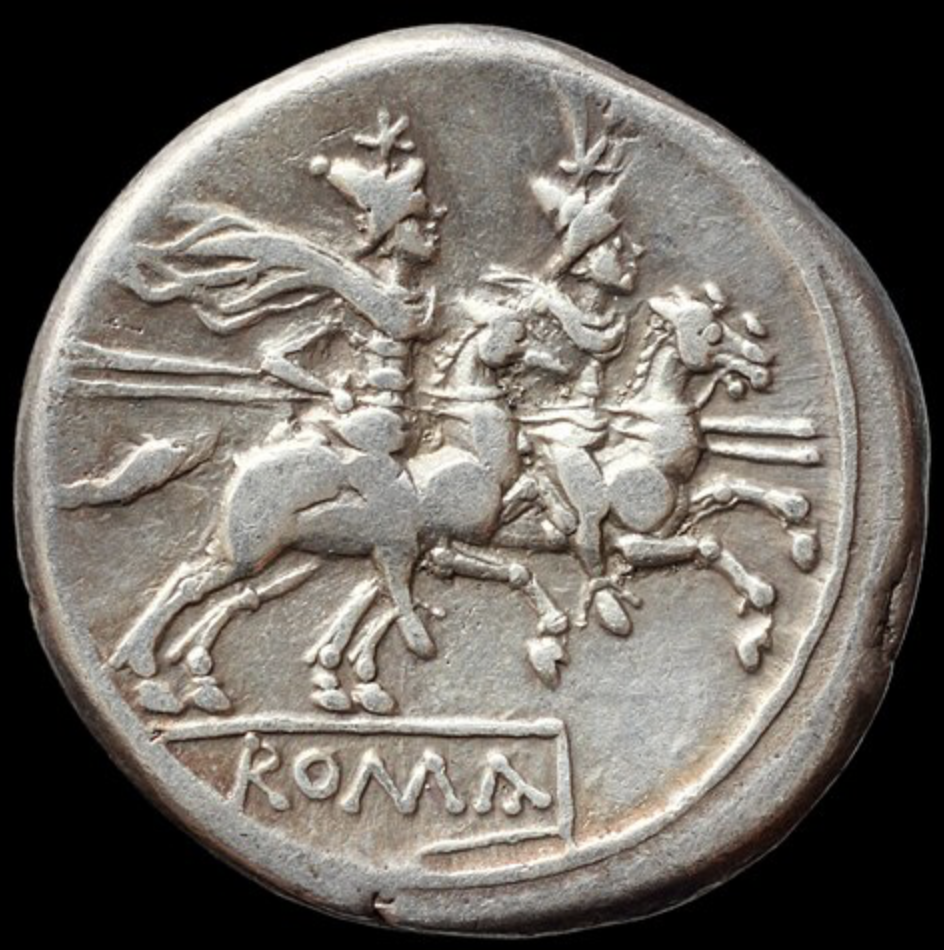
But Lucian seems to prefer the version where they exist in complementary distribution, one in Hell while the other is in Heaven.
Diogenes gives Polydeuces a message for his friend and successor Menippus, who is always mocking other philosophers, and then continues:
ΔΙΟΓΕΝΗΣ: Βούλει καὶ πρὸς αὐτοὺς ἐκείνους ἐντείλωμαί τι τοὺς φιλοσόφους;
ΠΟΛΥΔΕΥΚΗΣ: Λέγε: οὐ βαρὺ γὰρ οὐδὲ τοῦτο.
ΔΙΟΓΕΝΗΣ: Τὸ μὲν ὅλον παύσασθαι αὐτοῖς παρεγγύα ληροῦσι καὶ περὶ τῶν ὅλων ἐρίζουσιν καὶ κέρατα φύουσιν ἀλλήλοις καὶ κροκοδείλους ποιοῦσι καὶ τὰ τοιαῦτα ἄπορα ἐρωτᾶν διδάσκουσι τὸν νοῦν.
—Lucian, Dialogues of the Dead
DIOGENES: Do you mind if I also send a message to those philosophers?
POLYDEUCES: Go ahead; no problem at all.
DIOGENES: The whole thing is: tell them to stop acting like clowns, snarling at each other about The All, and putting horns on each other, and making crocodiles, and teaching the mind to ask such pointless questions.
The natural question that arises from this is: WTF? The beginning and the end are clear enough, but how do horns and crocodiles come into it?
At first I thought that the horns referred to cuckoldry. I’m sure Lucian would have enjoyed and employed the image of philosophers cuckolding each other, but the linguistic evidence seems to be against it.
Re horns: the tyrant OED says:
[Cuckolds were fancifully said to wear horns on the brow.] to give horns to, to graft, plant horns on: to cuckold.
The origin of this, which appears in so many European languages, and, seemingly, even in late Greek in the phrase κέρατα ποιεῖν τινί (Artemidorus, Oneirocritica II. 12) is referred by Dunger (Germania XXIX. 59) to the practice formerly prevalent of planting or engrafting the spurs of a castrated cock on the root of the excised comb, where they grew and became horns, sometimes of several inches long. He shows that German hahnreh or hahnrei ‘cuckold’, originally meant ‘capon’.
Putting aside the disturbing image of castrated roosters sporting grafted horns (maybe to reappear as basilisks in some future Morlock story), I’m wondering: how late is that Greek? Artemidorus writes his Oneirocritica (“Dream Interpretation”) in the 2nd century C.E., and so is roughly contemporary to Lucian. But I was disappointed to find, when I consulted Pack’s edition of Oneirocritica, that the passage in Artemidorus that refers to horns is an interpolation by a later, probably medieval hand. Probably the expression got loaned into medieval Greek from some Germanic language.
Anyway, it turns out that what Diogenes is complaining about (and what Lucian mocks in many of his dialogues) are the paradoxes which philosophers liked to employ in their philosophical standup routines.
You can find, as I did, a number of places online that talk about these paradoxes. But it turns out that the Fowlers’ translation has a handy appendix of allusions, including a note on these paradoxes, which they call “Puzzles”. (One of those Fowlers is the guy who wrote The King’s English, an entertaining and irritating book on the English language that a lot of people took far too seriously, but don’t hold that against him. Although I kind of do.)
The Horns. If you have not lost a thing, you still have it ? Certainly. Have you lost your horns ? No. Then you are horned.
The Crocodile. A child is caught by a crocodile ; the father asks him to give it back. I will, says the crocodile, on condition that you tell me correctly whether I shall do so or not. The dilemma is obvious.
—Fowler & Fowler, appendix to vol.4
of their Works of Lucian of Samosata, p.223f
The source of these paradoxes is probably Chrysippus, successor to Cleanthes as the head of the Stoic school. Chrysippus’ books did not survive the wreck of antiquity, but a lot of writing about them did, and Diogenes Laertius (not to be confused with the more famous Cynic philosopher; DL wrote a century or so after Lucian) tags Chrysippus as the author of these paradoxes. (Those interested can find the quotes in DL’s biography of Chrysippus or in Von Arnim’s Stoica Veterum Fragmenta.)
But, for the crocodiles, there’s a better (or at least earlier) authority than DL: Lucian himself. In one of his weirder dialogues, Πρᾶσις Βιῶν (“Lifestyles for Sale”), Zeus holds an auction at which a variety of philosophers are for sale, which allows Lucian to mock their philosophies one by one. When it’s Stoicism’s turn, Chrysippus steps forward and baffles the would-be buyer with a bucket of cryptic conundrums including the wily crocodile.
Whether Chrysippus fairly gets the blame or not, the Stoics in general were fond of paradoxes and grammatical quibbling, to an extent that even bothered some Stoics, e.g. my personal favorite Seneca. A century before Lucian set pen to paper, Seneca wrote to his friend Lucilius:
Multum illis temporis verborum cavillatio eripuit, captiosae disputationes quae acumen irritum exercent. Nectimus nodos et ambiguam significationem verbis illigamus ac deinde dissolvimus: tantum nobis vacat? iam vivere, iam mori scimus?
—Seneca, Epistula 45.5
“Quibbling stole a lot of time from those philosophers—tricky debates which occupy the intellect pointlessly. We weave knots, and bind double-sided meanings to words, and afterwards we untie them. Do we really have so much free time on our hands? Do we already know how to live and how to die?”
No doubt the paradoctors could have said a word or two in their own defense (e.g. that exercising the intellect is never pointless). But there seems to have been a general feeling that this kind of wisecracking made philosophers seem less than wise.
Very general. Lucian is echoing and amplifying a moral critique of abstract philosophy that goes back long before Seneca or even Plato. Why should we worry about gazing at the stars when it won’t keep up from falling into holes here on Earth?
The Regular Guy who asks this kind of question doesn’t really want an answer. Lucian is pretending to be this Regular Guy, even though no one could be more irregular than Lucian. For instance, he wrote in Classical Greek, but he didn’t speak it. Greek had undergone a lot of changes since Socrates gulped down his hemlock. When Lucian’s contemporaries read him they must have felt something like the disorientation that modern readers have when they encounter Eddison’s The Worm Ouroboros. Why should a man in the 20th Century write as if he were living in the 17th? Regular Guys don’t do things like that.
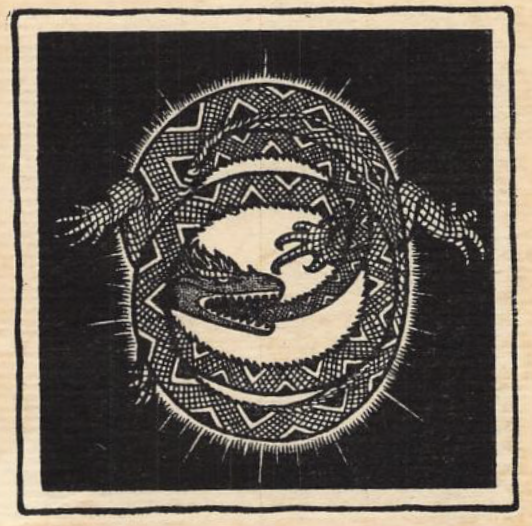
from the first edition of Eddison’s The Worm Ouroboros
Getting back to Lucian, let’s have another look at that sneaky (not snaky) crocodile, who starts to look a little like Epimenides.

so I snerged this image from a poster
for Lyle, Lyle, Crocodile (2022).
There are effectively two scenarios possible in the Crocodile Paradox. In scenario A, the hopeful parent says, “You’re going to give my kid back!” “Nope,” replies the crocodile, and eats the kid. In scenario B, the despairing parent says, “You’re not going to give my kid back.” “Right!” says the greedy crocodile… in which case, the crocodile has to give the kid back, in which case the parent was wrong, so the crocodile keeps the kid, in which case the parent is right, so the crocodile has to give the kid back, etc. etc. repitend etc.
This is, in fact, a variant of the Liar Paradox, which creates an undecidable dilemma.
Well, so what? What difference does it make, unless you’re on deadline for submitting a Star Trek script in which the crew of the Enterprise must defeat a computer with logic? (I’m sort of on strike against Star Trek lately, since its current owners are fascists trying to destroy American democracy. But that’s not Star Trek‘s fault.)

a screenshot from “I, Mudd”
Well, there is something more going on here than a running gag on Star Trek. Mulling over the Liar Paradox led Kurt Gödel to formulate his incompleteness theorems. The short (probably too short) version of Gödel’s findings: you can’t create any kind of symbol system which excludes the Liar Paradox unless you limit the kind of statements that can be made in the system. No system of symbols can be both complete and consistent.
In a world where people use symbol systems to communicate with each other, and in which there are symbol systems (computer software) that some people say are intelligent, or about to become so, this is a finding with some significance. And Gödel found it by taking seriously these ἄπορα, these undecidable dilemmas, these paradoxes that Lucian insists (over and over again) should not be taken seriously.
So Lucian was just wrong?
Yes, without a doubt. He was very wrong and bad. And after I log off here I’m going to go back and read some more of his stuff. That’s the paradox in my feelings about Lucian (or one of them, anyway).


