
When I find out that a movie I like is based on a book, I frequently seek out the book. It’s not just that I like books better than movies (though a case could be made, I guess). There’s just likely to be stuff even in a fairly short book that there wasn’t space to include in a two-hour movie (or even a three-to-seven-hour movie, the current standard).
“More of what I like” is a pretty easy sell for me. The pattern was set when I read the novels that The Maltese Falcon (1941) and The Thin Man (1934) were based on. Huston’s movie is an enduring classic, but Hammett’s novel is even better, and the “Thin Man” movies, though fun, are pale shadows of Hammett’s last novel.
I’ve probably watched Mike Nichol’s The Graduate (1967) fifteen times, and usually when I see the credit “based on the novel by Charles Webb” I think, “Hey, I should read that.” Then I forget about all that when Anne Bancroft appears onscreen.
But over the weekend, D and I visited NeverMore Used Books in Toledo—a truly great bookstore. I ran across a paperback of Webb’s novel there and snapped it up. (Spoilers for the 63-year-old novel and the 59-year-old film follow, if you’re worried about that.)
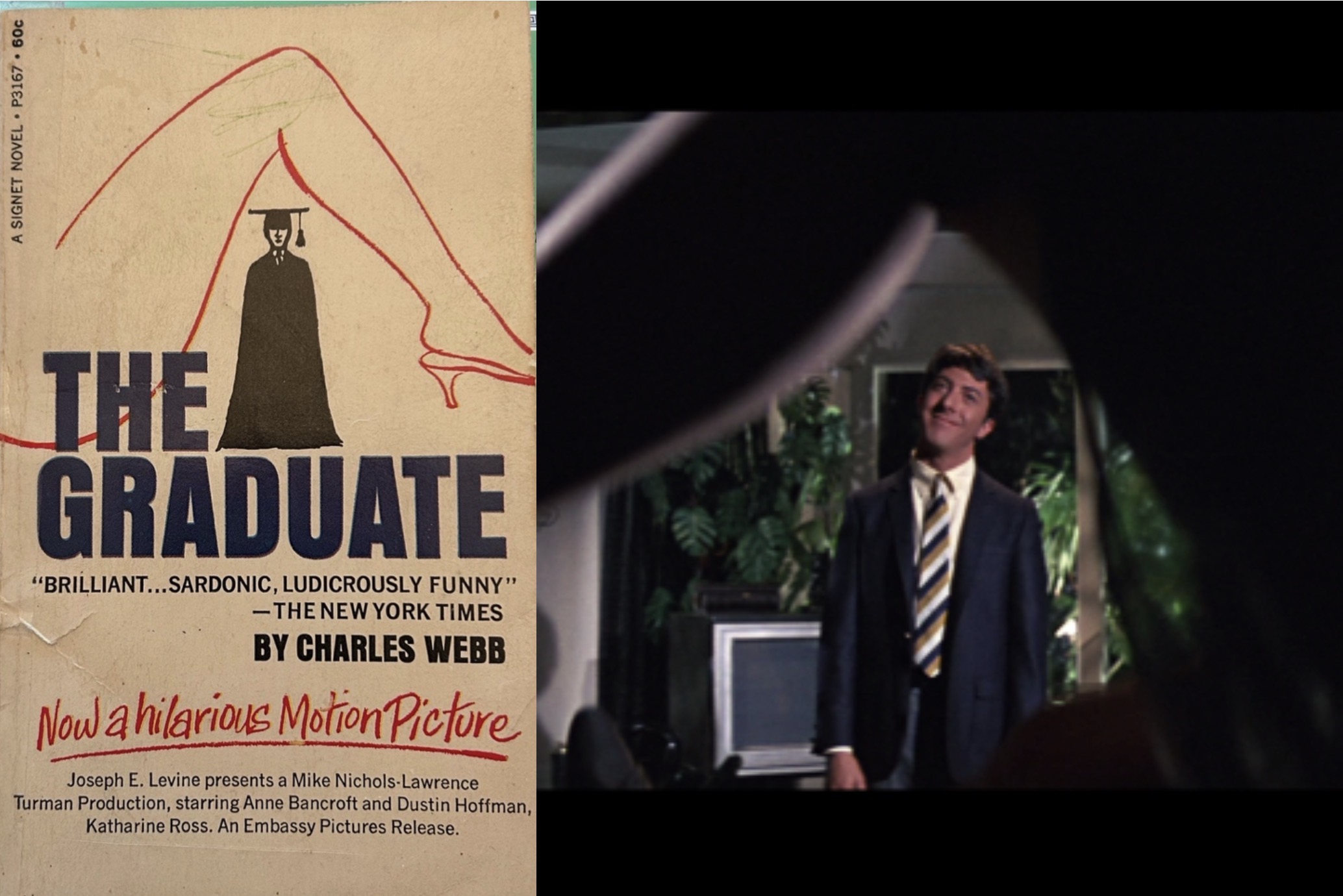
Webb’s novel is a quick read but, by and large, an unnecessary one. It has a lot of good stuff in it, but almost all of that good stuff was lifted by the crafty screenwriter Buck Henry and put into the screenplay, frequently sharpened and made more effective. (The script is co-credited by Calder Willingham, as mandated by the Writer’s Guild, but apparently it was Henry’s version that was shot after Willingham’s script was discarded; so says Mr. Wikipedia.)
The story common to book and movie:
Benjamin Braddock, an award-winning scholar and track star, comes home to California after graduating from college with no idea of what to do with the rest of his life. At a family party celebrating his return, he is buttonholed by Mrs. Robinson, who is married to the law-partner of Benjamin’s father and is a longtime family friend. (Sort of! More on this below.) She wants Benjamin to give her a ride home, and he churlishly agrees.
It turns out that what she really wants to do is seduce Benjamin (although she denies this in a brilliant conversational gambit that sets Benjamin back on his heels). Eventually, even Benjamin (not the brightest bulb on Broadway, no matter how many academic honors he piled up back east) figures out what’s going on; despite his original shock, he falls in with her suggestion and they begin an affair routinely conducted at a local hotel.
Benjamin has qualms and tries to break the affair off, but in the end he can’t bring himself to do it. In the gilded wilderness of his upper-class life, his trysts with Mrs. Robinson are (as he tells her) “the only thing I have to look forward to.”
There’s a fly in this existential ointment, though: Elaine Robinson. She’s the Robinsons’ daughter, a couple years younger than Benjamin, and the Braddocks and Mr. Robinson (at least) would like these two crazy kids to get together. Mrs Robinson (for reasons that are implied but not stated) is against this plan, as is Benjamin. For him, anyway, dating mother and daughter simultaneously would make the already-weird situation unbearably weird.
When a date with Elaine is more or less forced on the weak-willed Benjamin, he resolves to take her on the worst date ever, being a clinically insensitive jerk (his only evident talent, tales of collegiate glory notwithstanding) and landing eventually in a strip club. Elaine is humiliated and starts to cry. Benjamin is touched for the first time in the story with something like human sympathy, and tries to make it up to her. The date ends on a positive note and they agree to get together the next day.
That’s not to be, though. Mrs. Robinson intervenes. Benjamin tells Elaine of his affair with her mother, to forestall Mrs. Robinson doing so, and Elaine kicks him out of her house, eventually going back to Berkeley for college and a life that doesn’t include Benjamin.
After giving the matter some weeks of mopey thought, Benjamin decides to marry Elaine. He leaves his parents’ house, stalks Elaine at Berkeley, and (despite her doubts and the explicit interference of everyone he knows) succeeds in running off with her, away from her planned marriage with a cartoon of Joe College. They run away together, climb onto a passing bus, and ride off to a future as empty as Benjamin’s imagination.
At this point you’re probably saying, “Enge, if that is your real name, you seem to have wandered off task. You were going to sum up the story common to book and movie, not summarize the entirety of one or the other.”
That’s the thing, though. The detailed summary above applies both to the book and the movie. Nichols’ movie is one of the most faithful screen adaptations I’ve ever seen. On the rare occasions the movie differs from the book, the movie’s version is usually better.
Take, for instance, Benjamin’s first attempt to end the affair with Mrs. Robinson.
In the book, Benjamin writes her a Dear Jane letter. Hilariously, he addresses her as “Mrs. Robinson” in the letter, as he always does in every context. (Her first name never appears in the book or movie; in a little-known sequel published more than 40 years after the original novel, the character’s first name is given as “Glenda”.) Later on, they end back up together, without any clear transition.
In the movie, breakup and reunion are compressed into a single, highly effective scene that highlights Benjamin’s rootlessness and propensity to drift. We also get, courtesy of Anne Bancroft’s acting ability, a glimpse of the alienation and loneliness that are at the core of Mrs. Robinson’s character.
Similarly: in both the book and the movie, Benjamin and Elaine are enjoying their date so much that, instead of going home, they decide to go have a drink somewhere. At Elaine’s suggestion, they go to the nearby Taft Hotel. Benjamin is not crazy about this idea, and he has a good reason. However, he can’t say what it is: the Taft is where Benjamin and Elaine’s mother have been carrying on their affair. So they go, and a bunch of people recognize Benjamin, addressing him as “Mr. Gladstone” (the nom de la nuit that he uses when registering at the hotel). He retreats in confusion, and Elaine patiently elicits from him the fact that he’s been having an affair with “a married woman”—although Benjamin lies like a rug about it, saying that Elaine doesn’t know the woman and that she has a son (not a daughter).
It’s pretty funny (and then poignant) in the book—a turning point where Benjamin is confronted with his own lies and takes a belated and halting step toward honesty.
But the movie is even better, sharpening the ironic edge of the scene by having a series of people (Buck Henry as a desk clerk, Mike Farrell as a bellhop, Buddy Douglas as yet another bellhop) say in quick succession, “Good evening, Mr Gladstone!” to an increasingly dismayed Benjamin. (Dustin Hoffman is always brilliant, but never better than he is here.) Most of that stuff is there in the book, but without the ratcheting up of tension with each exchange, until they flee into the night. It’s like the scene in the book is the first draft of the script.
One element of the book that’s missing in the movie is a trip Benjamin takes after returning home. He tells his parents that he’s “going north” and doesn’t know when he’ll return: “Maybe in five years; maybe in ten years.” He’s going to spend his life among “real people” whom he expects to be different than the unreal people his affluent upbringing has stranded him among.
Three weeks later, he’s back home. He hitchhiked a lot, met many people, and helped fight a wildfire. But the “real people” he met were dull; the people who picked him up he dismisses as “queers”; fire-fighting, too, was apparently a snoozefest. None of this is in direct narration; we get in in fragments from Benjamin’s surly responses to his parents’ concerned questions.
At this point, my simmering impatience with Benjamin’s character began to boil over. He’s incredibly joyless. He gets to sleep with a beautiful older woman, somehow persuades said woman’s beautiful daughter to run off with him, leads in all respects a charmed life, and it’s nothing to him, to hear him tell it.
But that joylessness began to remind me of some people I’d known, and then I realized something: this kid is suffering from undiagnosed, untreated depression. (I am not, of course, That Kind of Doctor, but Benjamin is a fictional character and I have some expertise dealing with them.) At that point, I found I could sympathize with him, though at no point did I identify with him.
There’s one interesting bit from the book that didn’t make it into the movie. When Benjamin is writing his ill-fated “Dear Jane” letter to Mrs. Robinson, Benjamin’s father walks in on him. Benjamin tries to brush his father off, as usual, but his father won’t be brushed. He says he noticed Ben’s discomfort when the Robinsons visited earlier and asks if it’s because of Mrs. Robinson.
This bolt from the blue catches Benjamin’s hard-to-catch interest, and Mr. Braddock expands on his remark. “Ben, I’ve known that woman for twenty years and I still don’t know her. … There’s something about her that makes anybody feel uncomfortable. … But she’s—she’s really not much of a person. She never makes any effort socially or any other way. … But she’s not honest, Ben. … I think she’s devious.”
This could be read a few different ways. One is that it’s a straight-up attempt by the writer to villainize this character. I’m disinclined to accept that, though, partly because this passage made me more sympathetic to her, and because it underscored some similarities between Benjamin and Mrs. Robinson that Ben’s father may or may not have been aware of. I wonder, too, if Mrs. Robinson had an affair with Mr. Braddock at some earlier date, or tried to initiate one, and that’s part of Mr. Braddock’s distaste for his partner’s wife.
If it seems like I’m damning the novel with faint praise, I’m really not. If you have a favorite line from the movie, chances are it’s present in the novel. It can be very funny, reminding me sometimes of Amis’ Lucky Jim. There are some beginner’s mistakes, but on the whole I’d say this was a promising first novel, except that the writer’s promise seems to have been mostly unfulfilled.
A problem common to the book and the movie is Elaine Robinson. If you accept that every story must include an attractive young woman whose job it is to be the Hero’s Girlfriend, maybe there is no problem. But if we want to think of Elaine as a person rather than a trope, the story doesn’t give us much to work with.
We may infer that Elaine is disenchanted with the shallow and materialistic lifestyle of her parents, and that she doesn’t want to find herself a clone of her mother in twenty years. The book doesn’t say anything about that, but there is a significant exchange between Elaine and her mother as the younger woman is fleeing her marriage to Joe College. Mrs. Robinson grabs her daughter and says, “It’s too late!” Elaine shakes loose and says, “Not for me!”
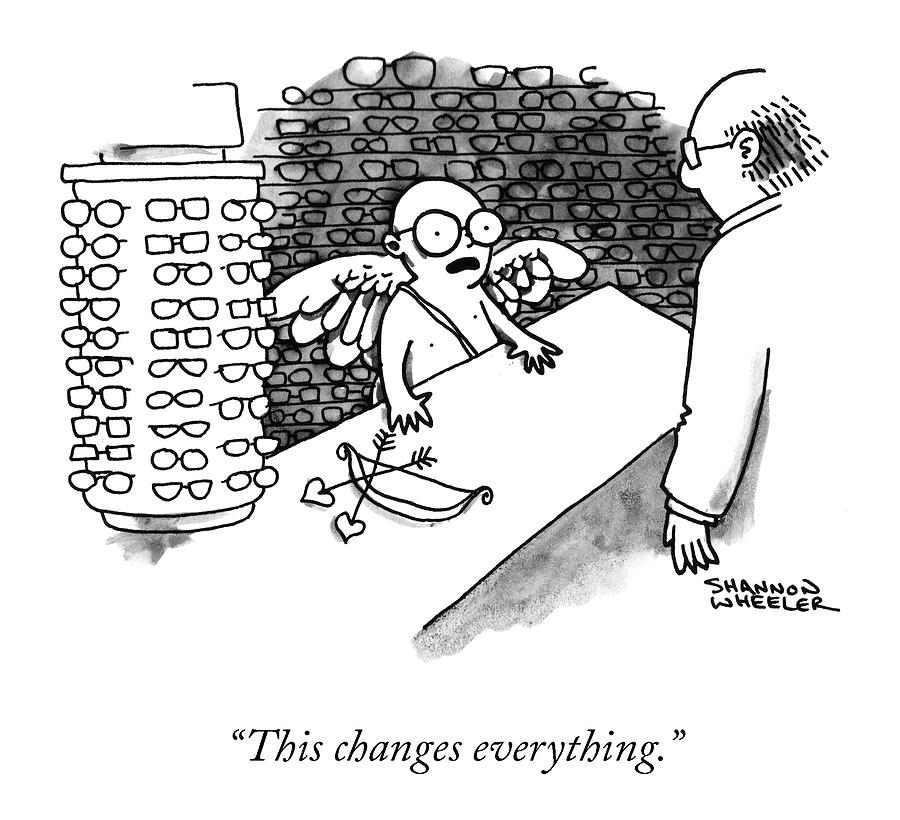
In the book, Elaine simply goes with Benjamin away from the abortive marriage, almost as voiceless as Lavinia in the Aeneid. We have to infer that there is some vibe between them that they both feel and can’t or don’t have to articulate. I guess that’s a thing that happens sometimes: Cupid, if not blind, is at least a little nearsighted. Still, this is another area where the movie has a leg up, as it were, on the book.

I saw The Graduate perhaps 5 times the year it was released, 1967-1968. I was a young 2nd lieutenant (ROTC) and had just graduated from college. I had already read the book. 1968 was also the year I saw Simon and Garfunkel in concert. The movie was a spark in their career. I very much identified with Benjamin Braddock and wondered, like him, where my life was going. Thanks for this analysis, you’re correct on every point. Buck Henry did a brilliant job with the screenplay, although I’ve never thought the ‘book Benjamin’ was as much of a bumbler as the ‘movie Benjamin.’ Certainly, I felt (and feel) that this was the movie of a generation. It expressed so much of what I felt and wanted.
The next movie to affect me this way came MASH (the movie) in 1970. The year after I got out. It was a crazy reflection of everything I’d just lived through for 2 years.
MASH (1970) was one of my favorite movies for a long while. I also tracked down the (very different, yet somehow not so very different) book and read/reread it a lot. I seem to be doing a series of book-and-movie reviews, and MASH might be a good topic for the next one.
I’d like to see you analysis Len Deighton’s Ipcress Files and Funeral In Betlin vs the movies with Michael Caine movies.
Hm. That’s a thought. I should dig up the Deighton novels; it’s been a while since I read them. There was a TV adaptation a while ago, too, if I’m remembering right.
I find the ending tragic, as I think they go off and reproduce their parents’ pedestrian lives. I agree with you wholly that the writer does Elaine, and most young women of the time a grave disservice. I also realize, in reading your essay, how much Benjamin reminds me of Holden Caufield in The Catcher in the Rye. They are so offended by “fakes,” and yet they too are fake and undeveloped, unsympathetic, should, just reacting to other, more responsibility-oriented people with disdain. IMO.
I was urged to read Catcher by well-meaning teachers, and did, but never really understood why is was supposed to be so great. I did like some of Salinger’s stuff (e.g. Nine Stories).
I like to think that Ben and Elaine at least made new mistakes, but you may be right. These two emigrants from Omelas seem to have no idea where they are going, or why.