

(ancestor breed of boxers) peering over my left shoulder.
Right: me ten years later, with a live (if not very lively)
boxer (dog-detective Lennie Briscoe) snoozing over my right shoulder.
Executive summary: this is an interesting pre-Hays-Code comedy/melodrama that’s worth watching at least once.
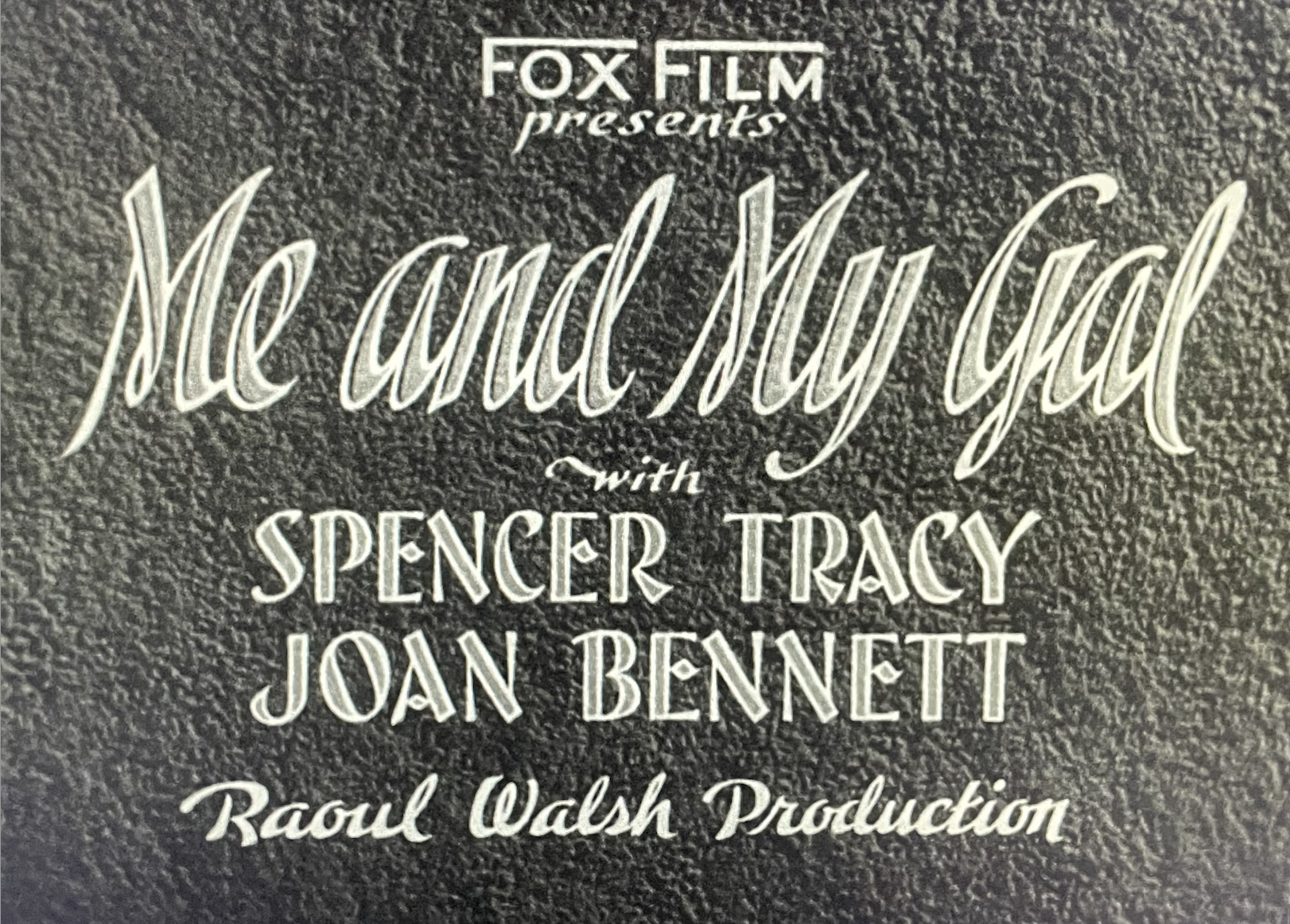
Spencer Tracy and Joan Bennett star in this fast-moving but minor movie, directed by Raoul Walsh in 19 days and written by at least seven people (and it shows).
Tracy plays a cop named Danny Dolan who works the waterfront where he runs into a bunch of crazy characters including a guy who’s getting ready to drown his dog because he can’t feed him, and a waitress with a smart mouth and a heart of gold. He saves the dog, romances the waitress, catches a crook and gets promoted to detective. That happens in about 10 minutes of screen time, and I’m leaving out most of the wacky characters who come and go without an impact on the plot.
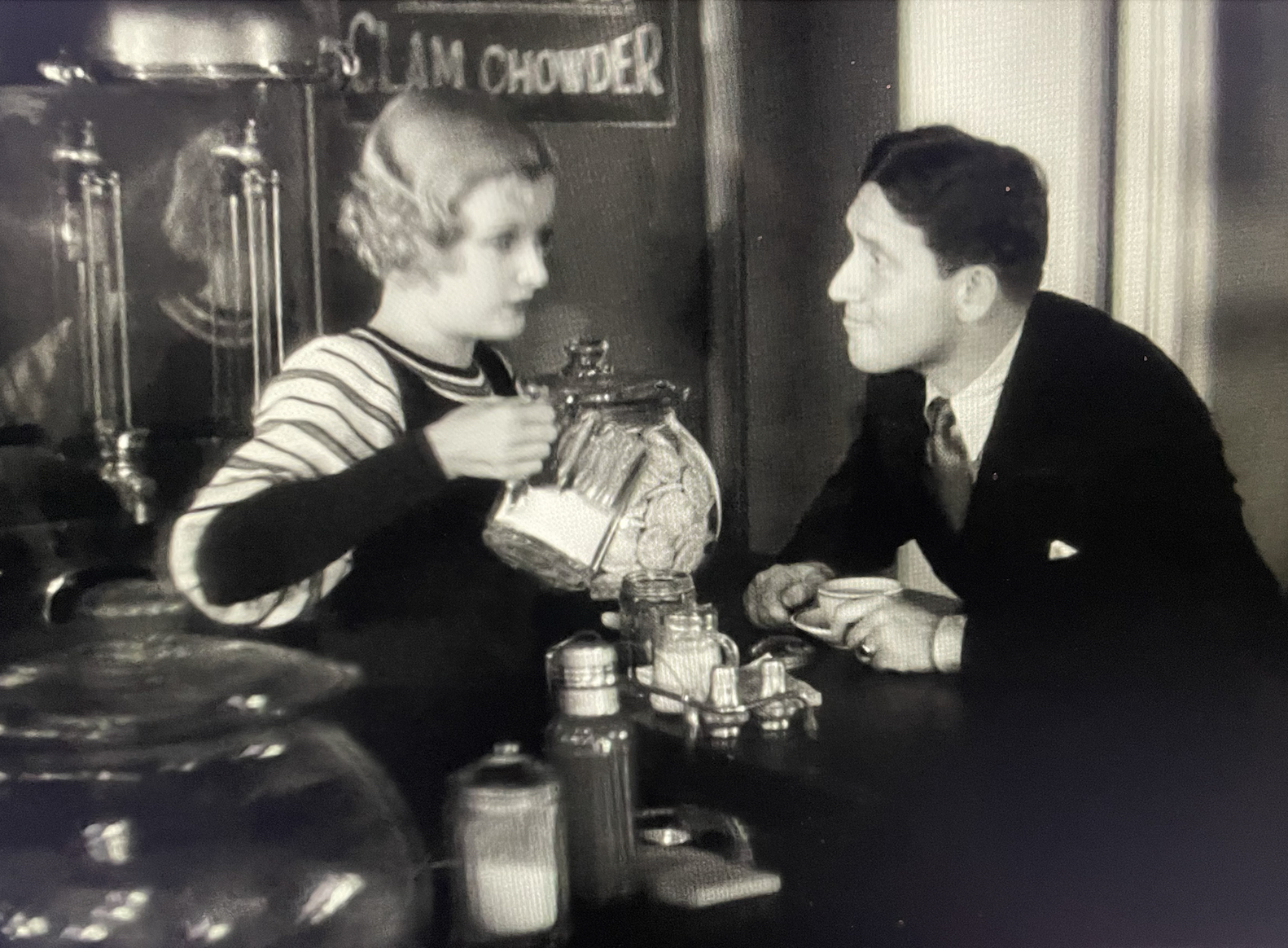
The waitress, Helen Riley (played by Joan Bennett), has a sister, Kate, who’s also engaged marry to a cop, Sarge. They live with their father, Pop Riley, an ex-cop who’s almost completely paralyzed from an injury in the line of duty.
Everything is rosy in this monochrome landscape of working girls dating cops, except that there’s a snake in the gray grass: a murderous gangster, Duke Castanega, played in a sneering monotone by the director’s younger brother. Kate used to date him and is still in love with him, and when he’s on the run he comes to Kate and convinces her to hide him in the attic. So the police force are looking all over town for for a guy who’s hiding in the attic of a retired cop.
Pop the ex-cop is fully aware that the gangster is in his attic, but he can’t speak or write. When Helen and Danny stop by to visit with him, he tells them the whole story by blinking in Morse code. They don’t read Morse code, but they take down the message and decode it later. That sets up the climax of the plot where Helen saves her sister from charges of aiding-and-abetting and Danny, after being shot, kills Duke off-camera. The good and semi-good guys live happily ever after, and the ungood guys are dead.
This movie tends to confirm my theory that screwball comedy is the funhouse-mirror of noir. There are a lot of darker elements here that the Hays Code would have ruled out—the illicit affair of the cop’s fiancée and the gangster, for instance. Also, Danny kills the guy. From Duke’s point of view, this movie is a noir. From Danny’s, it’s a light-hearted comic romance with a little light danger.
The wacky dockside characters were sometimes tedious but always brief. The smart dialogue between Bennett’s character and Tracy’s wasn’t as smart as it thought it was, but the actors delivered the lines with style. I liked it that a disabled guy cracked the case and is treated throughout as a person, not a piece of furniture. And the depression-era cynicism about institutions was frostily refreshing. At one point, the counter guy at the diner tells Danny about a bank robbery, and Danny says, “Oh yeah? Who’d the bank rob?”
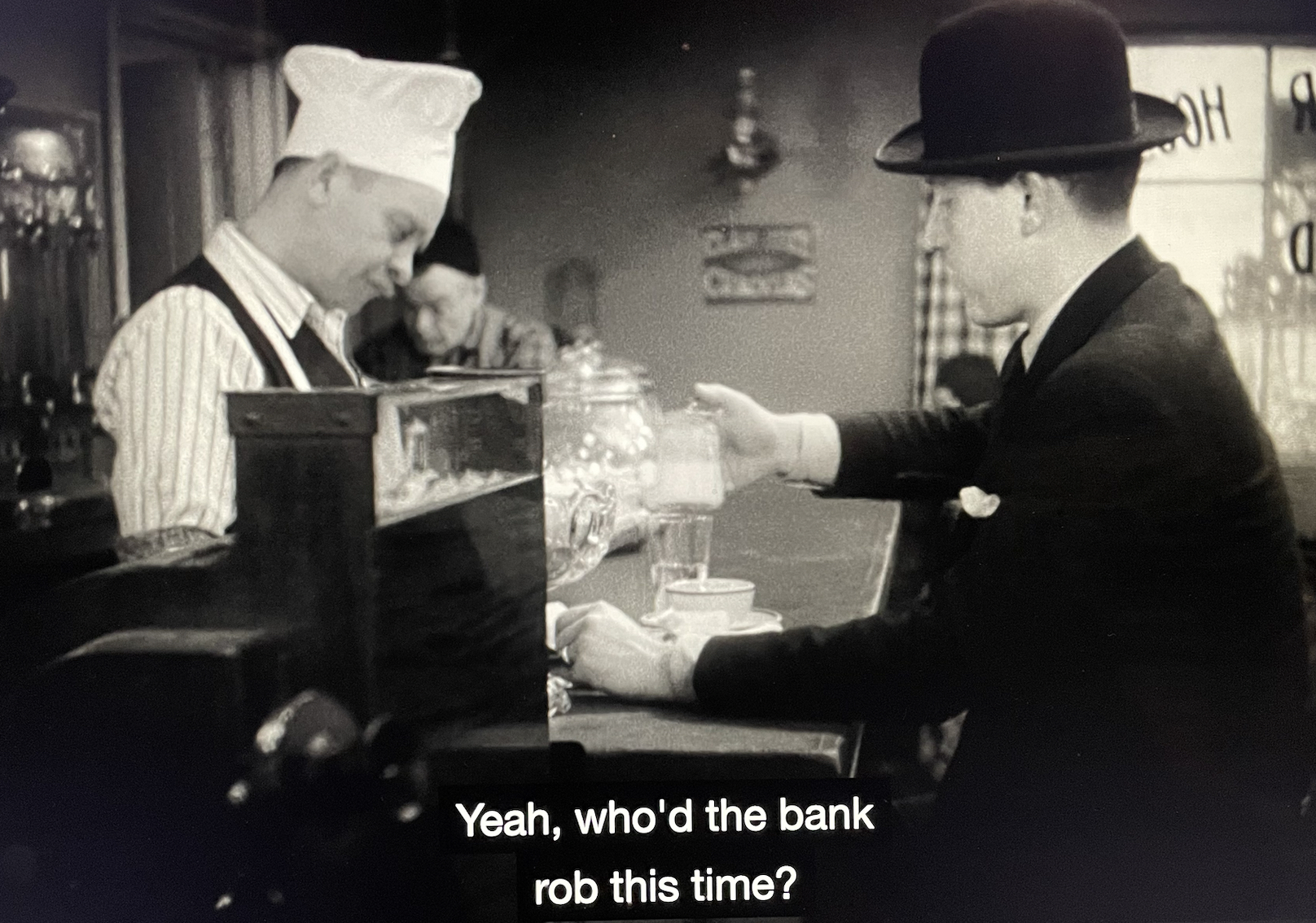
Lines like this probably brought the house down in 1932. Ninety years later, we’re much more sophisticated and we know that billionaires won’t harm us if we just tickle their egos in exactly the right way, and also surrender ownership of the world to them.
Typo of the day: He said saidly (for an intended He said sadly).
Saidly.
A gryphon holding up the corner of a sarcophagus. I took this photo in the Vatican Museum, in the now-distant summer of 2008. I was collecting gryphons that year.

It’s a Saturnalia on Saturday! It must be extra potent.

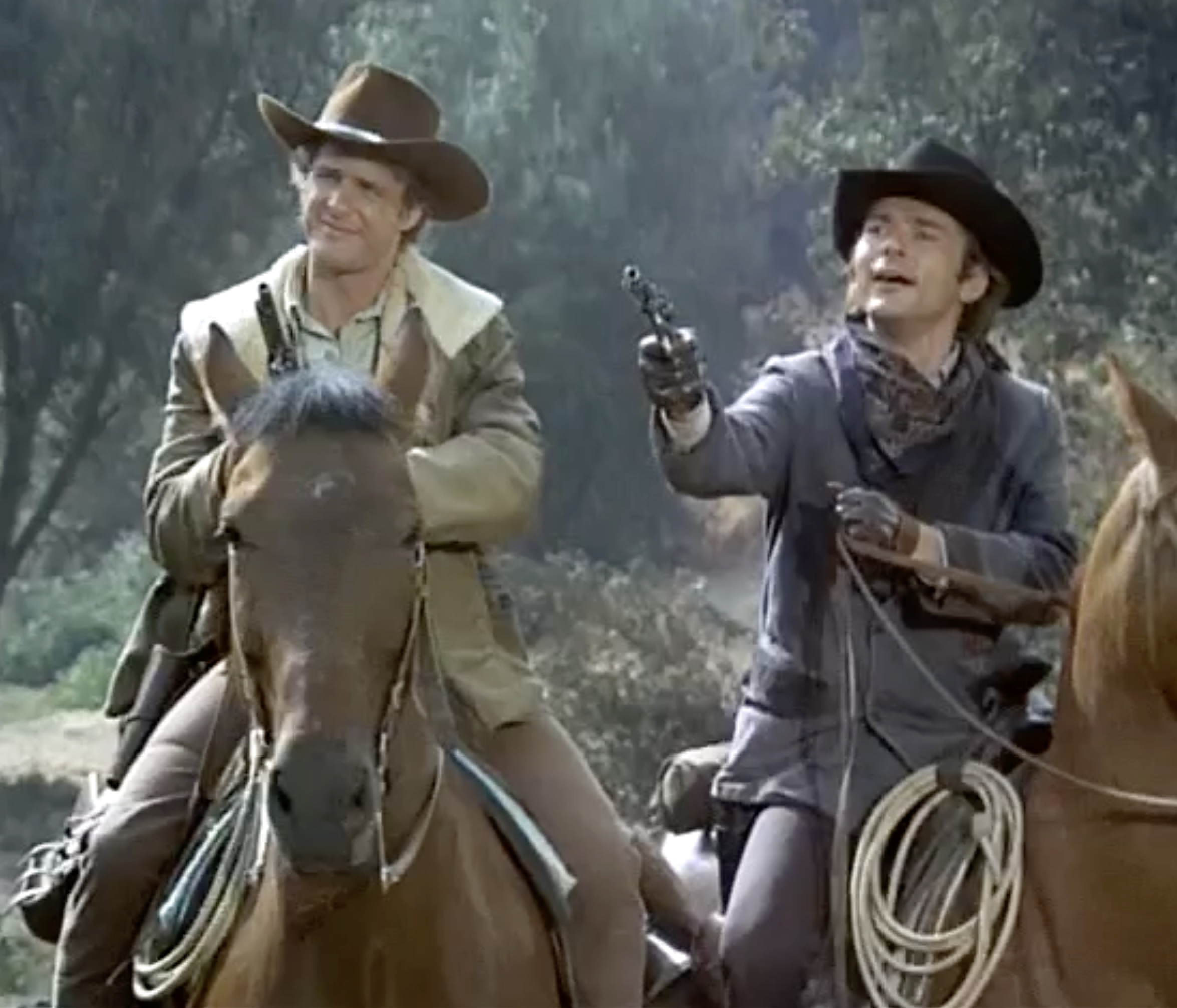
Everything Is Better With Latin!™, and alias is Latin for “elsewhere”. At least the pilot of Alias Smith and Jones has that going for it. That and the telegenic qualities of the leads are about the only thing in this hour-and-change that didn’t need changing.
The situation. Hannibal Heyes (Pete Duel) and Jedediah “Kid” Curry (Ben Murphy) are the leaders of the Hole-in-the-Wall Devil’s Hole Gang in an unspecified state or territory in an unspecified time—that Neverneverland of midcentury entertainment called “the Old West”. But things are changing in the Old West: safes are getting harder to rob, law enforcement is getting more effective. Heyes & Curry think it’s time to quit. The gang disagrees and they part company.
This is a proven formula for screen entertainment, but the trouble is that the proof had come only a couple years earlier in Butch Cassidy and the Sundance Kid (1969). The writers of AS&J‘s pilot steal a bunch of plot points directly from the movie: trouble with newfangled safes, trouble with a train robbery that leads to the gang being chased, using so much dynamite to blow up a safe that it scatters the money hither & yon, etc. To evade actually getting sued for plagiarism, the scenarists change the plot points just enough that they don’t work in the story and are no longer funny or even interesting. Problem solved!
For instance, the Gang finds that they can’t break into a safe on a train, and they have to leave because the law is coming. So they take the safe with them. If they were just going to load the thing onto a flatbed truck and get on the highway, this might somehow make sense. What they’re proposing to do is have their horses drag it behind them as they ride into the mountains. As they’re being chased. It gets dumber from there.
When Heyes and Curry break away from the gang, they look up an old friend of theirs, Lom Trevors (James Drury), a lawman who used to be a crook; they’re hoping he can help them go straight. This is another gobbet ripped from the bleeding corpse of BC&tSK, but in the movie, the old friend is no help. In the TV show, the friend reluctantly undertakes to go to the governor and negotiate for their amnesty.
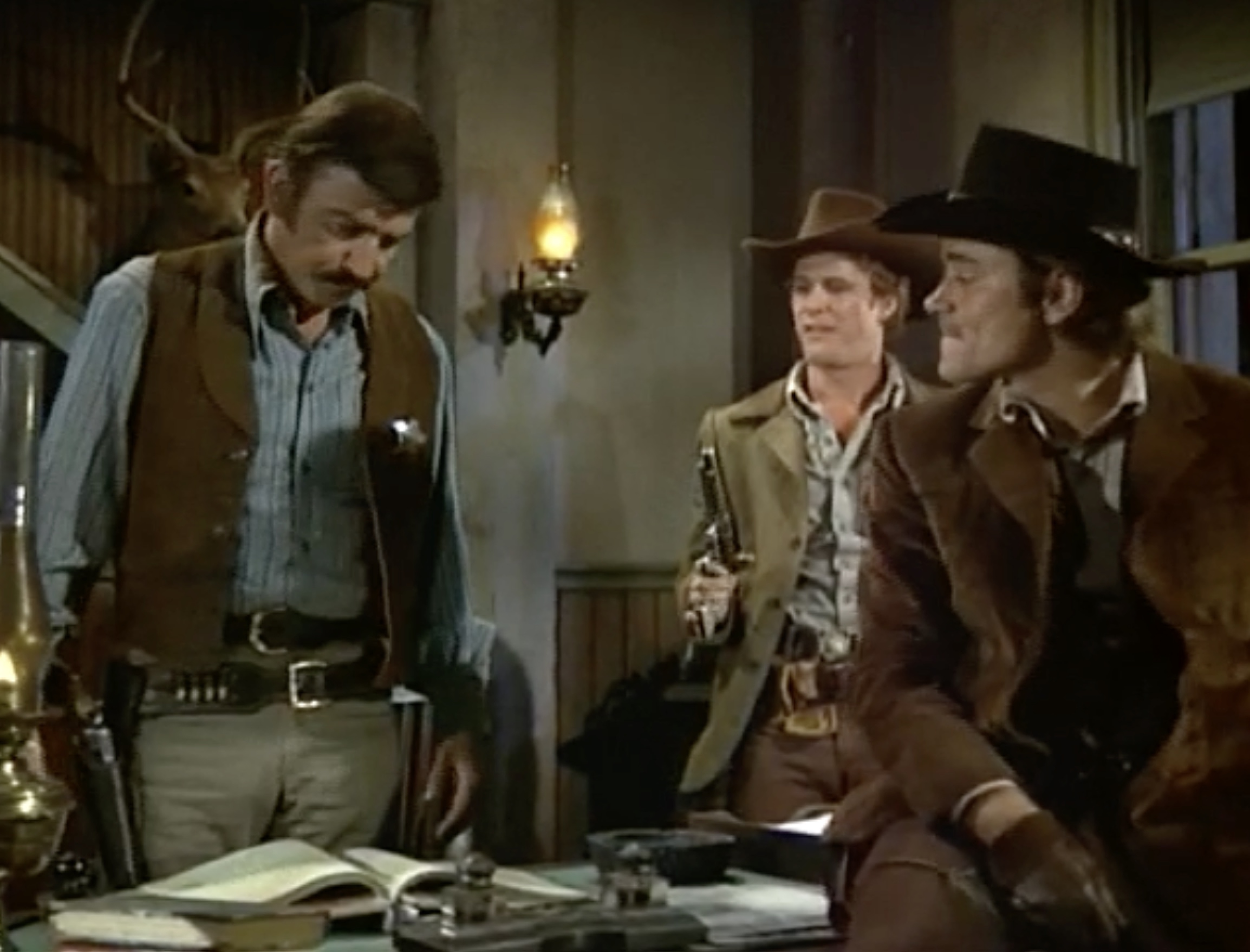
While they’re waiting for Trevors to return, our heroes take a straight job as bank guards for Miss Porter, a beautiful young bank owner played by Susan St. James, who does what she can with lines like “Not at all! I’m only thrilled you’d consider helping me out in Daddy’s absence.”
There is some modest who-am-I tension as Heyes and Curry resist the temptation to rob the bank instead of guard it. Then the Devil’s Hole gang shows up to rob the bank and, through a set of circumstances too complicated to go into, the bank vault is blown up and its contents is scattered all over town. The money from the bank literally rains down on the town’s main street. Heyes and Curry drive off their former gang, for which the bank owner is grateful. The bank has been saved! Except for the fact that it’s been destroyed and its money is scattered all over town.
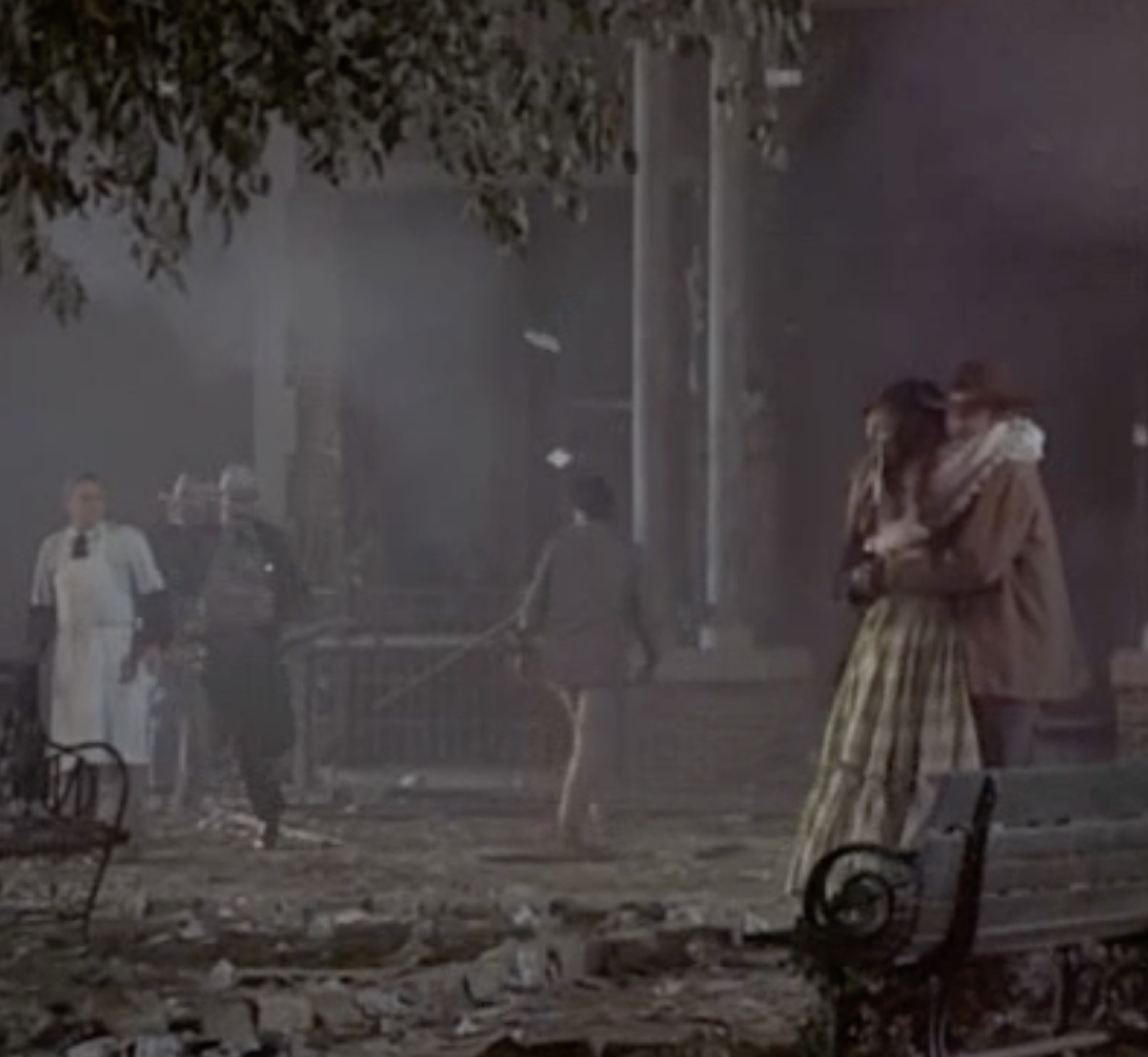
Sheriff Trevors returns and tells Heyes and Curry that the governor is willing to grant them a pardon, as long as they can stay out of trouble for a year. Until then, they have to travel incognito and try to live law-abiding lives.
Verdict: This is not very good. The only takeaway from the pilot is the premise for the series, that Heyes and Curry have to travel incognito in expectation of an amnesty, and you can get that with the voiceover that begins every episode of the series proper.
However, things do get better rapidly with the first episode of the series proper.
Additional notes:
People who ID Heyes and Curry: The sheriff knows them at sight, but he’s an old friend and they’re not incognito yet. A couple of thugs suspect the identity of our heroes in a saloon, but they get out of it by acting unheroically.
#EverythingIsStarTrek:
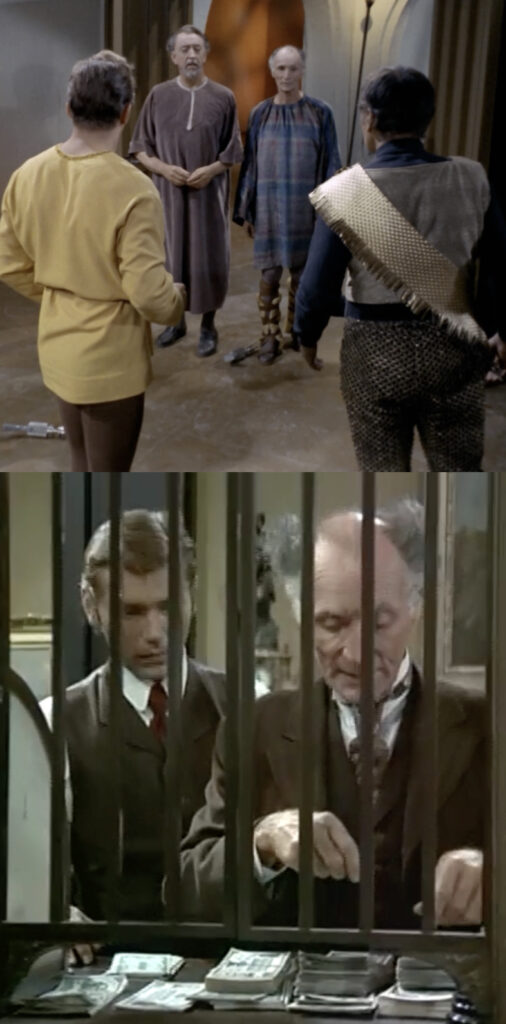
Don’t take my word for it. Take the world of Claymare. His fellow Organians mocked his innovative, Bozonian hairstyles, so he spanned the wastes of time and distance with the power of his disembodied mind and ended up as a bank teller in 19th C. America where, he was told, people were crazy about clownish haircuts. Tragically, he had been misinformed.
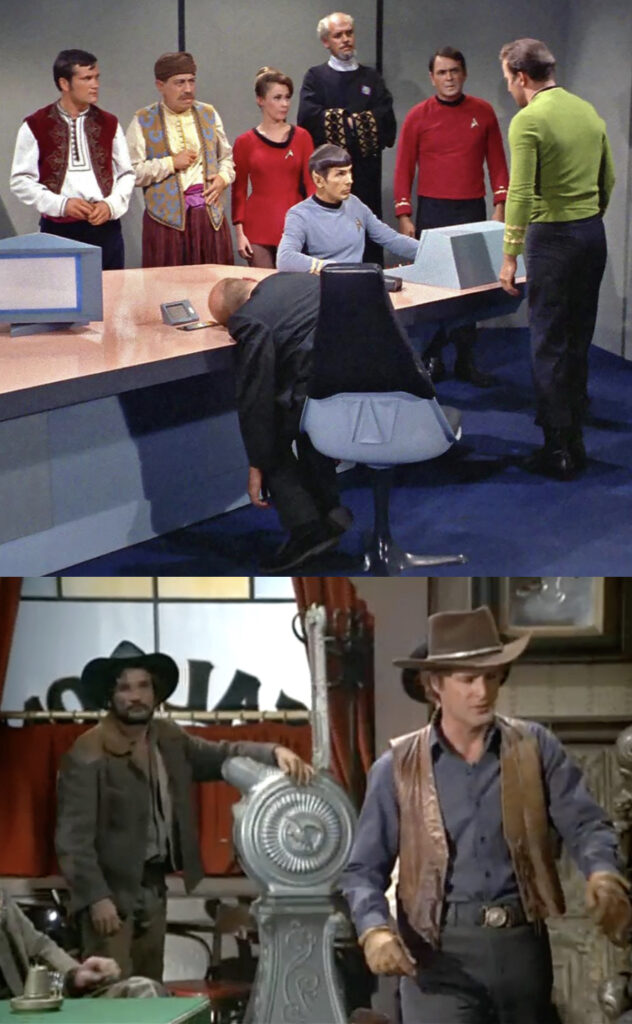
In this episode we also meet Morla of Argelius II. Convicted on his homeworld of the crime of sexual jealousy, he fled in shame through time and space, finally settling for a while as a gunman in the Old West, where his retrograde morals were more acceptable.
Universal Garner:
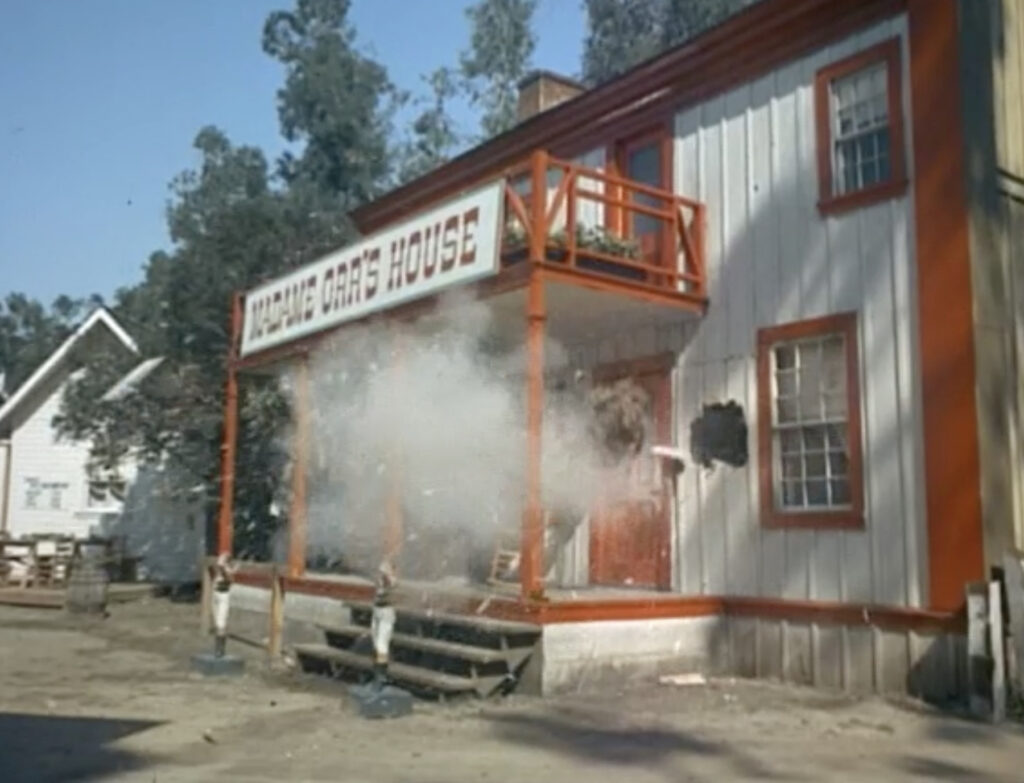
In the opening montage of Heyes and Curry’s misdeeds, we see Madame Orr’s House explode, a clip borrowed from the climax, as it were, of Support Your Local Sheriff. The theme song sounds a lot like the “Support Your Local…” movies, too. I was expecting Cherokee Productions, James Garner’s company, to be listed in the credits, but it wasn’t. This wouldn’t be last time Universal lifted something from Garner without proper accounting. One of the gunslingers who confronts Heyes and Curry in the bar later ends up on an episode of The Rockford Files. Coincidence or destiny?
Poker facts: none here, but they’ll come up in future episodes.
Crimes committed by the reformed outlaws: Breaking and entering; destruction of private property; wasting our time.
I’m just off a couple weeks of grading at the end of the term. When I’m grading stacks of quizzes, I usually have a video running in the background to assuage the pain of this unnatural activity. This semester I watched a lot of the screwball comedies that the Criterion Channel is featuring in December—some old favorites; some new to me.
Some of them I had thoughts about (if not very deep ones). Thoughts and none very deep? That’s what blog posts are for! So I figure I’ll retro-review a few of them.
First up: Ball of Fire (1941), featuring Gary Cooper and Barbara as leads, a deep bench of second bananas, a snappy script by Charles Brackett and Billy Wilder, and brisk direction by Howard Hawks. Executive summary: an extremely rewatchable classic, highly recommended.
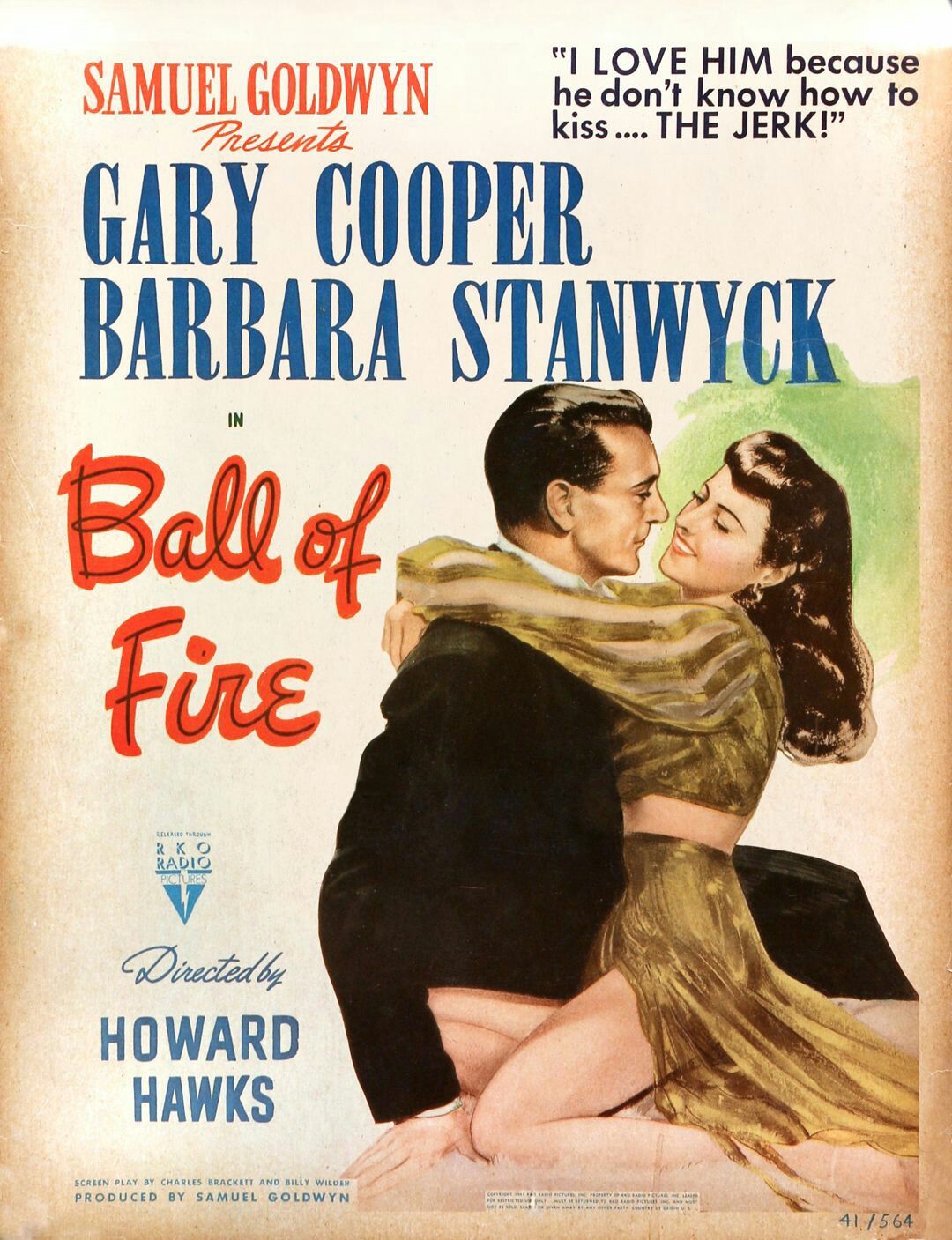
The career of Gary Cooper is somewhat mysterious to me. His behavior onscreen is almost always stilted and hesitant. Neither his face nor his voice is very expressive. He apparently gives or gave some people a charge, but I guess I’m not hard-wired to appreciate it.
That’s why he was born to play this role: Professor Bertram Potts, a dusty, awkward, unworldly pedant who, in the course of researching American slang, falls in with a slangy, slinky lounge singer named Sugarpuss O’Shea (a glittering, knifelike turn by Stanwyck at the top of her game).
The set-up is that Potts and seven other much older (but more nearly human) academics are living and working together in a mansion owned by a charitable foundation; their job is to pool their various kinds of expertise and produce an encyclopedia of all human knowledge.
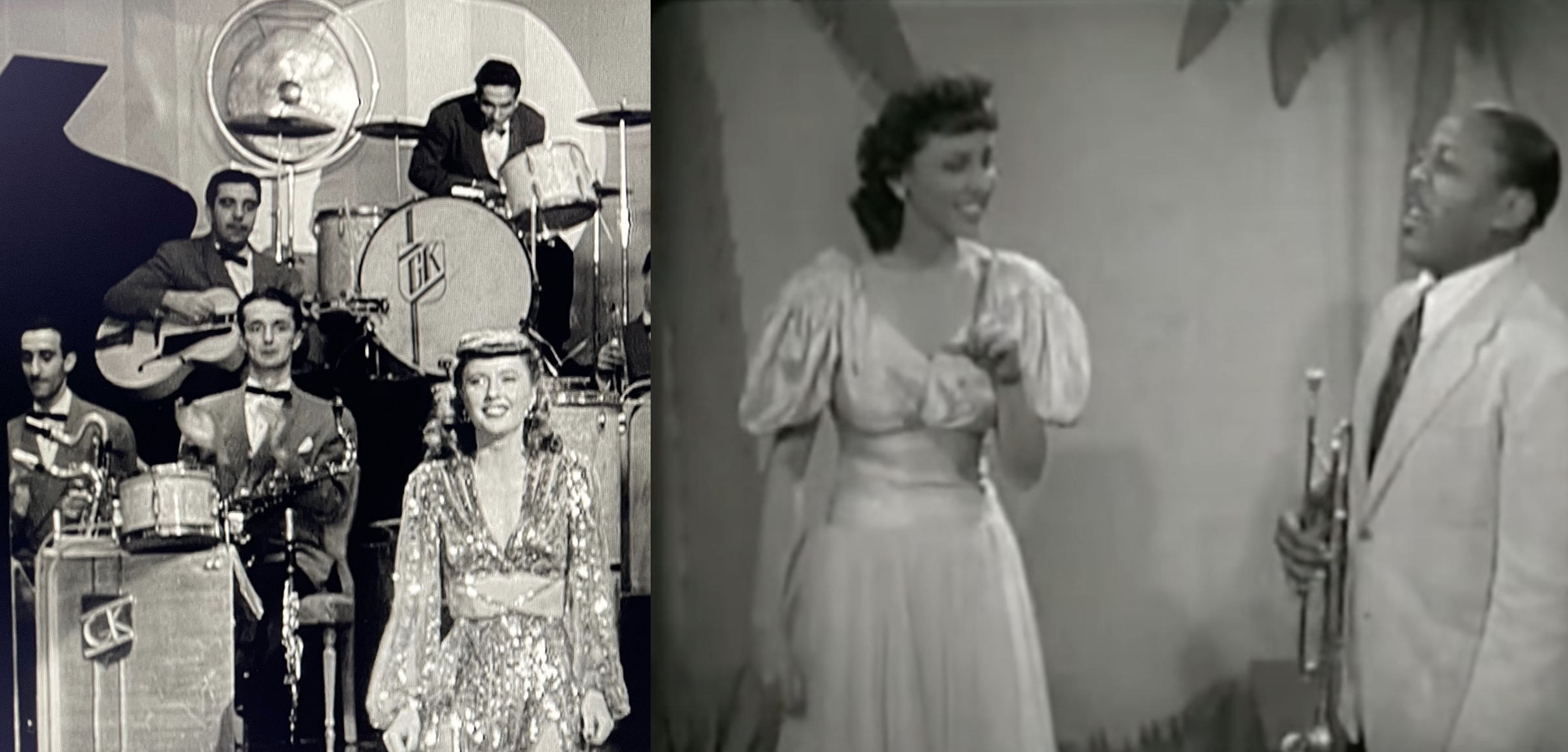
When they get as far as the letter S, Potts realizes that his article on slang is twenty years out of date, and he starts prowling around New York City, collecting data from live subjects. He ends up at a nightclub where Gene Krupa and his Orchestra, ably played by Gene Krupa and his orchestra, are burning up the place, fronted by a songbird named Sugarpuss O’Shea.
I’m pretty sure the songs in the club scene were actually sung by Anita O’Day, who was working with Krupa at the time (and who, Mr. Wikipedia tells me, actually sang early in her career at a New York club called Ball of Fire). Now I’m starting to wonder if Ball of Fire was started as a vehicle for O’Day, or maybe the resemblance between her stage persona and Stanwyck’s character was developed as a kind of in-joke by the filmmakers.
Potts makes it his mission to enlist Sugarpuss O’Shea in his project to explore slang and barges his way into her dressing room to give her his card. His pitch isn’t received very well; not only is O’Shea not the bookish type, she has problems of her own. Her gangster boyfriend, Joe Lilac (played by Dana Andrews) is under suspicion for a contract murder (spoiler: he’s guilty), and the police think O’Shea can help them with their inquiries (spoiler: she can).
Lilac sends a couple of his boys (played with thuggish glee by Dan Duryea and Ralph Peters) around to put Sugarpuss on ice so the police can’t find her. The question is where to put her. A hotel the cops are sure to roust? A warehouse full of rats? Options are few. Then it occurs to them that she could drop in on Professor Potts and stay for a while, and she does, fast-talking her way into room-and-board in the middle of the night.
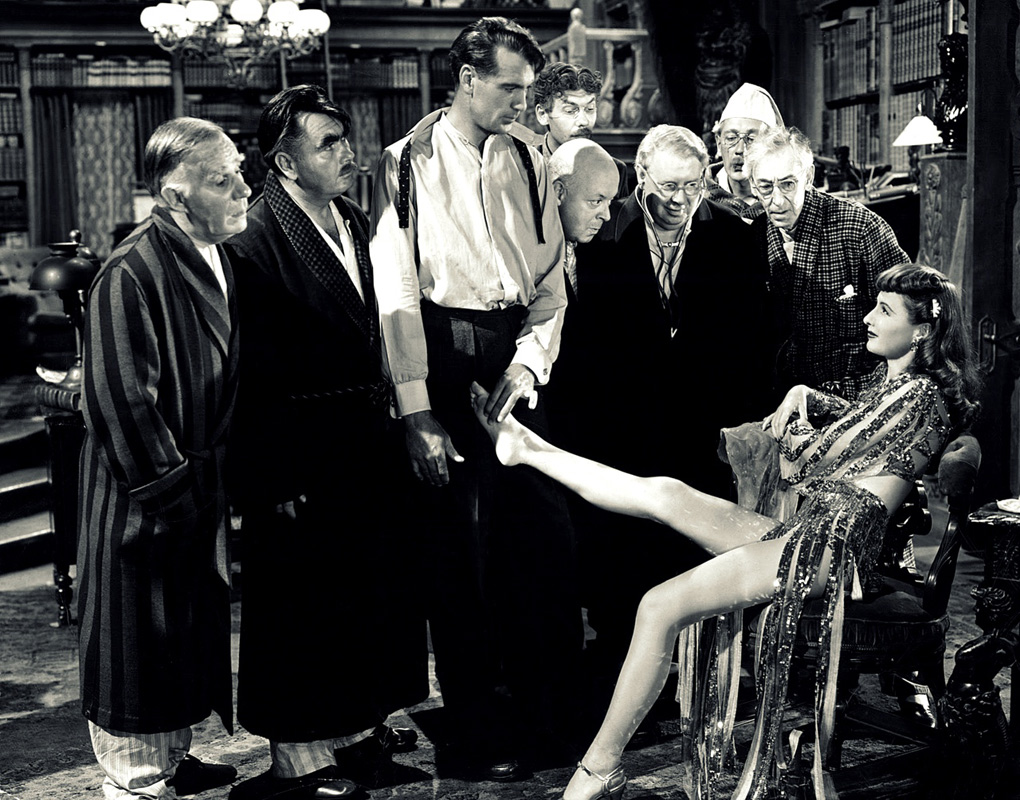
The seven elderprofs (rendered with eccentric brilliance by a crew of veteran character actors) are delighted to have Sugarpuss in their midst. She helps with the slang project, but she also teaches them how to dance the conga and in general brightens up the place. Potts nerves himself up to throw her out, but O’Shea convinces him that she’s in love with him and that’s why she wants to stick around. Meanwhile, Joe Lilac has figured out that the solution to his Sugarpuss problem is to marry her so that she can’t testify against him. She’s amenable to this as a business proposition, but then Potts also proposes. Which suitor will she choose, I wonder?
I won’t go into the fast-moving, almost Plautine, plot any further. It works as well as it has to for the events to play out in a happy ending.
A couple things struck me about the movie on this rewatch. One is how unmodern it is in its relative lack of cruelty and bitterness. It’s pleasing to watch Sugarpuss develop a rapport with the elderprofs, to see Potts develop friendships with the neighborhood garbageman, newsboy, etc. in his slang project. The gangsters are sadistic jagoffs who get their comeuppance, but the rest of the movie is packed with people who, despite their differences, come to like each other.
Like I say: a different world than ours.
The other thing is: with a couple of different choices, this is the plot of a film noir. A heartless singer derails the career of a professor? A bookworm whose life is destroyed when he falls in love with a golddigger who pals around with Dan Duryea? Or am I thinking of that other Dan Duryea movie where he tries to extort a professor?
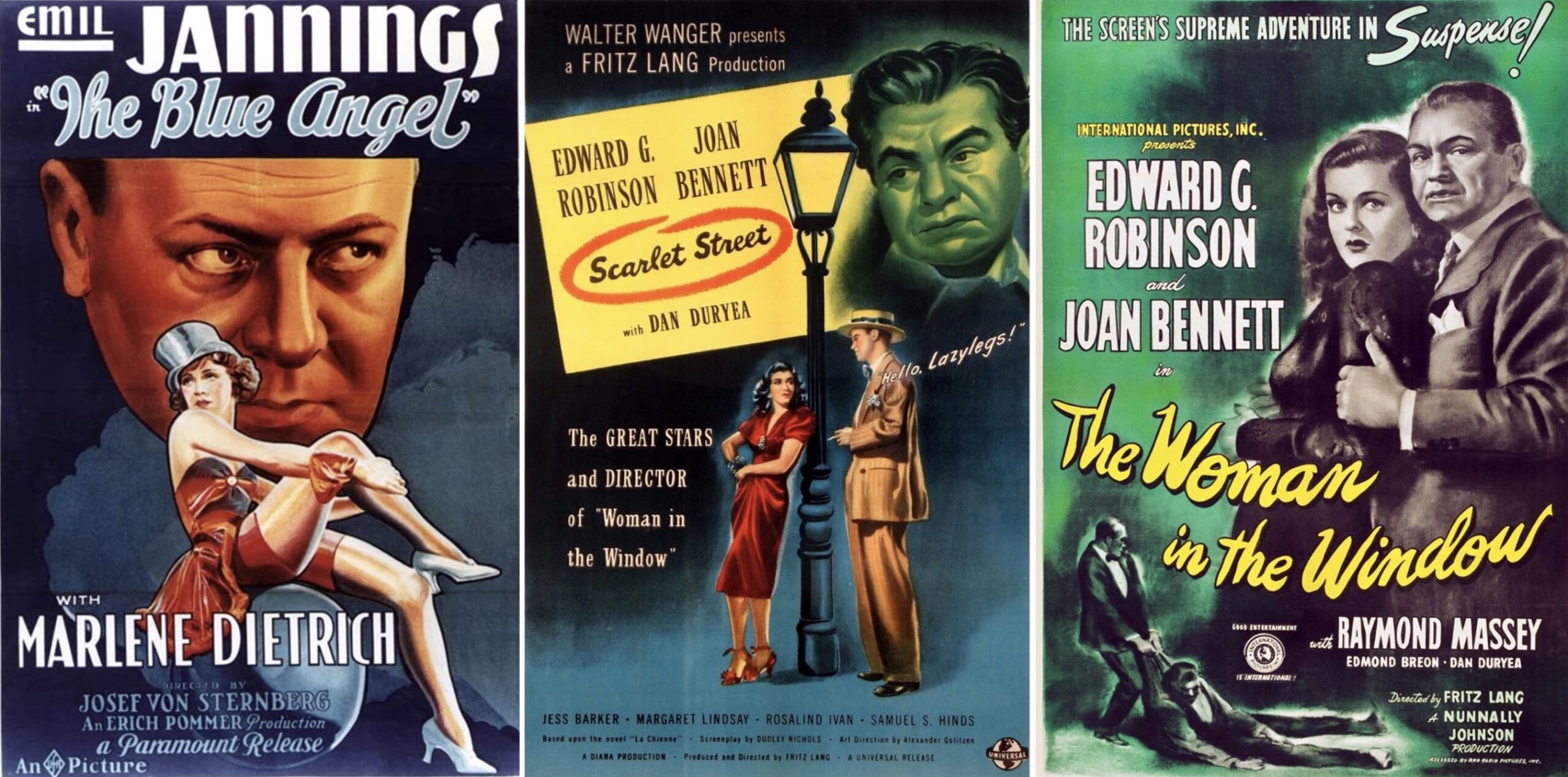
“Love’ll make you do things that you know is wrong.” If it works out anyway, you’re in a screwball comedy. If not, you’re in a noir.
Or… some other kind of drama?
divinam ex eo maiestatem asserere sibi coepit; datoque negotio, ut simulacra numinum religione et arte praeclara, inter quae Olympii Iovis, apportarentur e Graecia, quibus capite dempto suum imponeret.
—Suetonius, CALIGULA 22
“From that time he began to claim godhood for himself. He gave orders that divine images famous from the reverence given to them or the skill with which they were made (including the statues of Olympian Zeus) should be imported from Greece so that he could replace their heads with his own.”

We’re treed.




This is not new, but it’s new to me: a glorious map of the Milky Way as a Renaissance cartographer might have drawn it, from Starkey Comics.