Alias That Guy and That Other Guy

This is just a blog post about a TV show, but it does involve some discussion of self-harm. Caveat lector! If you’re in a tough place, remember there are ways to get help, especially by calling or texting 988.
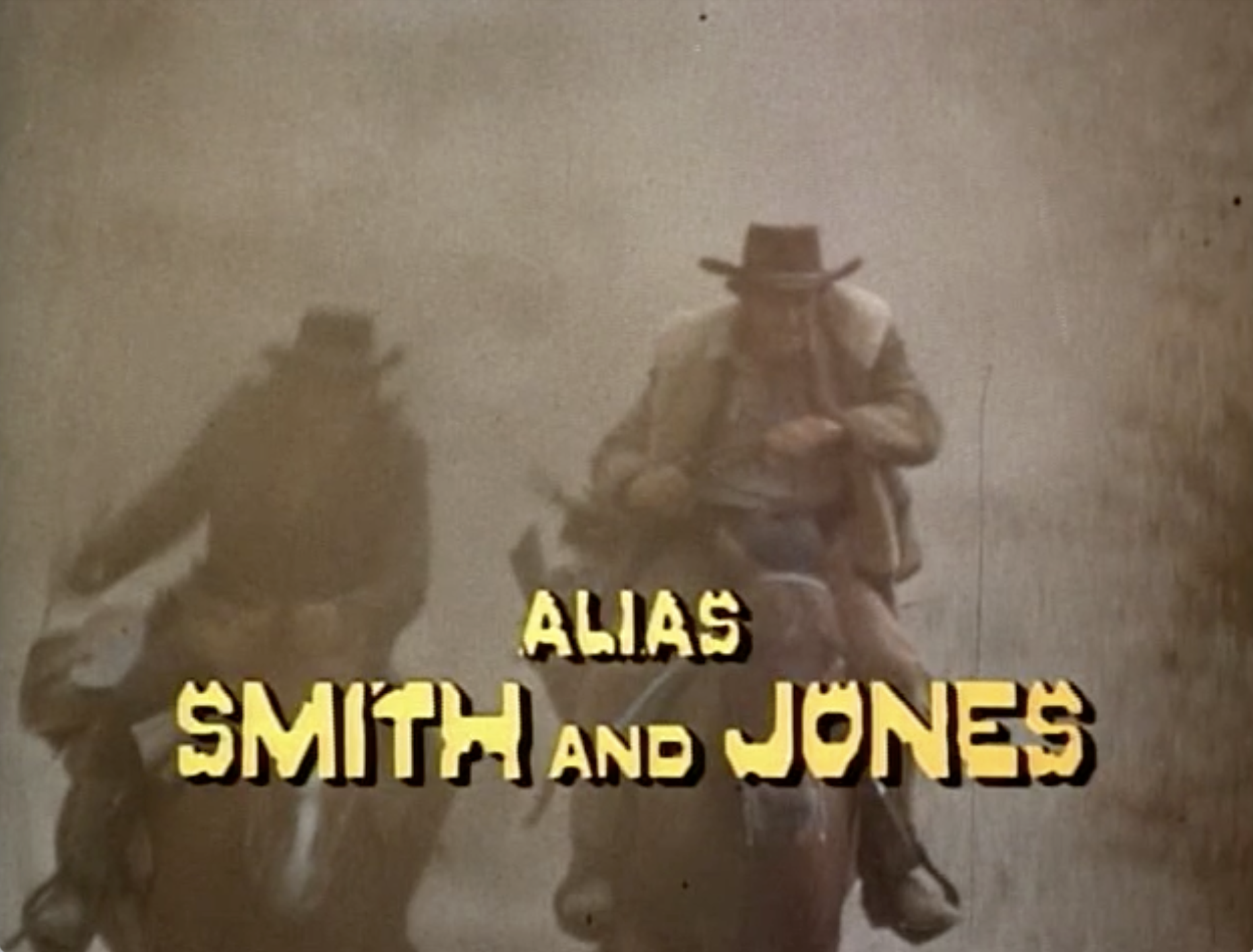
screenshot from the intro for Alias Smith and Jones

One of my favorite TV shows when I was a kid was destroyed by a tragedy I couldn’t understand—that I still have trouble understanding. Early in the morning of December 31st, 1971, a guy named Pete Duel put a gun to his head and shot himself. He was reportedly depressed about his drinking problem.

I don’t even like to think about the darkness that prompted him to take his life and the terrible suffering that inflicted on his family and the people who cared about him. Those are the most important things about this story and the things I have the least to say about.

But its less-important effects were felt far beyond Duel’s range of acquaintanceship. He was one of two leads in a light-hearted western called Alias Smith and Jones, a show I watched religiously. It was a kind of knockoff of Butch Cassidy and the Sundance Kid, but the idea was that these two crooks—instead of going to Bolivia and getting their livers perforated by flying lead—gave up their life of crime and started travelling incognito, in the hopes of getting a pardon from the governor. The setup makes no sense, but I remember liking the show a lot.
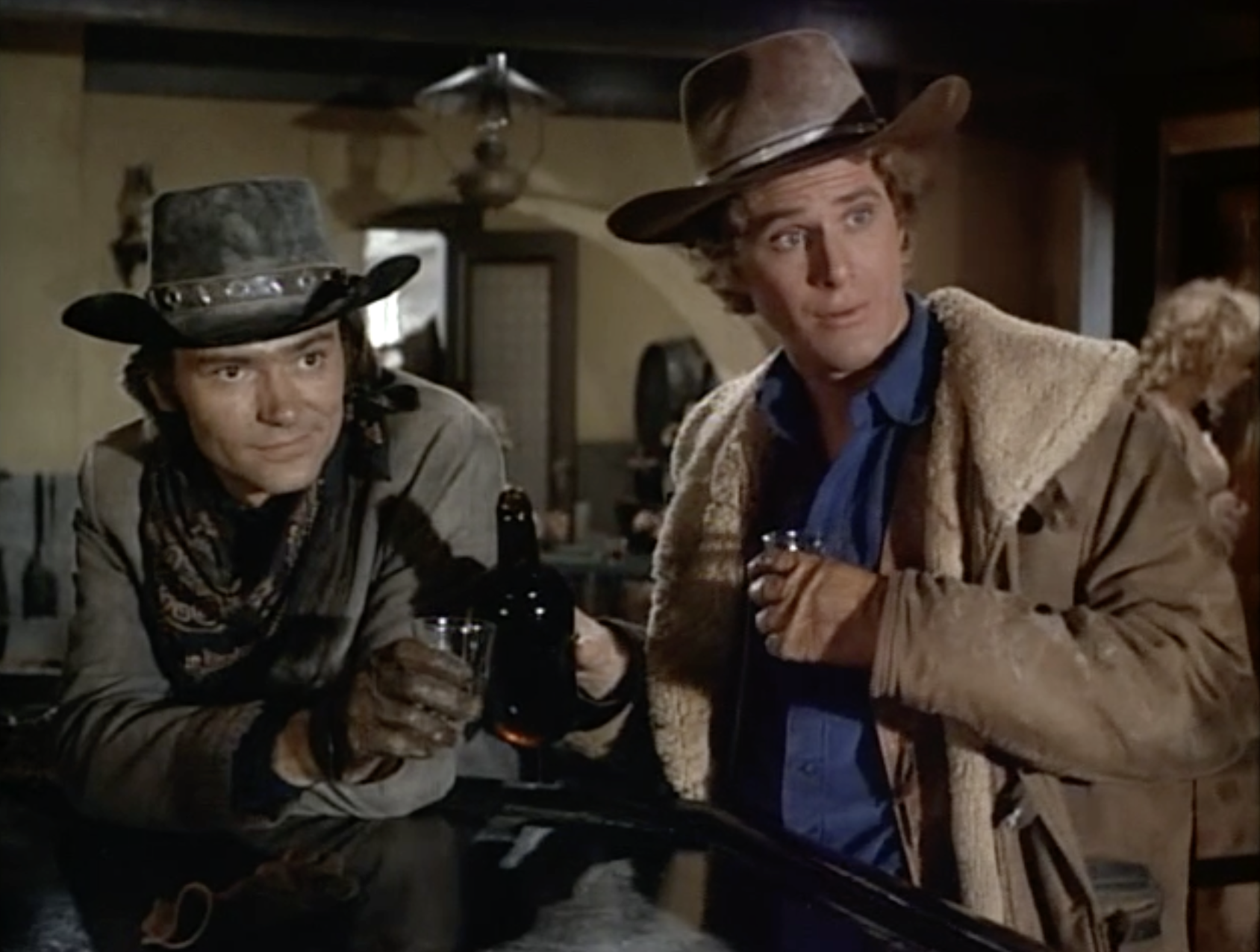
Pete Duel pretending to be Hannibal Heyes pretending to be Joshua Smith
and Ben Murphy pretending to be Jedediah Curry pretending to be Thaddeus Jones.
Jedediah was also known as “Kid”, in case you think there aren’t enough names in this caption.

The showrunner of the series, veteran Jo Swerling jr., assumed that Duel’s death would end the show, but the network, ABC (perennially last in the ratings) said no and they went ahead. Less than 12 hours after Duel’s death, production resumed.

By modern standards this is crazy, and by almost any standard is somewhat evil. But back then, 5 was a magic number. If a show lasted for 5 seasons it could be expected to go into syndication, reaping corporate profits for the indefinite future. (That’s why the Enterprise was originally scheduled for a five-year mission. As it happened, demand for Star Trek led to its syndication anyway, and you know the rest.)

They recast Duel’s role with Roger Davis. He’d been the show’s announcer, played a role in the show’s precursor, The Young Country, and was a veteran TV actor (mostly on Dark Shadows, another show I loved as a kid but rarely got to see because of its afternoon timeslot). Maybe the suits thought it made as much sense as recasting Darrin on Bewitched.
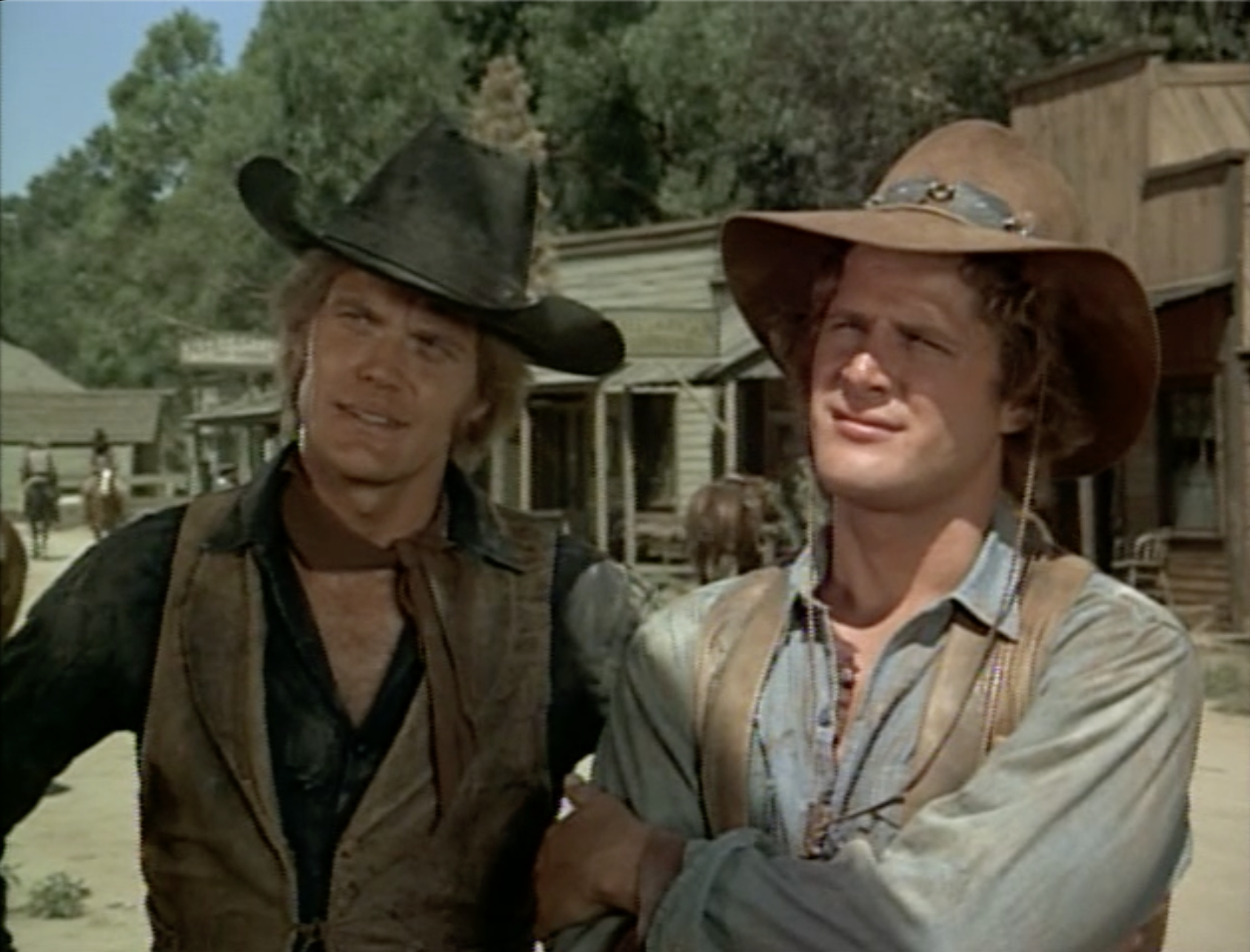
Davis, pretending to be Heyes pretending to be Smith.
Murphy, not even pretending to be convinced.

But the thing is… I hated that recasting, and I don’t think I was the only one. Also, it was more like recasting Samantha in Bewitched. No slam to Davis, a capable character actor, but you can’t replace people like lightbulbs. The ratings fell off a cliff and the show was cancelled.

Why am I approaching this TV graveyard with a shovel in my hand?

Well, nothing gone has to be forgotten anymore; the show was released on DVD some time ago. But also: I recently found out some stuff about the show that renewed my interest. 

The show’s creator is listed as Glen Larson, the veteran producer of stuff like Quincy M.E. and The Fall Guy and a lot of other stuff not on my watch list (although they have their fans and I’m not saying they’re wrong so don’t sealion me). 

But the pilot was a reworked version of a made-for-TV movie (and aspiring pilot episode) called The Young Country, written by Roy Huggins. That pilot didn’t get picked up for series, but Alias Smith and Jones did and, of its 50 episodes, all but four were written by Huggins or based on a story by him (under his “nom de nym or pseudoplume” of John Thomas James).

That’s “the bulk of the series,” as noted critic and bowler Walter Sobchak might say. Other episodes were written by hacks like Howard Browne (who wrote the half-brilliant mystery novel Thin Air, whose brilliant half was turned into a memorable episode of The Rockford Files), Stephen Kandel (creator of Harry Mudd), and Gene Roddenberry, because #EverythingIsStarTrek. 

But who is this Huggins, this writer dishonest enough to hide behind the false whiskers of a pseudonym?

He was a man like other men. Provided, of course, the other men were veteran writers of mysteries and westerns, the creators of television classics like 77 Sunset Strip (snap!snap!), Maverick, The Fugitive, and The Rockford Files.
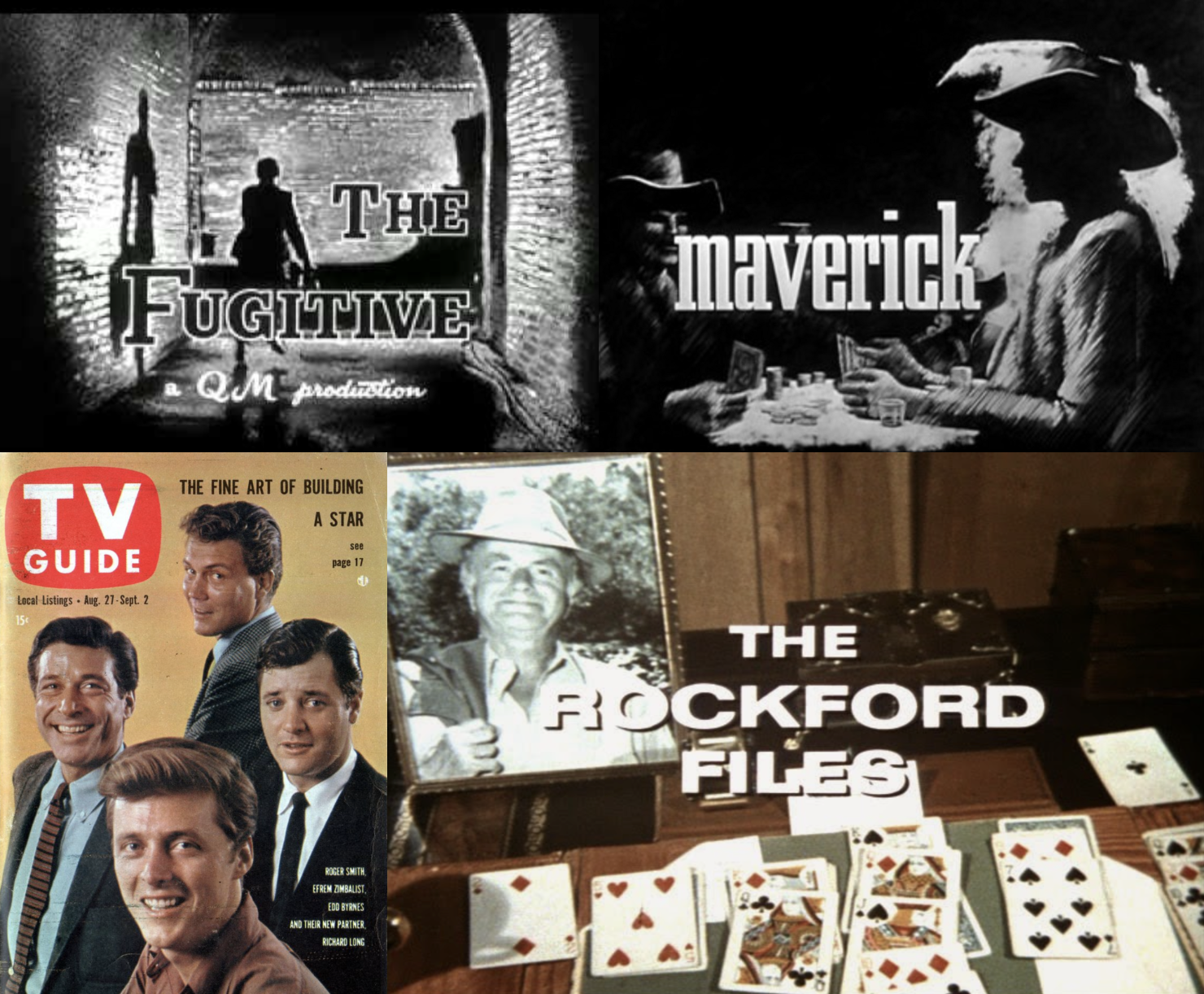
When I found that out Huggins was the motive force behind Alias Smith and Jones, I knew that I’d have to give the show another look, and I’ve started doing that.

So I watched the pilot, and it almost killed my interest in the series. It was dull, badly paced, not serious and yet not funny: 74 minutes of white bread waiting to be smeared with the precious condiment of commercials. It was the kind of thing we used to sit through in those days because we were too lazy to get up, walk over to the TV, and turn the thing off. It was not good.

But that was the script written by Glen Larson and another guy who used his WGA-authorized pseudonym to keep his real name from appearing on the screen. I figured I’d try a couple episodes from the regular run before giving up.

The first two were delightfully non-terrible, so I decided to go ahead and watch the rest of the series, at least until I get bored. I’ll report my findings here so that you can review them when you need something to help you get to sleep.

Posted in Alias Smith and Jones, review or meta-review, television | Comments Off on Alias That Guy and That Other Guy

Escape from the Twitterati

a parody of the Twitter bluebird logo
What’s the past tense of “tweet”?

The Muskification of Twitter has gotten me thinking about social media platforms and how they come and go. I’ve signed up for some new ones, and will update my bio when I’m sure which ones I’ll be actually using.

Still, I’ve been wanting to do the kind of writing I used to do when I had a blog. It amused me and the 12-15 people who read it, anyway.

No sooner had I muttered to myself, “I wish I had a blog,” than I muttered back, “You still do, you yutz. You just haven’t updated it in a while.”

So here I am updating it, with more to come.

Posted in Chaos, Twitter, Uncategorized | Comments Off on Escape from the Twitterati

The Ygg and I

Today I’m thinking about Weird water and eggs.

Snorri says that the first root of Yggdrasil comes down in Ásgarð and that next to it is the Pool of Weird. The Norns come out to it each day and splash some of its holy water onto Yggdrasil to keep it from rotting—a perennial danger for the sacred ash tree, so Snorri tells us.

Three hooded women at the vase of an enormous tree. One is measuring out thread; another is getting ready to cut some thread with a pair of shears; the third is pouring a white fluid onto one of the roots of the tree.
The Norns at the foot of Yggdrasil
by Johan Egerkrans

How holy is that water?

En þat vatn er svá heilagt at allir hlutir þeir sem þar koma í brunninn verða svá hvítir sem hinna sú er skjall heitir, er innan liggr við eggskurn.

—Snorri, Edda: Gylfaginning 16

“And that water is so holy that everything which comes into the fountain becomes as white as the membrane called skjall which lies next to the eggshell.”

I translated hvítir as “white” above, because everyone does, and the dictionaries say that’s right, and the Norse word is cognate with English white, but I still think it’s wrong here. If you’ve ever managed to pluck part of the shell off an egg without breaking the membrane beneath, you’ve opened up a cloudy kind of window into the egg. And skjall is also used of a membrane stretched over a frame to create a window. So “translucent” might be a better way to translate hvítir here.

A pool that makes stuff become translucent or transparent: that’s an intriguing idea. I’m going to steal it for a story at the next opportunity and I urge everyone else to do so.

Screencap of a TV commercial from 1993. A woman's thumb and forefinger holds up an egg. Printed over it is the American Egg Board's slogan "The Incredible Edible Egg".

My eye was also caught by eggskurn. The egg part is “egg”, of course, but I was interested to learn that this was loaned into English from Old Norse, the English forms (ǣg > ey/ay) being displaced by the Norse one in the Middle English period, maybe because the ME forms are too easily confused with other words, e.g. aye or eye.

“Give me an ay, eh?”

“Aye, sir!”

“No, the round kind of ey.”

“You want me to rip out my eye?”

It would take forever to cook something with this kind of backchat going on.

The skurn part means “shell” and it’s akin to the Old Norse word skera “to cut”. The English word shell goes back to the same PIE root *skel– “cut”. The same sharp root also yields scale, shale, shoal, skoal (from a kind of drinking bowl), shield, scalp, skill (another ON borrowing, I guess referring originally to someone’s ability to separate issues or things), school (a division), cutlass, and shelf (a split piece of wood).

The Latin word for school, ludus, means “play”. The English word is a military term referring to the division of an army. Etymology is not destiny, but I wonder if this is one reason early education in the English-speaking world is often so dull and regimented. (I’m not knocking teachers. But the system needs to be knocked around a little; kudos to those who are doing that.)

[originally posted over on Facebook, but ported over here now that Faceplace is increasingly a den of iniquity and fascism]

Posted in art, fantasy art, language, Myth & Legend, words | Tagged , | Comments Off on The Ygg and I

Good for the Gander?

Apparently the gands that appear in Gandalf and in Jǫrmungandr (the name of the world-girdling serpent in Norse myth) are really the same root. Cleasby and Vigfusson say “the exact sense of this word is somewhat dubious; it is mostly used in poetry and in compounds, and denotes ‘anything enchanted’ or ‘an object used by sorcerers’, almost like zauber in German, and hence ‘a monster, fiend’.”

Thinking of Gandalf as “Fiend-elf” certainly lends a new dimension to his character. I never associated him with Midgarð’s Serpent, either, but I think maybe Tolkien did. You’ll remember Gandalf’s description of the Balrog after they’d fallen into the deep water: “His fire was quenched, but now he was a thing of slime, stronger than a strangling snake.”

Gandalf and the Balrog are originally from the same class of supernatural being (the Maiar), so that’s another link in the monstery chain.

[images: GANDALF & BILBO by Tim Kirk; THOR, HYMIR, & JORMUNGANDR by Inga Torfadottir; THE WORM OUROBOROS by Keith Henderson]

[Originally posted on Facebook, but ported here, since the Facebots are turning more and more toward eeeeeeeeeeevil.]

Posted in art, books, fantasy, fantasy art, language, Myth & Legend, words | Comments Off on Good for the Gander?

Lang Story Short: Lang’s WHILE THE CITY SLEEPS (1956)

The movie I watched tonight while mostly avoiding exercise was Fritz Lang’s While the City Sleeps (1956), a melodrama about newspapermen, and the women who sort love them sometimes, during the hunt for a serial killer. I was hoping for a shot of noir-dark espresso, but it turned out to be a thin brew overfull of non-dairy whitener and too much sugar—not bad, but mostly pretty weak stuff for the guy who made M (1931).

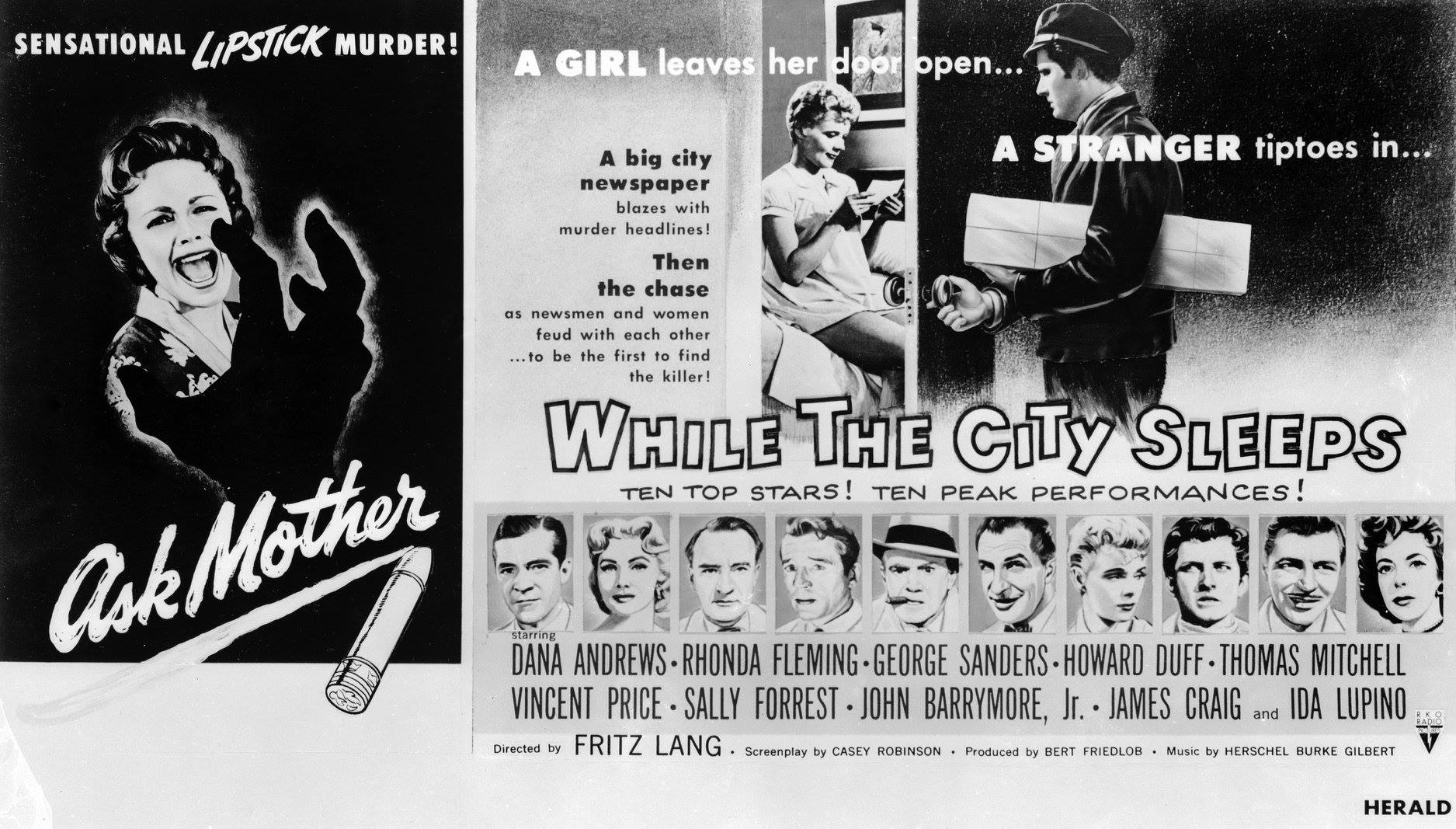
A newspaper ad for the movie. Left: a woman screams as the silhouette of a hand reaches for her. Text above her reads "Sensational LIPSTICK murder!" Below her, written in cursive is the sentence "Ask Mother" which is underlined by a drawing of lipstick. 

Right: a photo of a woman lightly dressed is standing, reading a letter, behind an opening door. In front of the door, with his hand on the doorknob, is a guy in a messenger's costume. 

Text on the image: "A GIRL leaves her door open... A STRANGER tiptoes in..."

Text left of the image: A BIG CITY NEWSPAPER blazes wth murder Headlines! THEN THE CHASE  as newsmen and woman <sic> feud with each other... to be the first to find the killer!"

Text below the image: the movie title. Beneath that: "Ten Top Stars! Ten Peak Performances!" And below that the names and photoes of the major cast members. At the bottom: behind-the-camera credits.

Dana (Daner) Andrews played the unlikeable-but-not-in-an-interesting-way lead, a drunk and lazy columnist/TV personality that somehow everyone thinks is a big deal. Vincent Price has an interesting turn as the effete, cuckolded heir of a publishing empire, and good work is done by Ida Lupino as a mercenary and merciless newswriter, George Sanders as the mellifluously treacherous head of a newswire service, and Thomas Michell as the beleaguered but unbowed editor of the New York Sentinel.

The serial-killer storyline verges on something interesting, especially when the oily hero engages in some of the sneaky, criminal behavior that we’ve seen the oily murderer commit. Then the movie backpedals the parallel: the hero is supposed to be very good and clever, whereas the murderer is a “mama’s boy”. (There may be some latent homophobia here; apparently he wears cologne LIKE A COMMON WOMAN OF THE STREETS NOT A REAL MAN.) Also: the murderer reads comic books. (The excited squeaking sound you hear in the background comes from Dr. Fredric Wertham as he fondles himself.)

The movie has another story about the jostling for power in a multimedia empire; it works a little better. And when the soap-operatic elements of that story cross the serial-killer plot, they both become more entertaining (at the price of a little plausibility). The serial killer only attacks single women, but the publisher’s wife has taken an apartment in town where she can engage in assignations with one of her husband’s underlings. Living as a single woman, she catches the killer’s attention… already drawn to that apartment house, because the hero’s fianceé lives across the hall. (You see what I mean about plausibility. The movie’s NYC is much smaller than the real one.)

The parts are greater than the whole, but (all snarking aside) this is a watchable story about newspaper people knifing each other to publish the truth at all costs, which in a way is kind of inspiring.

While the City Sleeps also features Howard Duff as a police detective; you’ll remember he made his screen debut in the Star Trek movie Brute Force (1947). But even I wouldn’t have the impudence to suggest that this movie, too, is a piece of the Star Trek universe.

Just kidding. Of course #EverythingIsSTARTREK

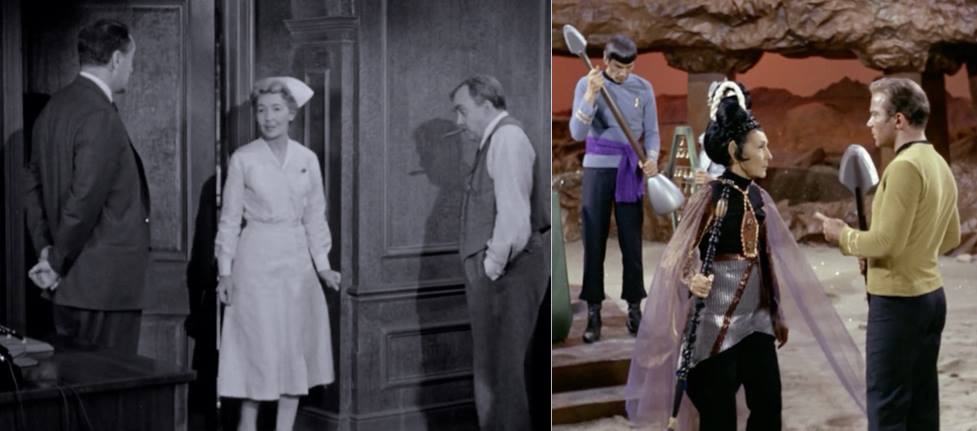
Above left: we see a young(ish) T’Pau officiating the mortal combat between Shere Khan of the Jungle Book and Uncle Billy from It’s a Wonderful Life. I hadn’t been aware that they were Vulcans, subject to the plak tow, the blood fever, but we can’t ignore the evidence of our own eyes. 

In the unrelated photo to the right, Celia Lovsky explains to Leonard Nimoy and William Shatner that they must fight to the death for the love of the Great Bird of the Galaxy.

It may be beating a dead horse or space warp at this point. But the Lipstick Killer was played by “John Barrymore jr” who later rebranded himself as John Drew Barrymore. Under that _nom de guerre_ he later contracted to play Lazarus in what is almost certainly the worst Star Trek episode from any series, “The Alternative Factor”. Barrymore never showed up for work, which some attribute to his well known substance abuse problems, and other people attribute to him having actually read the script. The producers recast the part hastily, and Robert Brown (worthy of a better fate) got to scream Lazurus’ incoherent lines through a fake beard that changed mysteriously in every scene. (The story of this doomed episode is well told by Marc Cushman in volume one of his These Are the Voyages.)

[I originally posted this on Facebook on July 14, 2018, but I’m trying to move my more substantial posts over here, since the Facebots are trying to make that place ever more evil.]

Posted in movie review, review or meta-review, sff, television | Tagged , | Comments Off on Lang Story Short: Lang’s WHILE THE CITY SLEEPS (1956)

Is This Thing On? How About That Other Thing?

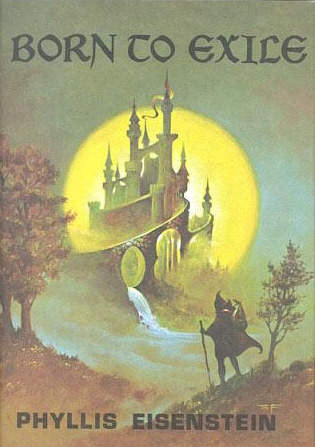
Stephen Fabian's cover for Eisenstein's BORN TO EXILE

Stephen Fabian’s cover for Eisenstein’s BORN TO EXILE

Thing 1: I return to the Blog Gate, writing about Phyllis Eisenstein’s brilliant Born to Exile.

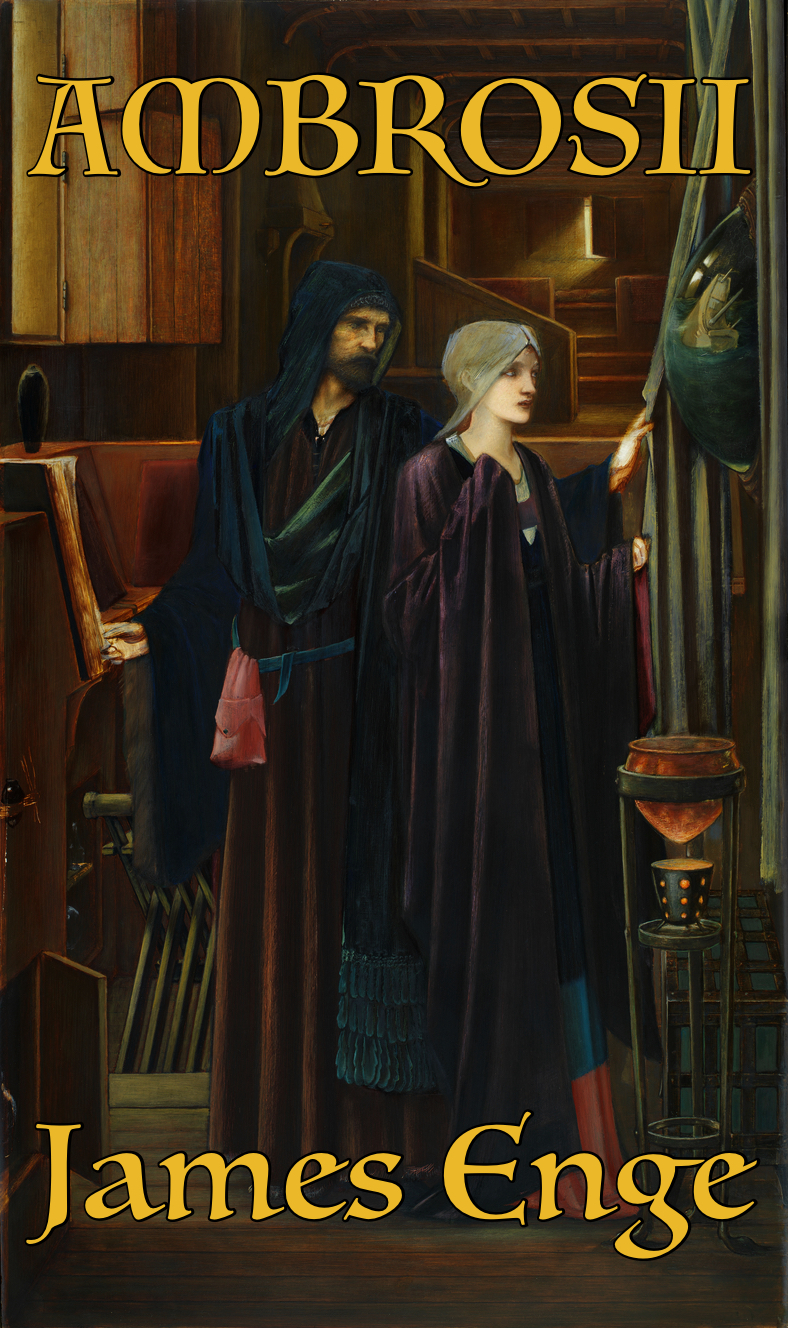
Thing 2: I’ve got a little series of e-books going. The first is Ambrosii, out now from Amazon worldwide. The second one, dubbed Monsters, is slated for release in October. I’m shooting for one of these a month for a while. Each one will be an experiment, in some way, so I’d be interested to hear your comments (at Facebook or Livejournal).Ambrosii.new

Posted in Blog Gate, Crosspost to LJ, Morlock | Comments Off on Is This Thing On? How About That Other Thing?

The Late, Late Show

I was watching TV, and for some reason there was a rather elderly Kim Basinger talking about awkward marriage proposals she’d received in her life. “But the worst,” she said, “was from Maxen Wledig.”

This interested me, as Maxen Wledig is the only Roman Emperor to appear in the Mabinogion, and I had no idea that Kim Basinger had dated him, or, indeed, any of the Roman emperors. I was sure I must have misheard, but when I tried to adjust the volume I woke up.

A young man wearing a headband and a gown or loose shirt sits in a boat at gazes bemusedly at the sea.
The header image for “The Dream of Maxen Wledig”
in Brooke’s Wonder Stories from the Mabinogion (1908)
artist unknown

[I posted this originally at Facebook, but have been porting my posts from there over here, since the Facebots seem increasingly dedicated to evil. I added the image on 7/14/2025.]

Posted in books, dream, Myth & Legend, Roman history, Rome | Tagged | Comments Off on The Late, Late Show

Crosspost Test from WordPress–please ignore

Happy Friday 13. Continue reading

Posted in Uncategorized | Comments Off on Crosspost Test from WordPress–please ignore

Aged in Oaken Heroes: Heroic Fantasy & Imagined History

What is the proper setting for heroic fantasy? Sometimes it seems that the Heroic Age is like the Golden Age of Science Fiction: twelve (according to the now-elderly wisecrack).

Anyway, it is widely agreed that heroic fantasy is set in some age before we learned that “digital watches were a pretty neat idea”, a period frequently described as the Middle Ages.

And this is almost perfectly dumb.

Jump into the dumb!

Posted in Chaos, Crosspost to LJ, Heroic Fiction League, Morlock, werewolves | Comments Off on Aged in Oaken Heroes: Heroic Fantasy & Imagined History

Removable Blast from the Past

In my recent move, I offloaded a bunch of my books to my office. Now I’m unboxing them and clearing off shelves and cleaning up the office.

The following constitutes progress:

Shocking fuzzy images that will shock you fuzzy!

Posted in Chaos, Crosspost to LJ | Comments Off on Removable Blast from the Past