Mountains and Monsters: Leiber’s SWORDS AGAINST WIZARDRY

A couple years ago I set out to review all of Fritz Leiber’s books about Fafhrd and the Gray Mouser—foundational texts for sword-and-sorcery and for my personal imagination. I knocked off the first three (or four, depending on how you count) pretty quickly. (See my review of Swords and Deviltry here, my writeup of Swords Against Death and Two Sought Adventure here, and my misty water-colored memories of Swords in the Mist here.) Then I ground to a halt.
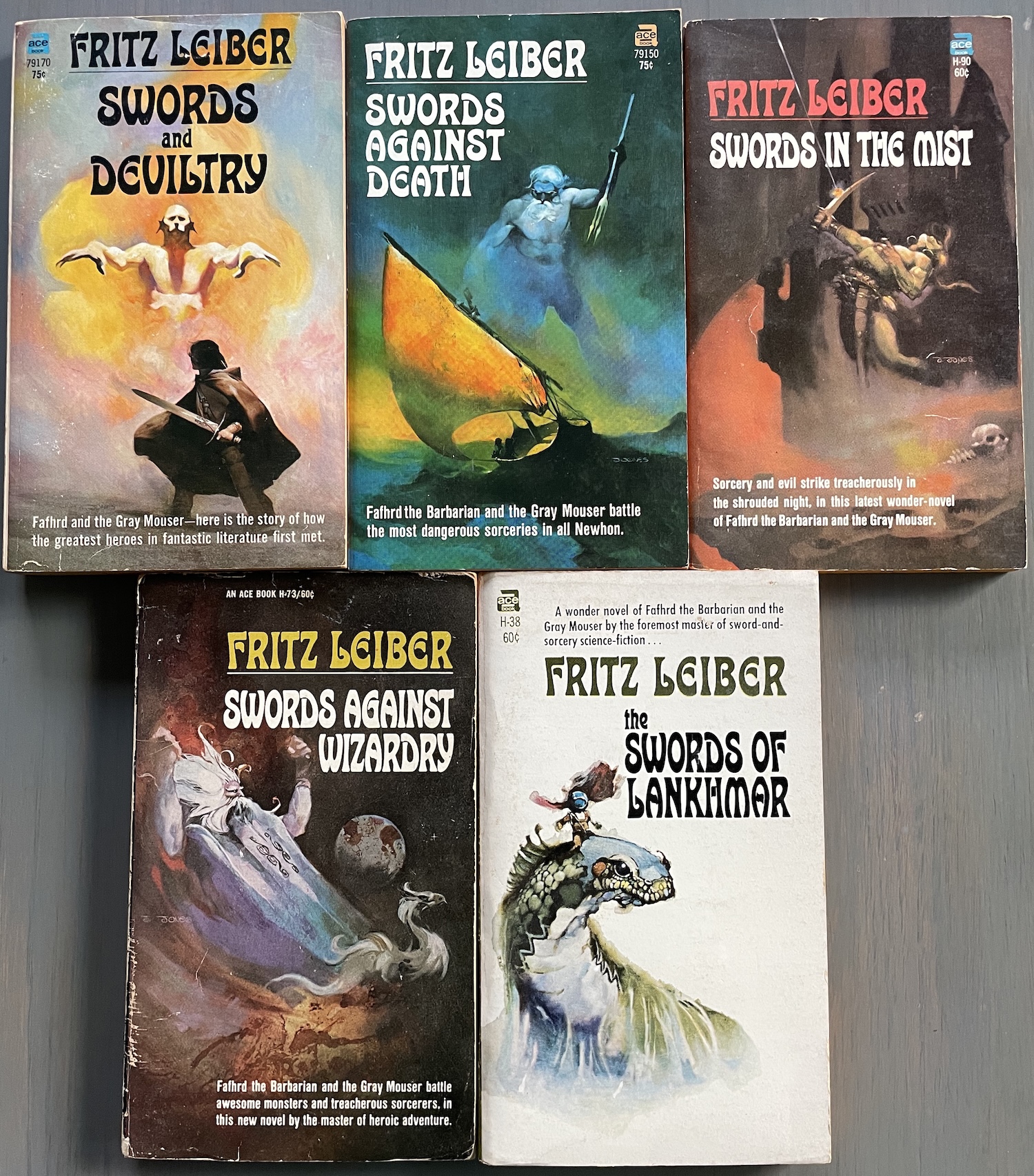
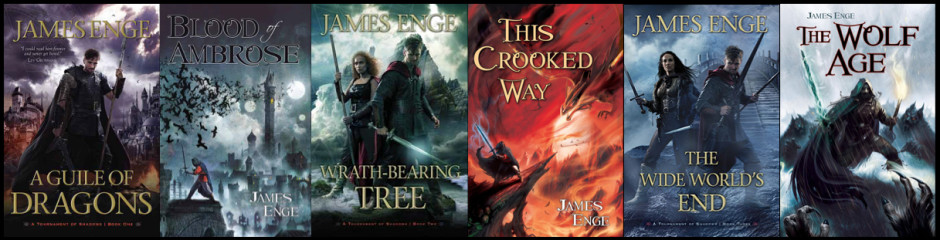
A photo of the Ace editions of Leiber's SWORDS AND DEVILTRY, SWORDS AGAINST DEATH, SWORDS IN THE MIST, SWORDS AGAINST WIZARDRY, and THE SWORDS OF LANKHMAR, cover art by Jeffrey Catherine Jones.

Why? In a single word: Quarmall. “The Lords of Quarmall” is not the least interesting of the stories about Fafhrd and the Gray Mouser, but it is by a fairly long chalk my least favorite, one that I almost always skip in rereading the saga, and it occupies roughly half the space in Swords Against Wizardry, the fourth volume in the Ace series collecting all the stories of the Mighty Twain. (I’m sure there are those that love the story. De gustibus non disputandum.)

But “The merit of an action is in finishing it to the end,” as Genghis Khan remarks, so here goes.

Is this book a novel? I’ve flogged that dead horse enough, possibly, so I’ll just say that the answer is absolutely yes. Or maybe no.

Anyway, the lion’s share of SaW‘s words belong to two unequal-sized novellas, “Stardock” and the aforesaid “Lords of Quarmall”, supplemented by an introductory episode, “In the Witch’s Tent”, and an interlude in Lankhmar, “The Two Best Thieves” in Lankhmar”. We’ll tackle them in the order that God and Leiber intended, but for once there’s no complicated backstory to the—no, of course there is, this being a Leiber book. But don’t worry about it. You’ve seen worse already.

I. “In the Witch’s Tent”

We find the Mighty Twain in the deep north, far out of the Mouser’s comfort zone. They’re in quest of a stash of legendary jewels said to be atop Stardock, the tallest mountain in their world of Nehwon. They stop in Illik-Ving, last and least of the Eight Cities, to consult a witch about their journey. While that’s happening they’re attacked by rivals on their quest, and take an unconventional route to escape.

This is just an episode, acting as an introduction to “Stardock” and written years later than the longer story. (It first appeared in SaW in 1968, whereas “Stardock” was first published in Fantastic three years earlier.)

But I like it a lot. It’s got some great back-and-forth between the heroes; the story, such as it is, moves swiftly, and there’s rich, disturbing detail about the witch and her tent.

Plus, there’s a kind of audiobook. In the 1970s, there was a company named Alternate World Recordings that released LPs of great sf/f readers reading their stories. The best one, in my view, was Ellison’s “Repent Harlequin,” Said the Ticktockman. It’s not only a great story, but Ellison was a professional performer at the height of his powers. I also had, at one time, Theodore Sturgeon’s recording of Bianca’s Hands, and a couple others, among them Leiber’s reading of his mythic fantasy Gonna Roll the Bones. There was some space on the B-side of the LP (ask your grandparents, kids, or your hipster friends), so they added a recording of Leiber reading “In the Witch’s Tent.

Cover of the Alternate Worlds Recording album "Gonna Roll the Bones as read by the author Fritz Leiber".

The cover art by Tom Barber shows a sinister figure with a skull face and a slouch hat. Stars are visible in its shadows. It holds a pair of skull-like dice in its gloved hand.

Leiber had briefly been a professional actor in his even-then-distant youth, but he didn’t stick with it and had lived a pretty hard life of alcohol and drug abuse. His voice is wavery in the recording. But he reads skillfully and with zest. I wish we had more of his voice.

A technical issue about the writing. Le Guin, who was the greatest stylist in American fantasy, wrote a great essay about style in fantasy, “From Elfland to Poughkeepsie”. In it, she took aim at two giants of sword-and-sorcery.

Fritz Leiber and Roger Zelazny have both written in the comic-heroic vein…: they alternate the two styles. When humor is intended the characters talk colloquial American English, or even slang, and at earnest moments they revert to old formal usages. Readers indifferent to language do not mind this, but for others the strain is too great. I am one of these latter. I am jerked back and forth between Elfland and Poughkeepsie; the characters lose coherence in my mind, and I lose confidence in them. It is strange, because both Leiber and Zelazny are skillful and highly imaginative writers, and it is perfectly clear that Leiber, profoundly acquainted with Shakespeare and practiced in a very broad range of techniques, could maintain any tone with eloquence and grace. Sometimes I wonder if these two writers underestimate their own talents, if they lack confidence in themselves.

I think Le Guin’s mistaken here, partly because she may underestimate the power and poetic impact of colloquial American English. Leiber knew exactly what he was doing in exchanges like the one below, and the literature of fantasy would be poorer without them.

“Shh, Mouser, you’ll break her trance.”
“Trance?” … The little man sneered his upper lip and shook his head.
His hands shook a little too, but he hid that. “No, she’s only stoned out of her skull, I’d say,” he commented judiciously. “You shouldn’t have given her so much poppy gum.”
“But that’s the entire intent of trance,” the big man protested. “To lash, stone, and otherwise drive the spirit out of the skull and whip it up mystic mountains, so that from their peaks it can spy out the lands of past and future, and mayhaps other-world.”

The clash of symbols between the Mouser and Fafhrd here is audible and intentional. The Mouser uses “stoned out of her skull” in one way, and Fafhrd understands it in another, investing the trite slang with mystic import. That’s not lack of confidence on the writer’s part; that’s complete understanding of the instrument he’s making music with.

II. “Stardock”

Fafhrd and the Gray Mouser arrive at a range of mountains in the Cold Waste, along with a snow-cat (a kind of lioness of the north) named Hrissa. Their task is to climb Stardock, but if climbing an unclimbable mountain weren’t enough of a challenge, they face human rivals with both weather-magic and werebear servants at their command, not to mention invisible enemies riding invisible flying bird-fish through the snows, and the occasional hotblooded furry snake-monster.
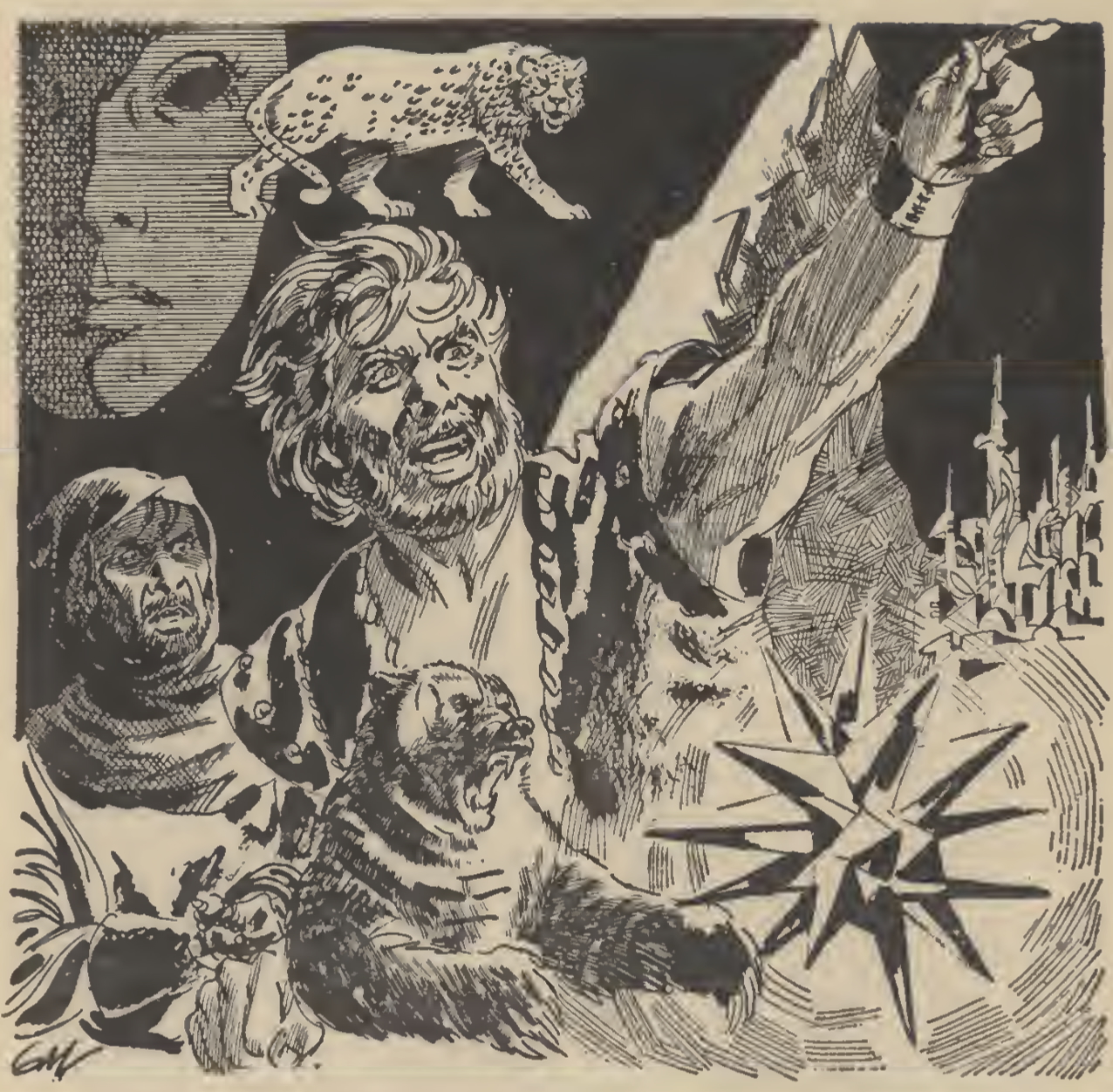
A monochrome image. At the center if Fafhrd, a large barbarian, pointing at something out of frame, while the Gray Mouser looks on in dismay. surrounding them are elements from the story: a roaring bear, the Heart of Light, some Ice Gnomes, the snow cat Hrissa, a masklike woman's face only half visible.
Gray Morrow’s illustration for “Stardock”, from Fantastic (Sept, 1965)

The clues to Stardock’s treasure were scattered around the world by the mountain’s savage yet sorcerous ruler, who’s looking for new seed to infuse into his people’s thinning bloodline. Fafhrd and the Mouser conquer the mountain despite all, sleep with a couple of invisible princesses, escape the more brutal attempts to collect their seed, and make it safely back to the base of the mountain, which is more than their rivals can say.

The ascent of Stardock is one of the great mountain-climbs in fantasy fiction, matched only by Juss and Brandoch Daha’s ascent of Koshtra Pivrarcha in the mighty Worm. It’s harrowing and dense with authentic detail. Leiber mentions in “Fafhrd and Me” how he climbed the occasional rock himself, and he dedicates “Stardock” to Poul Anderson and Paul Turner “those two hardy cragsmen”. No doubt they swapped a few stories.

A must-read for the sword-and-sorcery fan.

a black-and-white outline of a mountain against a somewhat abstract skyscape
decoration by Keith Henderson from Eddison, The Worm Ouroboros (1922)

III. “The Two Best Thieves in Lankhmar”

The Mouser and Fafhrd have fallen out on the long road back to Lankhmar. They split the loot and take different paths to fence their valuable but hard-to-dispose-of jewels from Stardock. Their different paths bring them to the same place at the same time: the intersection of Silver Street with the Street of the Gods in early evening. There the aristocracy of Lankhmar’s thieves are gathered, and the Twain grudgingly admit to each other that they’re the best of the lot.

Or are they? Before the end of the night they’re shorn like sheep and heading out of town by different routes.

This is just a transitional piece, to link “Stardock” with “The Lords of Quarmall”, but it’s nicely done. There’s some nice writing, and some nifty worldbuilding touches for the city of Lankhmar; we get a first mention of Hisvin the merchant, who’ll figure largely in The Swords of Lankhmar, and we see a lot of the thieves of the City of the Black Toga, including one intruder from another world: Alyx the Picklock, heroine of a wonderfully weird set of stories by Joanna Russ. Russ borrowed Fafhrd for her first story about Alyx (“The Adventuress”, a.k.a. “Bluestocking”), and this is Leiber nodding back at her.

IV. “The Lords of Quarmall”
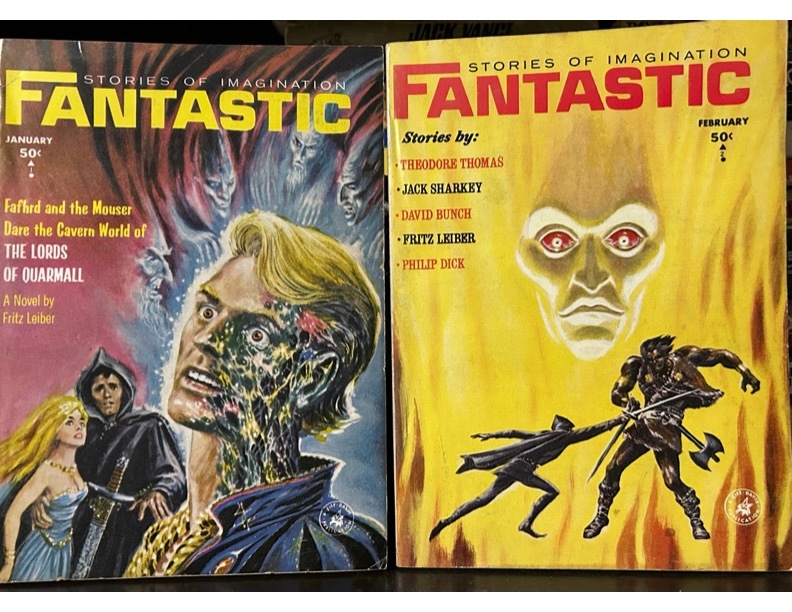
The cover paintings are by Emsh.
Left: The Gray Mouser and Ivivis watching with shock as Gwaay rots from a sorcerous attack; Gwaay is surrounded by sorcerous figures. Right: the Gray Mouser and Fafhrd duel while a sorcerous red-eyed figure looks on.
The covers of Fantastic (January 1964 and February 1964) in which “The Lords of Quarmall” was serialized.

Okay. Here we are. What’s not to like about this novella?

There’s a lot to like about it, that’s for sure. For one thing, it includes the only substantial writing in the saga from Harry Otto Fischer, who invented Fafhrd and the Gray Mouser in correspondence with Fritz Leiber in the 1930s. He’d written about 10,000 words of a story and ground to a halt. With his approval, Leiber took his draft and wrote 20,000 more words, fitting in sections from Fischer as he did so.

In the novella, Fafhrd and the Mouser both find themselves in the subterranean realm of Quarmall as it comes on a crisis of succession in power. The current Lord of Quarmall is about to die, setting up a battle between his two sinister sons: sadistic, twisted Hasjarl and kindly, murderous Gwaay. Unbeknownst to each other, Fafhrd has gone into the employ of Hasjarl and the Mouser has been hired by Gwaay.

One of the two sons has to win the coming battle, and that means that their two bodyguards must come into mortal conflict. Unless there’s some third way for things to go. (Spoilers: there is.)

An interesting setup, certainly, and there are some good things along the way.

However, I find the pacing in this story to be off. For instance, the first 10 pages of the novella are just the Gray Mouser and Fafhrd each being bored in their respective places in Quarmall. Boredom is a difficult subject for fiction: it’s hard to depict it without boring the reader, and there’s seldom any point in doing it. Doubling these scenes by having Fafhrd and the Mouser go through almost exactly the same discontents doesn’t make it more interesting. Boredom in stereo is still boring.

Things start to pick up when the sorcerous stalemate between the two awful brothers breaks down. That’s forty-five pages into the story, but better late than never. In the end, Fafhrd and the Gray Mouser will face each other in battle, like Balin and Balan in Malory’s Morte d’Arthur, but less tragically, while Hasjarl and Gwaay settle their sibling rivalry in the only way that can satisfy them both, and the next Lord of Quarmall reveals himself.

It’d be interesting to figure out which parts of the stories are Fischer’s and which are Leiber’s. I spotted a couple passages I think may have been written by HOF rather than FL. One is the long infodump in the form of a letter sent to Fafhrd from Ningauble. It’s well-written but doesn’t sound like Leiber’s Ningauble; it’s interesting and shows great elements of worldbuilding, but it doesn’t advance the story at all–and in fact is slightly in conflict with it. Another is a scene where a local farmer narrowly escapes being captured by the Quarmallians. Again, it’s well-written and interesting, but doesn’t advance the plot. There are a few other bits that stand out to me. But unless there’s some evidence in the Leiber papers, wherever they are kept, I doubt we’ll ever know about this.

Not a worthless story, anyway; Leiber was incapable of writing something that is not worth reading. But the end of it has Fafhrd and the Mouser racing back to Lankhmar, where a far better tale awaits them in The Swords of Lankhmar.


Posted in art, books, cats, fantasy, fantasy art, review or meta-review, sff, sword-and-sorcery, writing | Tagged , , | 3 Comments

Lured Lucy

D and I watched Lured (1947). It was watchable, maybe even rewatchable. With a script by Leo Rosten (of Joys of Yiddish fame), I expected it to be wittier than it was. But, given that it’s about the hunt for a serial killer, maybe it’s too light-hearted as it is. The mystery was pretty transparent, even though the red herrings in the story kept getting larger and neon-luminous. But the story moved pretty quickly, took some interesting turns, and made sense more often than not.

poster for the movie LURED (1947). Image shows a personal ad torn from a newspaper ("FAMOUS ARTIST seeks beautiful model" etc), a red carnation, and words in a scriptlike font reading "Don't answer this ad... Don't  Don't Don't Don't"

The "Don't"s slide down into a pool of green water with ripple, as if something has just been dropped into it. The top cast and staff (available at the IMDb link) are listed on the poster, along with inset photos of the principal characters.
Screenshot

A very strong cast: Lucille Ball as the lead (as much as a woman is usually allowed to be the lead in a mid-century crime movie) was likable and convincing. George Sanders did his George-Sanders thing which works equally well if he’s a suave hero, a shifty spy, or a man-eating tiger. Borith Karloff chewed holes in the scenery in a wonderfully weird if small role. The secondary cast was full of character actors who appeared as murderers, crooks and third bananas in Universal’s Sherlock Holmes series (e.g. George Zucco, Alan Mowbray, Gerald Hamer).

Ball plays Sandra Carpenter, a taxi-dancer who becomes involved in the hunt for the serial killer after her friend becomes his latest victim. She clues the police into the fact that the killer is contacting his victims via the personals. She’s hired by the police to answer suspicious personal ads and keep the police informed. (I know this would never happen. Please direct all inquiries and comments to Messrs. Sirk & Rosten, who are dead and won’t mind so much.)

The joke, if it’s a joke, is that she’s constantly running into schemes to exploit young women in various ways. Only one of them is a serial killer, but they’re all creeps, and the movie implies that their name is legion. It’s the most realistic note in this not-very-realistic movie.

The murderer turns out to be the guy you knew the producers didn’t hire just to say two lines in three scenes. In the end, he’s caught red-handed. And true love triumphs over all, which is a weird feature of these softer-edged midcentury crime stories.

A painless 100 minutes for me, and a decent nap for D. Not quite up to the level of Sirk’s Thunder on the Hill (1951), which I saw for the first time recently and was deeply impressed by. But good enough to keep working my way through his filmography.

I’m always a little bemused that Lucille Ball didn’t have a bigger career in film. She was beautiful, had an expressive face and voice, projected intelligence, and (I’ll go out on a limb here) she was a gifted comic actress. But maybe that was the problem: comedy was the kids’ table in the studio system, and most of the seats were reserved for men.

Also: #EverythingIsStarTrek. In case you thought I’d forgotten that.

Lucile Ball depicted as a Starfleet captain, Voyager-era.
Artist unknown, but I’m pretty sure this image predates generative-AI boom.
Anyway, she has the right number of fingers.
Posted in movie review, mystery, sff, television | Tagged | Comments Off on Lured Lucy

Endless Glove?

I reread more than I read. This has certain bad effects; e.g., the towering stacks of TBR books that constantly threaten to topple over and crush me, which are always growing taller, more numerous, and (if I’m not misreading their expressions) more angry.

I’d like to say rereading has compensating benefits, e.g. a deeper understanding of the texts I obsessively reread. But often my rereads just make me more confused.

Take Beowulf, a text that would be on my always-reread list even if I didn’t teach it twice a year.

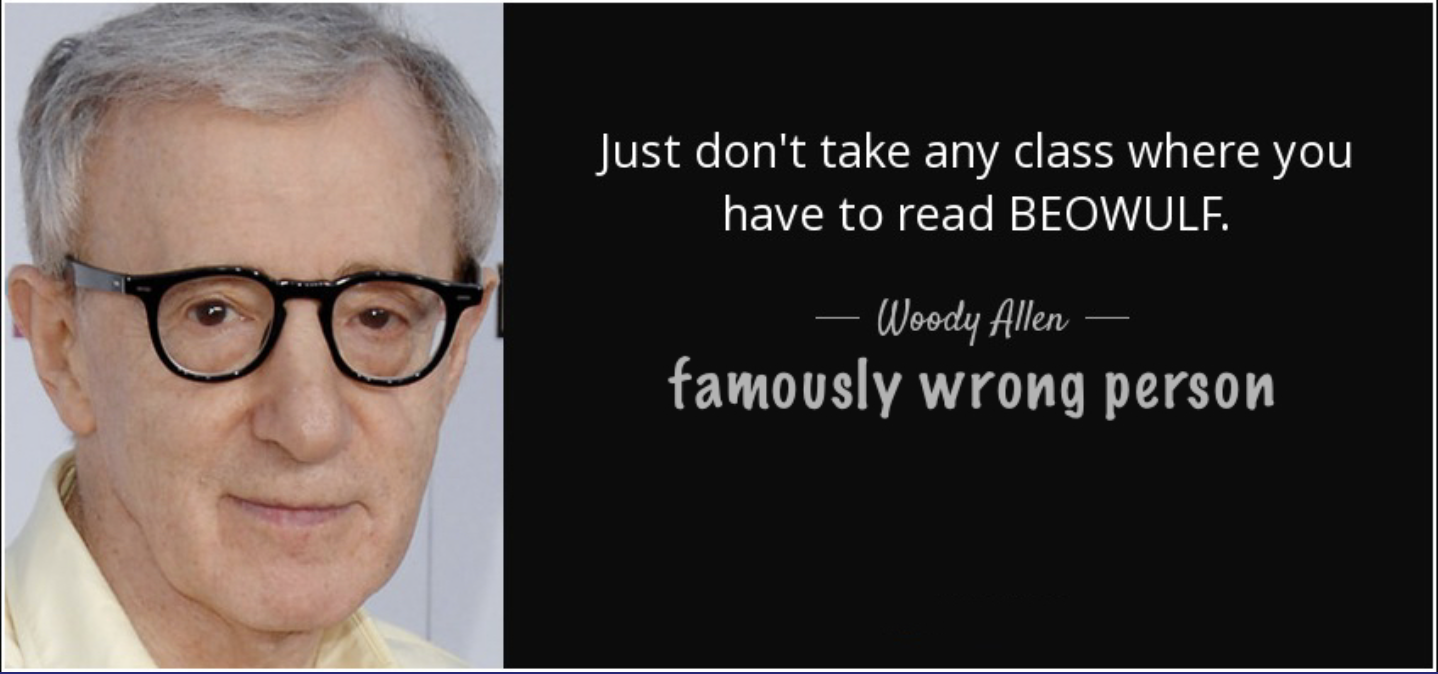
An image of director and creep Woody Allen. Accompanying is a quote from ANNIE HALL: "Just don't take any class where you have to read BEOWULF." The attribution reads "Woody Allen FAMOUSLY WRONG PERSON"
Woody Allen was one of my heroes as a kid, but this line from Annie Hall should’ve been my first warning that there was something wrong with him.

Beowulf is already a hero when he lies down in Heorot, King Hrothgar’s famous mead-hall, to await the arrival of Grendel, the manslaying monster. Beowulf has come with his Geatish pals to Denmark specifically so that he can defeat Grendel. He discusses in advance his plans to engage in hand-to-hand combat with the monster, putting aside weapons and armor.

So: why doesn’t he wait by the door?

Beowulf may want to draw Grendel into the hall, not warn him off from the door. But that doesn’t explain what happens next. I’m not trying to roast Beowulf here, by the way, just trying to wrap my head around the scene.

Grendel bursts in, slamming the door of the hall open. He’s come to kill and eat, as he has so many times before.

Beowulf does nothing.

Grendel goes to one of Beowulf’s band of Geatish warriors, a guy (we will later learn) named Hondsciō (“glove”; compare modern German Handschuh “hand-shoe; glove”).

Beowulf does nothing.

Grendel kills Hondsciō and rips him to pieces.

Beowulf does nothing.

Grendel goes to where Beowulf is lying.

Beowulf does nothing.

Grendel grabs Beowulf, and then the fight is on. It’s WWE Raw Is War.

The (surviving) Geats leap up from where they’re lying and try to attack the monster but their swords have no effect. The Grendelkin seem to be immune to ordinary weapons.

Grendel soon realizes he’s out of his depth and tries to flee, but Beowulf won’t let go. Finally Beowulf rips Grendel’s arm off (hand, arm, shoulder), dealing him a mortal wound. Grendel flees back to his underwater lair to die.

The question that constantly bedevils me when rereading this passage is: why does Beowulf wait so long to start doing what he came there to do?

So far, my answer to this question (spoilers: I cannot really answer this question) comes in multiple parts.

The first part is geographical, and hinges on the design of these medieval Germanic halls like Heorot. They’re long buildings with a peaked roof, and a firepit running down the middle.

A pair of images stacked atop each other. The upper one is a photo of the exterior of the type of hall described in the paragraph above. The lower image is a reconstruction of such a hall's interior.
image above: a reconstructed Viking-era meadhall at Trelleborg in Sweden.
image below: artist’s conception of such a hall’s interior
from Gudmundson, Den islandske Bolig i Fristats-Tiden (1894)

After the feast, the tables etc would be stacked away (or used as beds?) and the henchmen would sleep in the hall by the firepit.

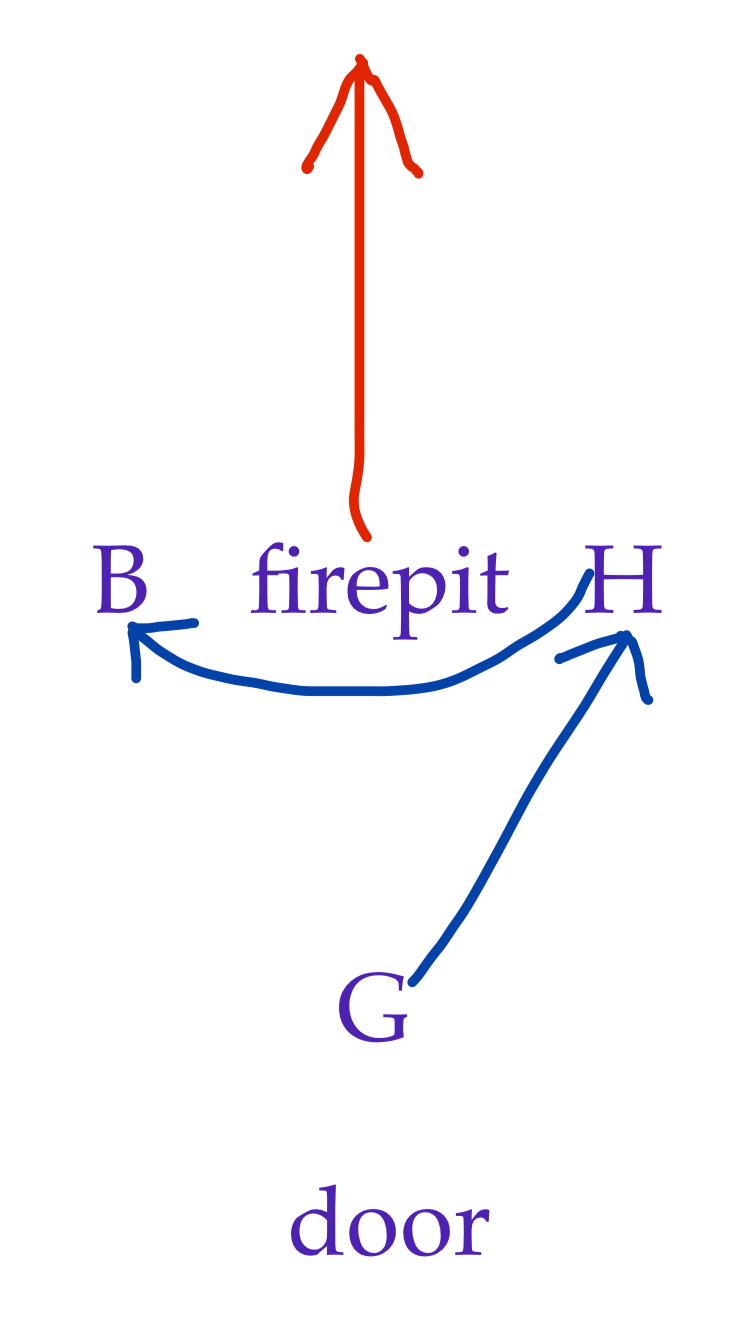
So the Geats come to Heorot, make a big deal about it being occupied again. (Grendel has been attacking it at night for twelve years, and people had given up sleeping there, lest they wake up dead.) The Geats lie down as if to sleep on either side of the firepit. Maybe Hondscio is on one side of the firepit and Beowulf is on the other. Grendel, like Buridan’s donkey, could go in one direction or the other. Unlike Buridan’s donkey, he’s not going to starve to death while making a decision. He launches himself against Hondscio, and then turns to the guy on the other side, who is Beowulf.

A schematic marking Beowulf's position on one side of the firspit with a B, Handscio's on the other side with an H, and using hand-drawn lines to indicate Grendel's movements for the door to Hondscio and
Professionally drawn graphic by a professional graphic-drawing guy.

Okay. But this still doesn’t explain why Beowulf takes so long to act. He’s not asleep and he’s not scared (according to the poet). It’s almost as if this is a turn-based game, like chess, and Beowulf has sacrificed a pawn to put the opposing player in an untenable position. That seems to conflict with the magnanimous nature of the hero as the poet represents him, though.

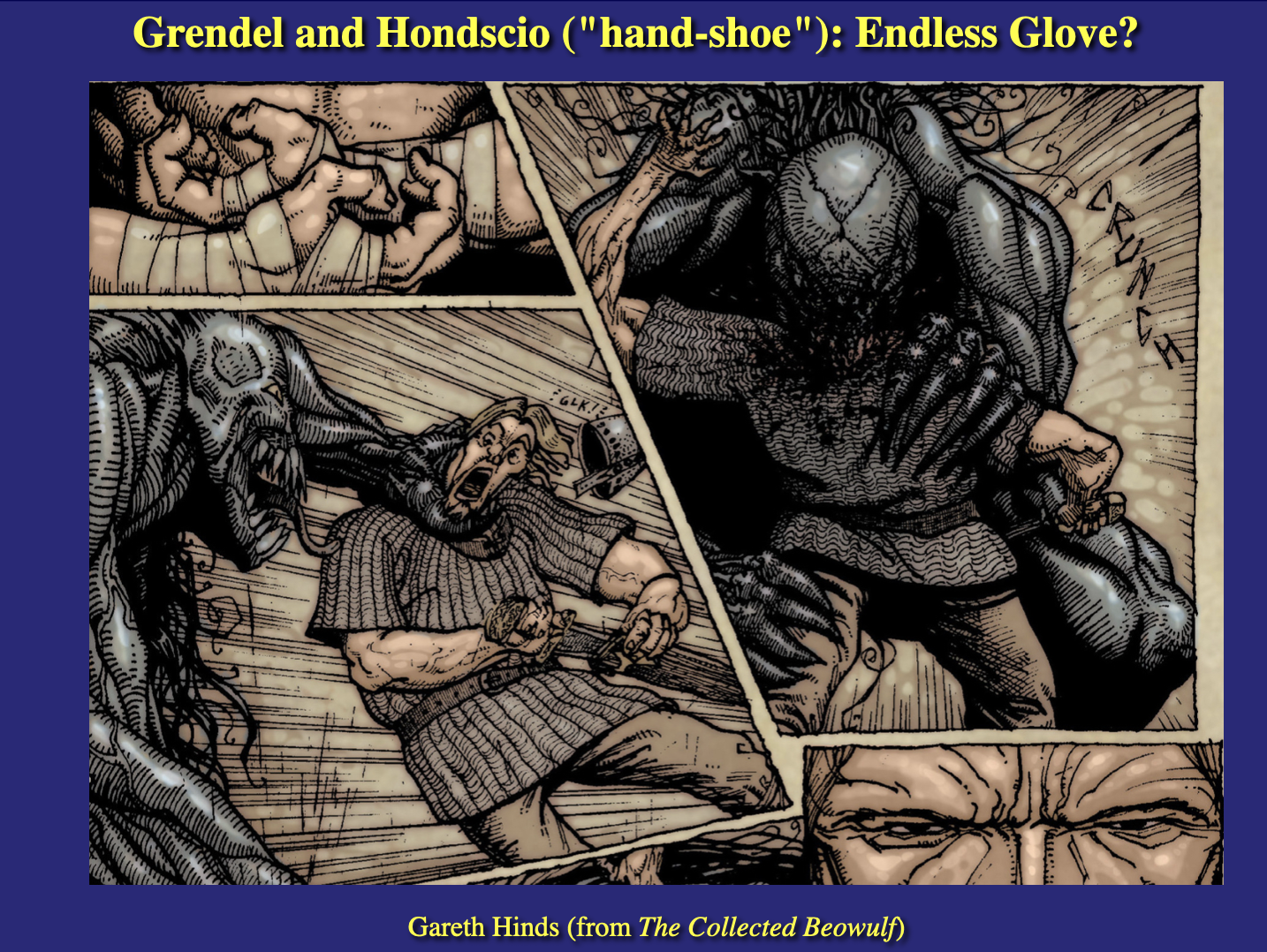
A bookish sort of explanation: Hondsciō’s death is necessary because it prefigures Grendel’s own death. In reparation for the loss of Hondsciō, Grendel loses his hand (along with his arm and shoulder), suffering a fatal wound.

Title of the slide: "Grendel and Hondscio ('hand-shoe'): Endless Glove?

The image is a screencap from Gareth Hinds' THE COLLECTED BEOWULF. One frame shows Beowulf clenching his fists. Two others show Grendel ripping up Hondscio. The fourth shows Beowulf squinting like Clint Eastwood getting mad.
A slide from my Norse myth class.

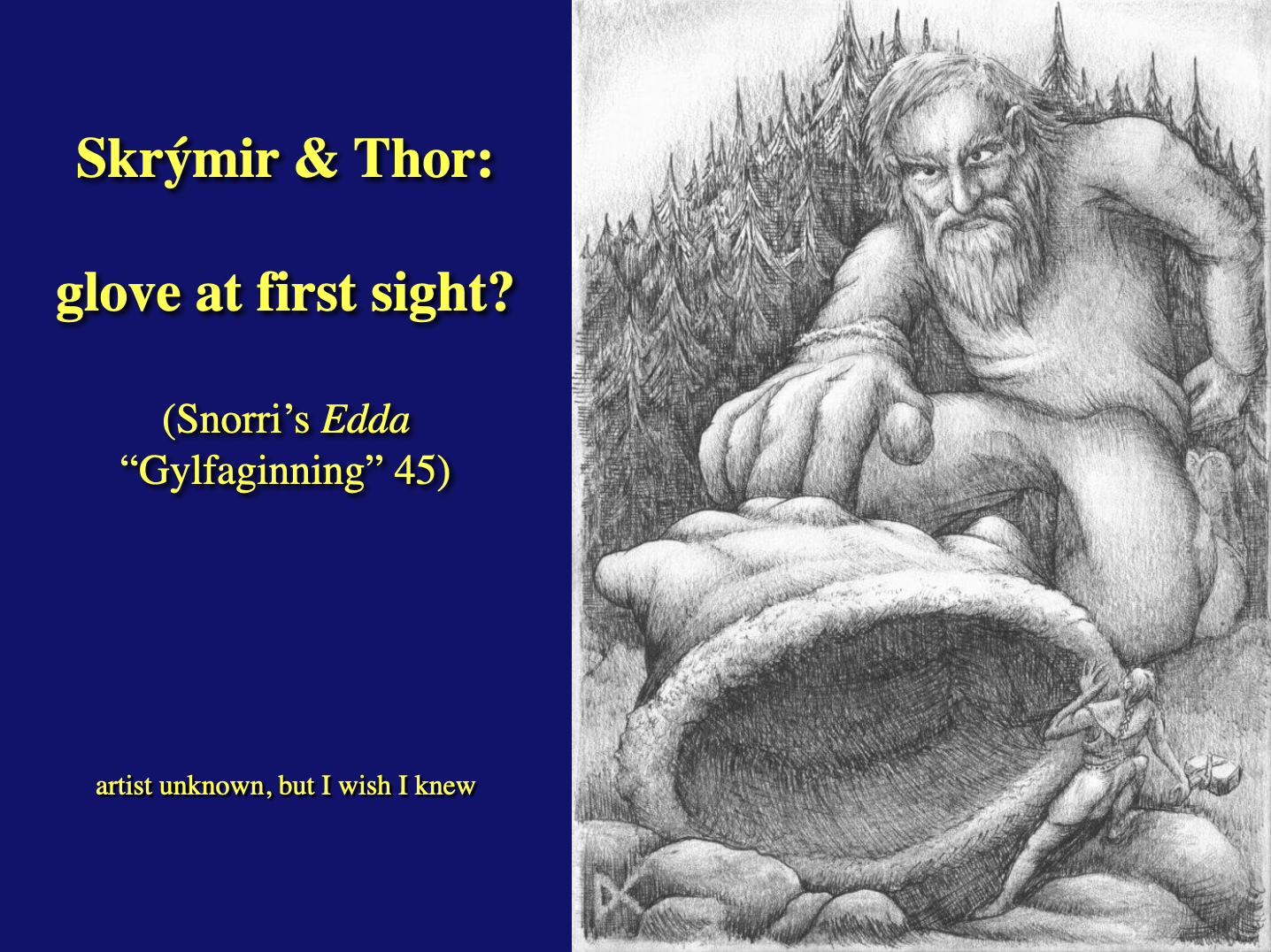
If this seems too academic and tweedy a reading for so savage a poem, I should add that Beowulf himself makes the connection when he’s retelling the tale to his uncle and king, Higelac, back in Geatland (line 2069b-2100). He talks about the hond-rǣs hæleða (“the hand-battle of heroes”) and goes on to describe the death of Hondciō, naming him for the first time in the poem. He mentions for the first time a weird glove (glōf) made of dragon-hide that Grendel had. Beowulf seems to describe Grendel’s habit of putting dead men into the glove. Which is really weird, does not clarify the situation, but does remind me of another mythological situation, where Thor and friends find themselves in a giant’s glove.

The image on the slide shows a guy with a hammer climbing out of a gigantic glove. Reaching for the glove is a guy who seems big enough to wear it.

The text on the slide reads "Skrýmir and Thor: glove at first sight? (Snorri's EDDA "Gylfaginning 45)" and adds "artist unknown, but I wish I knew"

Beowulf concludes this part of his humblebrag by mentioning how Grendel’s right hand (swīðre… hand) remained behind in Heorot.

That line from hand to hand connects a lot of dots in the narrative. And maybe that’s enough. Beowulf describes Hondsciō as fey (“doomed”; fǣgum), and maybe that’s enough.

But maybe it’s not. It still doesn’t give a motivation for Beowulf’s odd stillness until he himself is attacked.

I wonder if the answer isn’t hidden inside Grendel’s identity. The Beowulf-poet famously or infamously grafts the Grendelkin onto the family tree of Adam and Eve, tracing their line of descent from Cain the murderer. But the Beowulf-poet is Christian, and this story probably pre-existed the arrival of Christianity in northwest Europe. So what was the pre-Christian identity of Grendel and his mother?

I think they were the restless dead, a perennial affliction in these Nordic stories. (Think of the Barrow Wights from The Lord of the Rings.) Glám, Grendel’s analogue in Grettir’s Saga (chs. 33-35), is one of the walking dead. And Grendel is repeatedly described as a ghost (ellengǣst “bold ghost”, 86a; se grimma gǣst “the cruel ghost”, 102a; wergan gāstes “accursed ghost” 133a).

But Beowulf kills Grendel. Killing someone who’s already dead seems like a definitional impossibility. But it is something that comes up a lot in these stories, and the answer is frequently some kind of mutilation, a practice known as “arm-pitting” (Greek μασχαλισμός). It’s precisely this kind of thing that Beowulf inflicts on Grendel.

But (not to beat a dead horse or monster here) why does it take Beowulf so long to act?

This is where I came in and this is where I go out, I guess, asking the same question. The only answer I can come up with is personal and has to do with nightmares. I don’t know if you’ve ever been attacked by a ghost or a sinister shadow in a dream. It used to happen to me pretty frequently, back when I was able to get a decent night’s sleep. (Deep sleep is a luxury old people have to learn how to do without. If you wonder why the old people in your life are increasingly crazy, that might be one of the reasons.)

When the ghost is coming for you in the dark, it seems to get the first move. You may see it; you may know it’s coming for you. But you can’t do anything about it. There’s a whole branch of magic in Morlock’s world devoted to stuff you can do in these situations. (See “A Stranger Comes to Town” for some practical applications.)

It may be that in the Ur-myth of Beowulf, he was in that nightmare state, watching the ghost approach and unable to stop it.

That’s not the the answer; as is common in myth and storytelling, there isn’t just one answer. But that’s the best I’ve got from this most recent reread.

A graphic for the band The The.
Posted in academia, art, books, dream, fantasy, fantasy art, language, Morlock, Myth & Legend, sword-and-sorcery, words | Tagged , , | 5 Comments

Pseudoplumes, Nom de Nyms, Birds, & Oooze

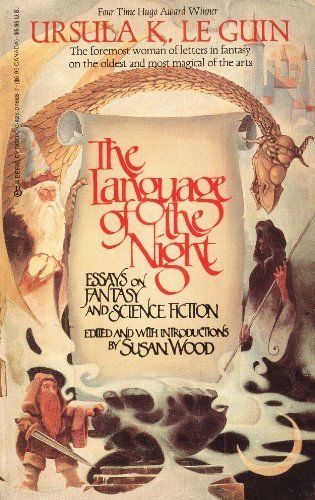
I’m not a big fan of literary criticism in any field (although I have committed some), but one of my big books from my late teens onward was Le Guin’s The Language of the Night (1979), especially for the essays “From Elfland to Poughkeepsie” and “A Citizen of Mondath”.

cover of the 1st edition of "The Language of the Night". The image features a couple of sorcerous figures, a dragon, and a dwarf armed with a sword, a crescent moon, etc.

Le Guin has some great passages in “Citizen” about what she liked to read as a kid, and how she liked it.

We kids read science fiction in the early forties: Thrilling Wonder, and Astounding in that giant format it had for a while, and so on. I liked “Lewis Padgett” best, and looked for his stories, but we looked for the trashiest magazines, mostly, because we liked trash. I recall one story that began “In the beginning was the Bird.” We really dug that bird. And the closing line from another (or the same?)—“Back to the saurian ooze from whence it sprung!” Karl made that into a useful chant: The saurian ooze from which it sprung / Unwept, unhonor’d, and unsung. I wonder how many hack writers who think they are writing down to “naive kids” and “teenagers” realize the kind of pleasure they sometimes give their readers. If they did, they would sink back into the saurian ooze from whence they sprung.

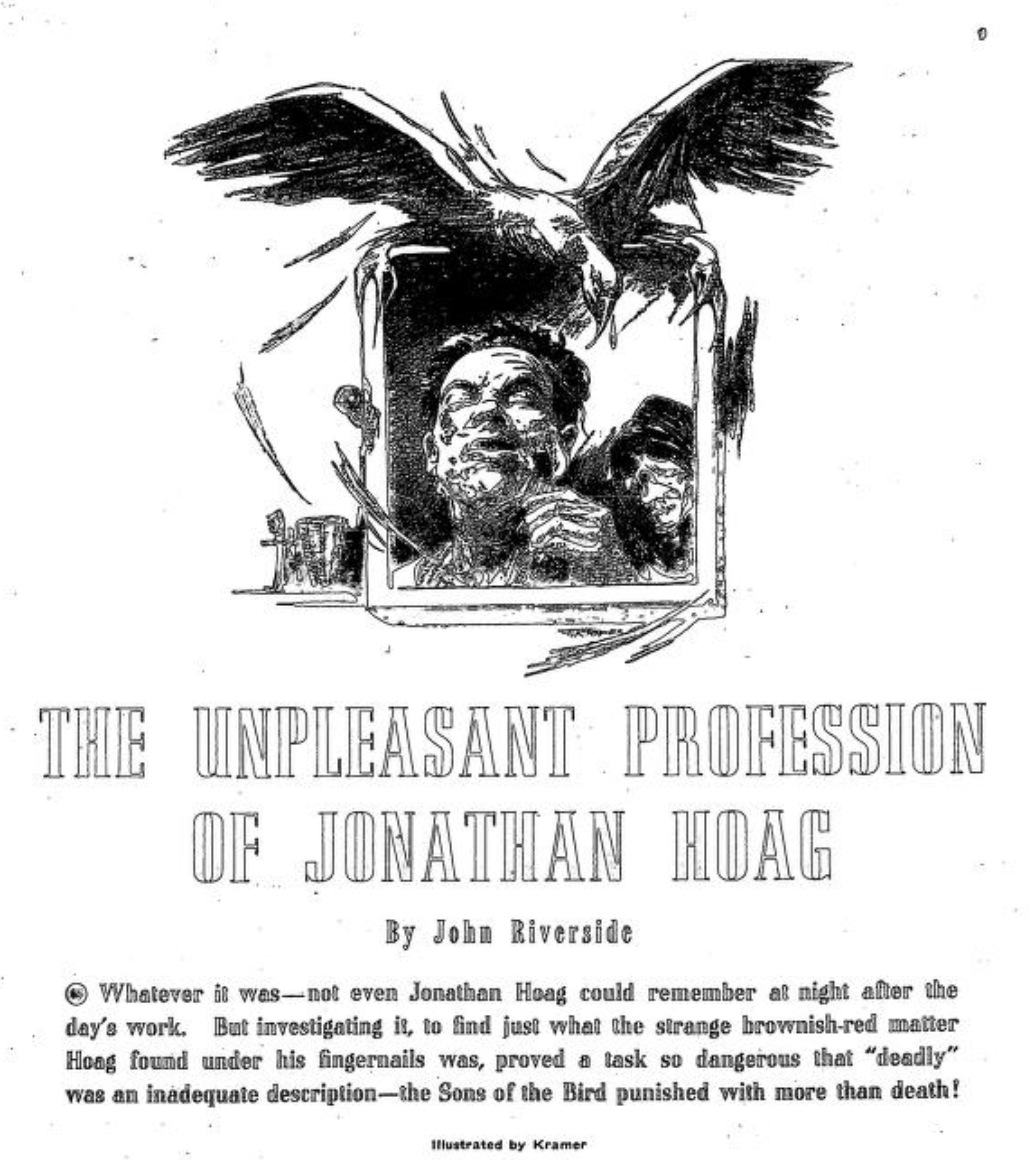
I’m pretty sure the first story she refers to is “The Unpleasant Profession of Jonathan Hoag” by Heinlein in Unknown (Oct 1942). It appeared under the false whiskers of “John Riverside” because at the time the Heinlein byline was reserved by John W. Campbell for RAH’s “future history” stories.

screenshot of a page from UNKNOWN WORLDS (Oct, 1942)

The image by Kramer seems to depict a bird attacking a painting of a guy with a hooded skeleton behind him, but it's kind of hard to tell from the blurriness of the scan

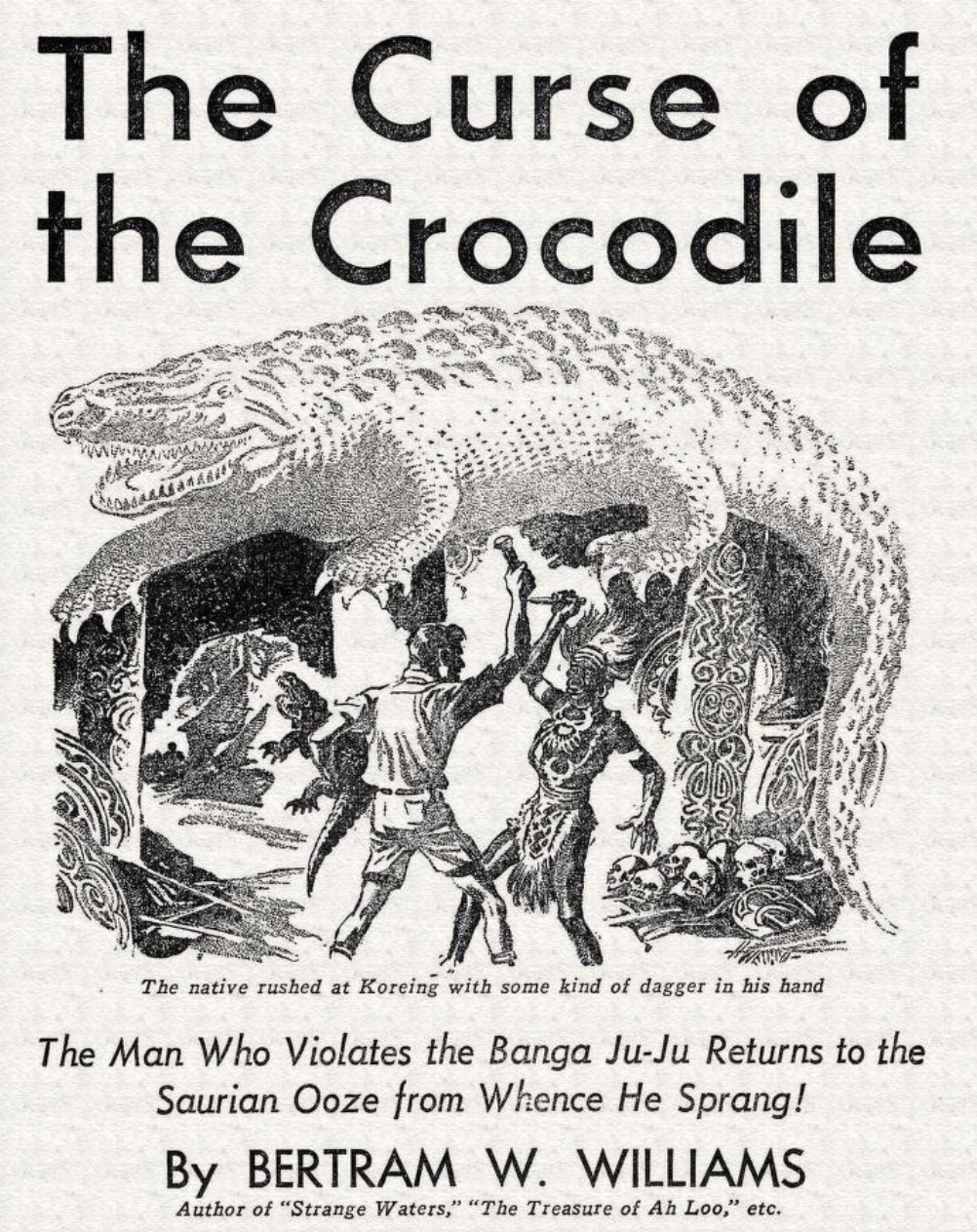
I never figured I’d find the source of the mysterious “saurian ooze”–except that maybe I just did. In looking for Henry Kuttner stories online I found this opus in Strange Tales (Aug, 1939). The appearance is pseudonymous, because he had a “Prince Raynor” novelette in the issue under his own name. And the crucial phrase was from the editorial blurb rather than the story itself.

screenshot of a page from STRANGE STORIES (August, 1939). The art by H.W. Wesso, depicts a white man in khakis with a crocodile under his left arm while raising a flashlight in his right hand to combat a black man in African dress who is wielding a knife. A ghostly crocodile arches over them both. The caption reads "The native rushed at Koreing with some kind of dagger in his hand". The title of the story is "The Curse of the Crocodile" by "Bertram W. Williams, author of "Strange Waters", "the Treasure of Ah Loo' etc." The editorial blurb reads: "The Man Who Violates the Banga Ju-Ju Returns to the Saurian Ooze from Whence He Sprang!"
Screenshot

Kuttner, of course, was roughly half of “Lewis Padgett”, along with C.L. Moore. And most of their work, whatever name it appeared under, seems to have been collaborative from the time they met and married, so Moore may have exuded some of that saurian ooze herself.

Le Guin’s accounts don’t exactly match up with these texts: “In the Beginning was the Bird” is a ritual phrase used by the Sons of the Bird in Heinlein’s story (one of his best fantasies, by the way), but it’s not the opener of the story. And the saurian ooze springs out at the reader at the Kuttner story’s beginning, not its end (and with a shift of ablaut at that). But given that Le Guin was writing about these stories 20-30 years after she’d read them, I’d say the shoes fit the footnotes pretty well.

Posted in academia, art, fantasy, fantasy art, language, review or meta-review, sff, sword-and-sorcery, words, writing | Tagged , , , | Comments Off on Pseudoplumes, Nom de Nyms, Birds, & Oooze

Nerves in a bundle? Fall into a morðcrundel!

I’m rereading Beowulf, preparatory to teaching it in a couple weeks to my Norse Myth class. This kind of thing always involves falling into the dictionary and getting swept away by a tide of weird words.

This afternoon’s discovery is morðcrundel. Morð means “death”; it’s the root of murder and Mordor (a linguistic fact that Asimov used in one of his stories of the Black Widowers), and is cognate with Latin mors, mortis “death”. (It occurs to me that this probably affects the spelling of Mordred’s name in Arthurian legend. The older spelling is Medraut/Modred, but it was changed in the Old French versions, maybe because storytellers associated Mordred with death and destruction—of his uncle-father Arthur in particular.)

Crundel (to my ear) sounds too friendly to be linked up with doomful morð, but Clark Hall & Merrit say it means “ravine”. (None of my dictionaries gave me an etymology for crundel, but I wonder if it’s cognate somehow with ground.) Hence morðcrundel “death-ravine”: the pit under a barrow where the dead are buried.

I expect morðcrundel (the word) and death-ravines (the phenomenon) will appear in my stories in the near future.

I’m reading Beowulf in stereo this time, comparing the Old English original to Heaney’s translation (which is the one I’ve been assigning to my classes for the past few years).

There’s no translation like no translation. Or, as they say in Italian: traduttore, traditore (“translator = traitor”). This kind of passage-by-passage comparison is the kind of reading that is most likely to make one unhappy with almost any translation. Heaney’s translation is clear and eloquent, a good match for the modern reader. They didn’t give this guy the Nobel Prize for nothing.

But in a couple passages he munges the meaning of things that (to my fantasy-oriented mind) are important.

One of the praise-songs about Beowulf in the text of Beowulf is about Sigmund the Dragonslayer. I particularly want to bring this passage to the attention of my students, because we’re also going to be reading the Volsunga Saga and the Eddic poetry about the screwed-up family of the Volsungs (and the screwed-up families they become entangled with). In those better-known versions, it’s Sigurð, son of Sigmund, who kills the dragon.

“Myth is multform” is the ritual incantation I always invoke on these occasions. Myth isn’t history; it’s more like quantum physics, where Schrödinger’s cat is both alive and dead until you open the box. Sigmund both is and is not the slayer or Fafnir, until you begin telling (or reading) a particular story. At that point the storyteller usually (not always) picks a version and sticks with it, a process analogous to wave-form collapse in quantum physics. Audiences of myths have the luxury of enjoying, even insisting on, particular versions (like toxic Star Wars fans). Students of mythology have to be sensitive to multiple versions and beware the temptations to over-historicize a particular rendition of a myth.

Anyway, in the story of Beowulf, it makes sense for the praise-singer to associate Sigmund with Beowulf. Sigmund famously killed a monster; Beowulf has just earned fame by killing a monster (Grendel). And the Beowulf-poet can use this celebration of young Beowulf’s victory to foreshadow old Beowulf’s final battle where he kills and is killed by a dragon. In fact, the Sigmund story might help explain old King Beowulf’s strange behavior toward his last enemy, how he insists on going alone against the dragon (just as Sigmund did) to earn treasure (just as Sigmund did).

I mostly like what Heaney does in his translation, but there was one part of this passage that I wasn’t crazy about.

The Beowulf-poet, describing how Sigmund slew the dragon says this:

hwæþre him gesǣlde, ðæt þæt swurd þurhwōd
wrǣtlīcne wyrm, þæt hit on wealle æstōd,
dryhtlīc īren; draca morðre swealt.

Beowulf 890-892

“Nevertheless it befell him that the sword passed through
the wondrous worm so that it on the wall stood fixed
the illustrious iron; the deadly dragon died.”

Here’s what Heaney does with it.

But it came to pass that his sword plunged
right through those radiant scales
and drove into the wall. The dragon died of it.”

Better than my dry literal version, certainly. But here’s Raffel’s (1963) version.

“Siegmund had gone down to the dragon alone,
Entered the hole where it hid and swung
His sword so savagely that it slit the creature
Through, pierced its flesh and pinned it
To a wall, hung it where his bright blade rested.”

Because Raffel is not binding himself to translate line by line (as Heaney does), his version rocks a little better, I think.

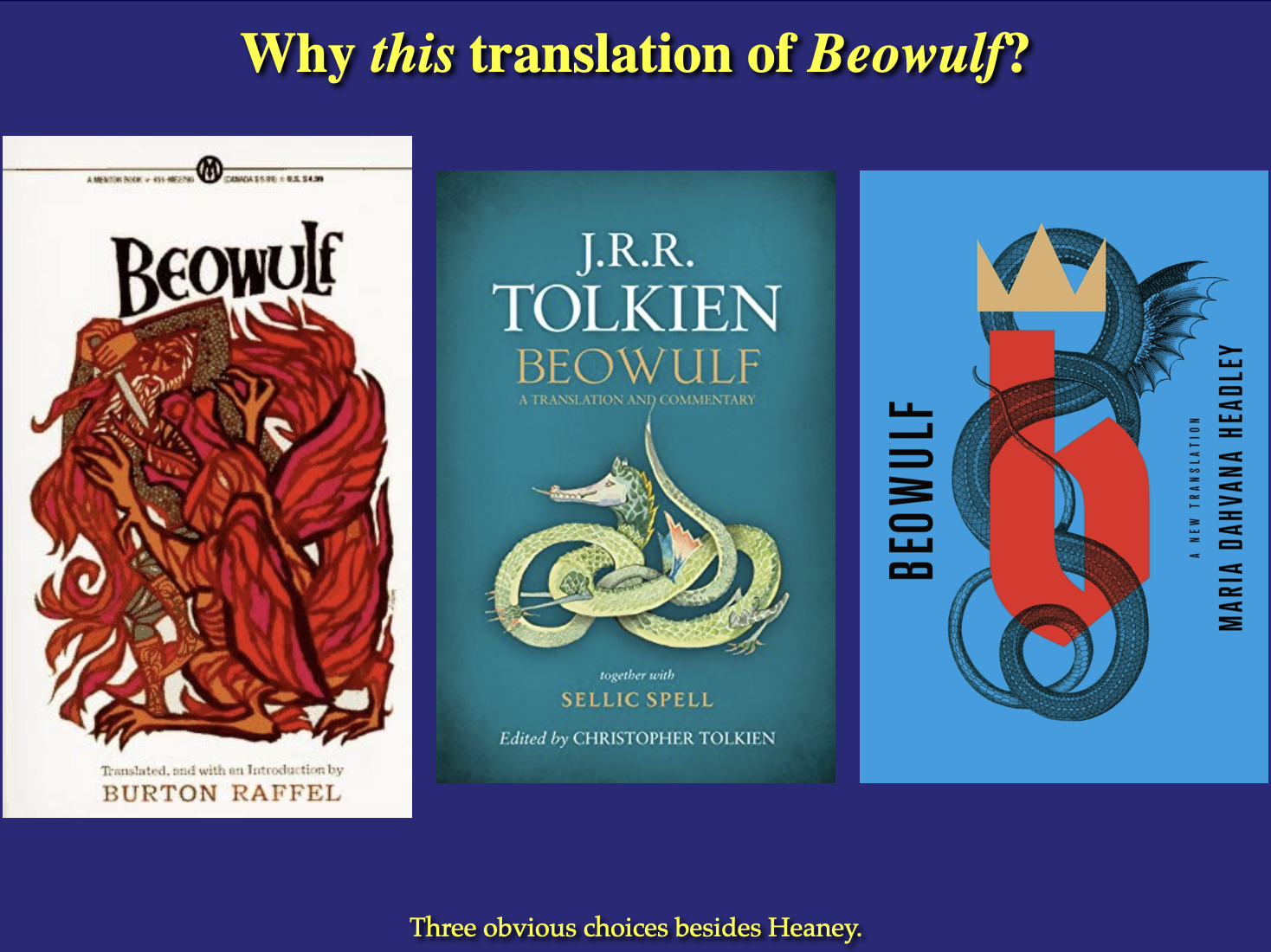
I’ll probably stick with Heaney. It’s still fresh, represents the original pretty well, and has a couple of different editions with distinctive advantages: one accompanied by the Old English text, another illustrated with copious images of the physical culture of northwest Europe in the early Middle Ages–weapons, jewelry, manuscript paintings of monsters, etc.

Still, I always try to keep the alternatives in mind. Myth is multiform, and every translator is a traitor. I can only be faithful to the original if I at least flirt with alternative translations.

A slide for my Norse Myth class, for when I talk about the alternatives to Heaney. The title reads "Why _this_ translation of BEOWULF?"

On the slide are the covers of three different translations: Raffel's version, ullustrated with a glorious Leo-and-Diane Dillon painting of old Beowulf fighting a fiery dragon; Tolkien's translation & commentary, illustrated with Tolkien's painting of the Green Dragon from the inn of the same name; Maria Dahvana Headley's translation, illustrated with a lower-case b, wearing a crown and wrapped around by the coils of a snaky dragon.
Posted in academia, art, books, fantasy, fantasy art, language, Myth & Legend, sword-and-sorcery, words, writing | Tagged , | Comments Off on Nerves in a bundle? Fall into a morðcrundel!

No Maps of Hell

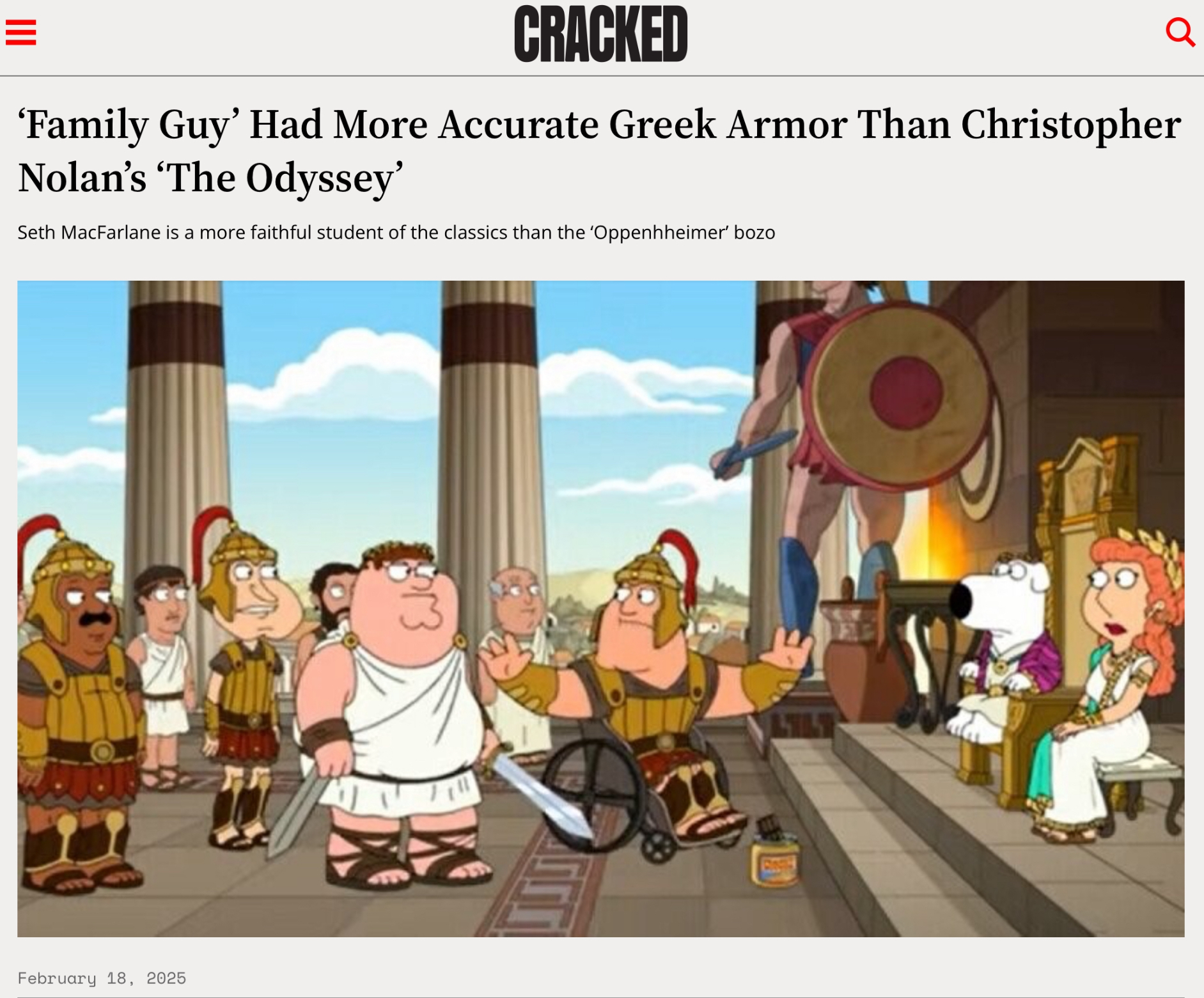
Saw the article below on Bluesky and felt the irritation that almost always accrues when scrolling through social media. But this irritation was really specific. Demanding a historically accurate version of a myth is like trying to find the zip code of Ásgarð. It misconceives the whole enterprise of storytelling. It Must Be Stopped.

screenshot of the Cracked article linked in the caption: “FAMILY GUY had more accurate Greek armor than Christopher Nolan’s THE ODYSSEY.” Image is a scene from FAMILY GUY with the characters in ancient Greek drag.
https://www.cracked.com/article_45570_family-guy-had-more-accurate-greek-armor-than-christopher-nolans-the-odyssey.html

This got me thinking about maps in fantasy novels, because that was one way to avoid useful work.

Maps are really not as necessary for fantasy novels as people sometimes pretend, although I sympathize with readers who want to know how you get from the Lantern Waste to Ettinsmoor, etc. As a rather shifty storyteller, I’d prefer not to be pinned down if I can avoid it. (I always cite Melville on this point: “It is not down on any map. True places never are.”)

But I really resist the modern tendency to make fantasy maps follow modern standards of cartography and geology. That’s like insisting that the Fellowship of the Ring should have taken public transit from Rivendell to Mordor.

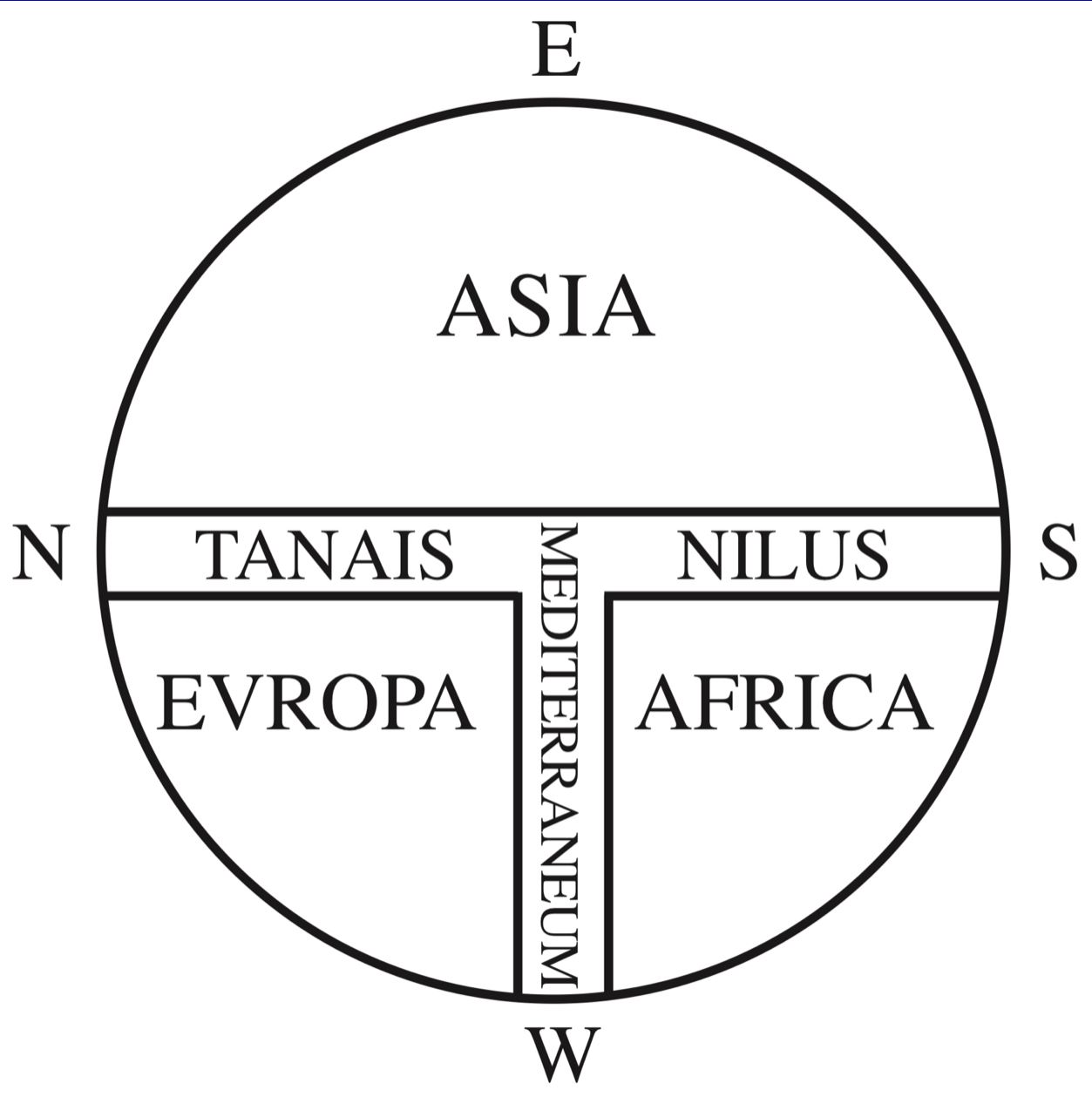
Conventions of maps vary from culture to culture, and they often don’t look familiar to us at all. In this context I often have occasion to think of this medieval model:

The Isidorean (and Snorrian) mappa mundi after an illustration in a manuscript in the Bayerische Staatsbibliotek, Munich.

The image depicts the known world as a circle divided in half by a line of water labelled Tanais (the Don) running from the center northwards, and Nilus (the Nile) running from the center soutwards. The upper (Eastern) half of the map is labelled ASIA. The lower half is divided by a line of water marked MEDITERRANEUM (the Mediterranean). The northwestern corner is labeled EVROPA and the south west quarter is labelled AFRICA.

Or a late-Roman map, the Tabula Peuteringeriana.

Plus, there’s no reason to suppose that a fantasy world was formed along scientific principles. Imposing contemporary standards of geology onto fantasy worlds makes fantasy into a subgenre of science fiction, whereas the reverse is obviously true.

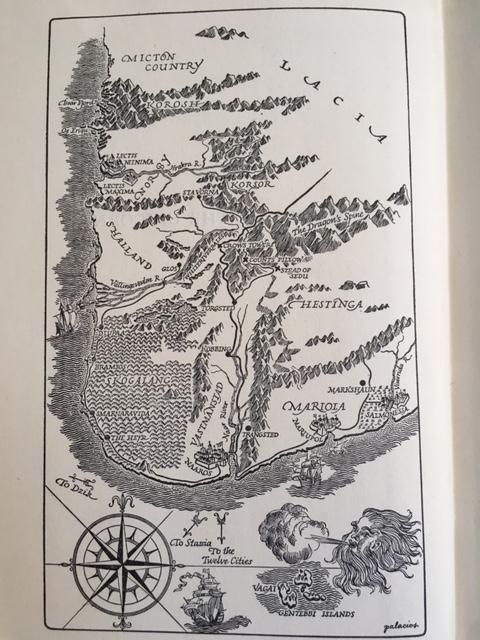
If people want to write a kind of mundane fantasy with low or no magic, that can obviously be done and has been done with great success. Pratt’s The Well of the Unicorn is a celebrated example. (Magic exists in the world of the book, but it reads like a historical novel for an imaginary world.)

scan of a map of the imaginary countries in Pratt's THE WELL OF THE UNICORN. It's decorated with various ships in the watery areas and the disembodied head of a wind god.
Rafael Palacios’ map for Pratt’s The Well of the Unicorn
“Are mountains really distributed like that on a real landscape?
How big are those ships, really?
Are we supposed to believe there’s really a giant disembodied head
blowing up a gale over that sea?”

This isn’t an obligation built into the genre, though. Like everything in an imaginary world, maps, the type of maps, or even the mappability of the world should be a deliberate choice on the part of the worldmaker, not something just thrown in because that’s the way it’s done, or to satisfy specious notions of accuracy.

Let us close with a hymn from the sacred texts.

“What’s the good of Mercator’s North Poles and Equators,
Tropics, Zones, and Meridian Lines?”
So the Bellman would cry: and the crew would reply
“They are merely conventional signs!”
—Lewis Carroll,
The Hunting of the Snark

Posted in academia, ancient art, art, books, fantasy, fantasy art, magic, Morlock, Roman history, Rome, science, sff, social media, sword-and-sorcery, writing | Comments Off on No Maps of Hell

What Are the Óðs?

I was thinking the other day about Hengist and Horsa, the two Saxon chieftains/gangsters who show up to assist and then overpower the usurper Vortigern in the run-up to King Arthur’s origin story. Horsa (Horsus in Geoffrey of Monmouth’s Latin) clearly means “horse” in modern English, but WTF is a hengist? Turns out that also means “horse” (going back to Proto-Germanic *xanxistaz; so says Orel). Horsa doesn’t really do much in the story; Hengist always takes the lead, bringing in Saxon goons and becoming Vortigern’s father-in-law, and in general making V’s life a living hell.

I wonder if “Horsa” didn’t start life as a more-transparent translation of Hengist’s name (“Hengist–i.e. Horse”), and then the name got promoted to full personhood by a storyteller who didn’t know the two words meant effectively the same thing.

Vortigern’s situation with the Saxons reminds me of a “bust out”, where organized crime infiltrates a business and then runs it into the ground (e.g. the Sopranos episode 2.10 “Bust Out”). Fortunately that situation could never happen to the U.S. govt. I guess.

Another thing I found out while horsing around was that English horse is cognate with Latin currere “to run” (going back to PIE *kers- “run”). Which makes sense, since initial k sound in Latin often corresponds to initial h in English (cf English horn and Latin cornu).

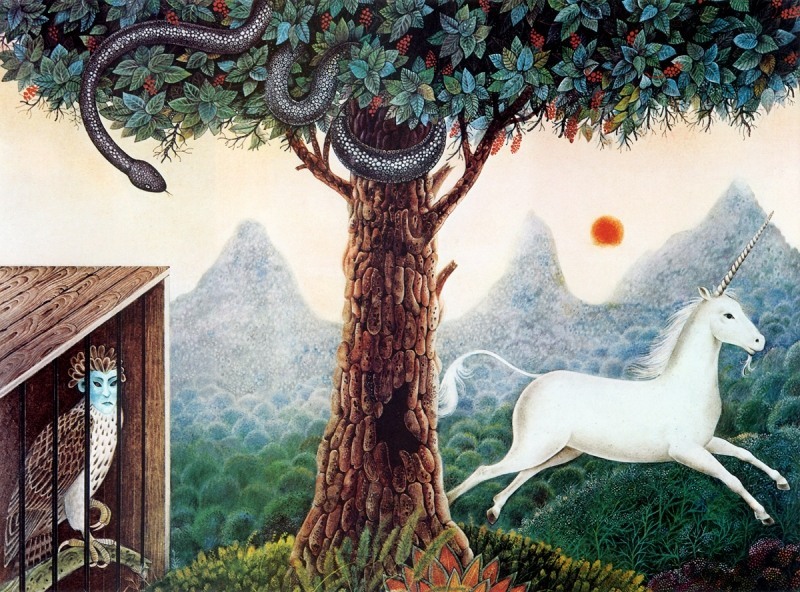
Gervasio Gallado's cover painting for the Ballantine edition of Peter S. Beagle's THE LAST UNICORN. On the right, the titular unicorn; in the center, a tree bearing fruit and a snake; on the left, a blue faced harpy in a cage. "Creatures of Night Brought to Light."
Gervasio Gallado’s cover painting for the Ballantine edition of Peter S. Beagle’s The Last Unicorn.

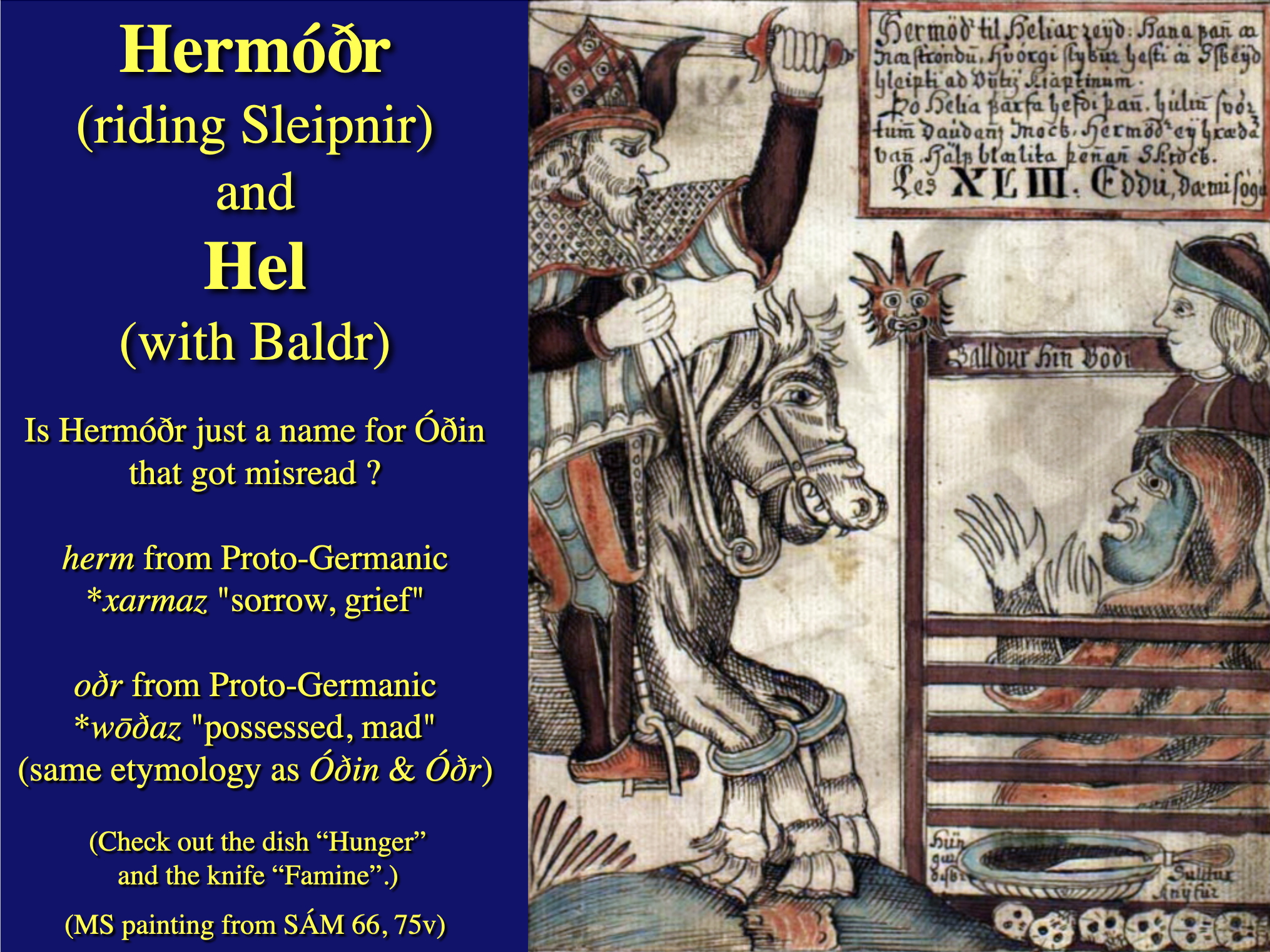
The h/k correspondence got me thinking about Hermóðr, Ódin and Frigg’s son who borrows Sleipnir, his dad’s eight-legged horse. The -óðr is pretty clearly the same root as in Óðin’s name, but what would *kerm- mean in Proto-Germanic or PIE? I looked it up in Orel’s Handbook of Germanic Etymology and it sort of snapped into focus.

Maybe there is no Hermóðr really. Maybe it’s just another name of Óðin that Snorri hypostasized into a son of Óðin. That’s explain why he’s riding Slepnir, among other things.

So my Norse Myth students got a generous side-portion of Germanic philology yesterday.

A slide from my Norse myth class.

Image is Hermóðr on Sleipnir waving a sword outside an inclosure containing Hel and Baldr.

Text reads: Hermóðr
(riding Sleipnir)
and
Hel
(with Baldr)

Is Hermóðr just a name for Óðin that got misread ?

herm from Proto-Germanic *xarmaz "sorrow, grief"

oðr from Proto-Germanic 
*wōðaz "possessed, mad"
(same etymology as Óðin & Óðr)

(Check out the dish “Hunger” 
and the knife “Famine”.)

(MS painting from SÁM 66, 75v)
Screenshot

Posted in art, fantasy, fantasy art, language, magic, Myth & Legend, sff, sword-and-sorcery, words, writing | Comments Off on What Are the Óðs?

Call Him Poul (if you can pronounce it)

A judicious review by Paul Weimer of a great NESFA volume linked below.

I liked this book a lot, but for me the most distinctive feature of this series is the one that I like least: the stories are a mixture of early & late. I’d prefer a chronological ordering, or an ordering by series, or some kind of order. (The ebook only edition of the complete short fiction of Clifford Simak had the same unprinciple, and I didn’t like it there, either.)

On the other hand, you could get hold of all the volumes and use ISFDb to go through them in your preferred order. The “Collected Poul Anderson” volumes are all available pretty cheaply as ebooks from NESFA, so that’s not as flippant a suggestion as it may seem.

https://www.nesfa.org/press/available-books/?ebooks=e

I’ve often wished for a single volume “Best of Poul Anderson” I could hand to or recommend to people. But The old Pocket Book “Best of PA” didn’t really fit the bill; the DAW “BOOK of PA” was a little closer, but was light on fantasy as I recall. And of course they’ve all been out of print forever.

Posted in fantasy, Minnestoics, review or meta-review, sff | Comments Off on Call Him Poul (if you can pronounce it)

Worlds on Worlds Are Rolling Ever…

I realized this weekend that one of the pleasures of inventing a Martian language was coining new names for all the planets. (Including ones that don’t really exist, like Vulcan, Antichthon, and the Lost Planet that was once supposed to be the precursor for the asteroids.)

I think this version of the Solar System will have 12 planets, including Pluto & a trans-Plutonian planet. 12 is a magic number & if I end up wanting to add a 13th or even a 14th planet, that’s still a dozen (cf the baker’s dozen, the “12” Olympians, tribes of Israel, apostles, Labors of Herc, etc).

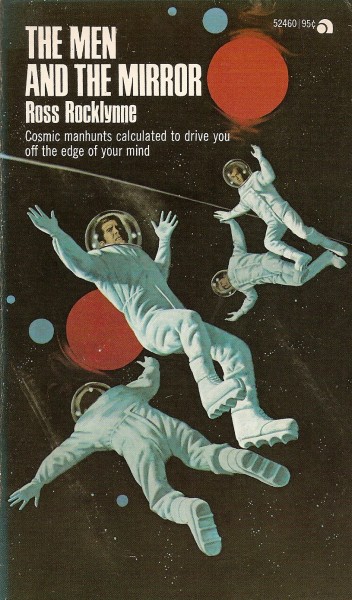
This made me nostalgic to read Rocklynne’s The Men and the Mirror (Ace, 1973), which includes one of the few stories written about Vulcan (not Spock’s planet, but the planet that was briefly believed to exist closer to the sun than Mercury). My sword-and-planet version of Vulcan will have to be different–possibly an invisible and/or dirigible planet.

Two men in space suits with bubble helmets are sliding down a mirrorlike object; both men and some planets in the background are reflected in the mirror.
The cover for the 1973 Ace edition of The Men in the Mirror; artist unknown.
Posted in art, fantasy, sff, sword-and-sorcery, words, writing | Comments Off on Worlds on Worlds Are Rolling Ever…

Fire Up the Gat Signal!

Typos of the day, from trying to type Batgirl in a hurry on a small screen: Vatgirl and Gatgirl. Both of these sound like they belong to the Legion of Regrettable Supervillains.

The cover of John Morris’ THE LEGION OF REGRETTABLE SUPERVILLAINS, featuring six knockoff villains by various artists: a golden guy with a lightning bolt through his head; a guy in an iron helmet attacking a Batman-knockoff; a green guy with scales pressing a button; a creepy, drippy green monster in an orange robe; a bald devil wearing a business suit, backed with flames; a giant shaggy red monster, pierced through by several projectiles, preparing to hurl a boulder.
Posted in art, Typo of the Day, writing | Comments Off on Fire Up the Gat Signal!