Echoes of Wuruyaaria

Still reading Lucian, and came across a great new-to-me Greek verb: ὠρύομαι (oh-ROO-o-mai). It means (and sounds like) “to howl” (as a wolf or dog).

It comes up in conversation between Hermes, who is conducting a party of ghosts to the underworld, and Menippus, the recently dead Cynic (“Doglike”) philosopher. Hermes has been describing how the world above is mourning or celebrating the deaths of Menippus’ fellow travellers, and he goes on to (sort of) put Menippus in his place.

ΕΡΜΗΣ: σὲ δὲ, ὦ Μένιππε, οὐδείς δακρύει, καθ’ ἡσυχίαν δὲ κεῖσαι μόνος.

ΜΕΝΙΠΠΟΣ: Οὐδαμῶς, ἀλλ’ ἀκούσῃ τῶν κυνῶν μετ’ ὀλίγον ὠρυομένων οἴκτιστον ἐπ’ ἐμοὶ καὶ τῶν κοράκων τυπτομένων τοῖς πτεροῖς, ὁπόταν συνελθόντες θάπτωσί με.

Lucian, Dialogues of the Dead 10.12f

HERMES: But no one weeps for you, Menippus. You alone lay down in silence.

MENIPPUS: Not so! In a little bit you’ll hear dogs howling most piteously over me, and ravens beating their wings when they come together to bury me.

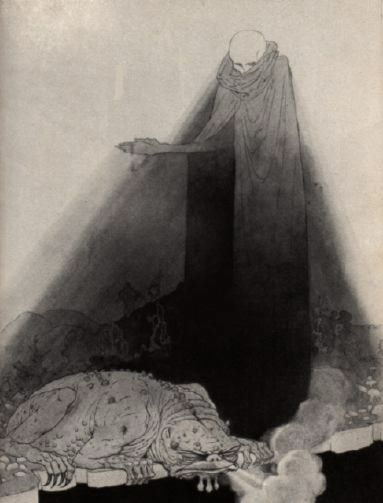
The painting shows crows gathering around a recently dead body lying in a doorway or bridgehead.
Barrias’ “Death of the Pilgrim”
Posted in art, books, dogs, fantasy, language, Morlock, Myth & Legend, words | Tagged , | Leave a comment

“Ixnay on the Ocodilecray!” Lucian Against the Paradoctors

I’ve been reading a lot of Lucian lately, for reasons that are difficult to explain; maybe I’ll write something about that when I figure it out. But I am finding that he reads better in Greek than he does in English. In a good translation, the words flow by so readily and the content seems so thin that it’s easy to miss his point. In wading through the text in the original language (by no means the second language that is easiest for me), I am forced to slow down and ask, “Wait a second! What does he mean by that?” And in that moment of confusion I’m closer to getting his point than I ever am when sailing through an English version of the same work.

But when he starts throwing crocodiles around, I get confused in any language.

photo of a crocodile's head, seen from the side
image of a crocodile from publicdomainpictures.net
Swim the slimy waters of paradox beyond the jump!
Posted in academia, Adventures in the Public Domain, AI is a misnomer, ancient art, art, astronomy, books, dogs, language, Myth & Legend, sff, words | Tagged , , , , , | Leave a comment

A Walk Around the Parker: Westlake’s THE HUNTER and Boorman’s POINT BLANK

Left: the cover of the first edition of "Stark"/Westlake's THE HUNTER. The cover painting by Harry Bennett depicts a guy who looks kind of like Lloyd Bridges but with enormous knotty hands, surrounded by various underworld figures. 

Right: a poster for John Boorman's movie POINT BLANK. The central figure is Lee Marvin holding a gun in his right hand; surrounding him is a collage of scenes from the movie.
Left: the 1st edition of The Hunter by Westlake/”Stark” (1962); Harry Bennett was the artist.
Note the deranged Lloyd-Bridges lookalike with the mutant hands: that’ll be Parker.
Right: a poster for Boorman’s Point Blank (1967).

I recently rewatched John Boorman’s Point Blank, which caused me to reread the novel it was loosely based on, The Hunter by Donald Westlake (writing as Richard Stark). The Hunter is very low on my always-reread list, and would not be on it at all except that it’s the beginning of not one, not two, but three amazing series of crime novels by Westlake/”Stark”, who was one of the great genre writers of the 20th century.

The novel and the movie are very much the same story, except insofar as they are not at all the same story. If you’re only going to tackle one, I’d recommend sticking to Point Blank, which is a self-contained and evocative crime film, an early work by the visionary director who would later helm films like Deliverance (1973), Zardoz (1974), and Excalibur (1981). The Hunter, in contrast, is not great, but it contains the seeds of greatness.

Hunt with Blank Points Beyond the Jump!
Posted in books, comedy, movie review, mystery, review or meta-review | Tagged , , , , , , | Comments Off on A Walk Around the Parker: Westlake’s THE HUNTER and Boorman’s POINT BLANK

Escape is No Escape

For escape, in the midst of the grading storm that always accompanies finals, I’m reading Innes’ England Under the Tudors (3rd ed; 1911). It scratches a longstanding itch to sort out the reigns and events of the pre-Liz Tudors, and is a dryly fun read. I realized the other night that it’s because the narrative voice reminds me of Jeeves, as played by Stephen Fry.

A poster for the BBC series JEEVES & WOOSTER (1990) with Hugh Laurie as Wooster and Stephen Fry as Jeeves.

Innes, an older contemporary of Wodehouse, must have been exactly the kind of agreeable old pedant that PGW admired and rebelled against.

But he’s no dusty old buffoon. He’s a sharp observer of character and writes with a democratic contempt for tyrants. Here I was, reading about the English Reformation, worlds away from the dangers of the 21st C, when Innes smacks me between the eyes with this (about Henry VIII’s Treasons Act):

“An irresistible instrument of tyranny was created, justified of course by the usual argument that without such powers it was not possible to deal adequately with the abnormal dangers of the situation. It need only be remarked that where there is practically no check on the abuse of such powers save the scrupulosity of the persons in whom they are vested, the risk of flagrant injustice becomes almost incalculable.”

It turns out that the past is relevant to the present. Much of my life has been devoted to sustaining this truth, but it still surprises me sometimes.

Posted in academia, Adventures in the Public Domain, books, comedy, history, review or meta-review, television | Tagged , , | Comments Off on Escape is No Escape

What Are You Doing New Year’s Eve?

Happy New Year to all on the Gregorian calendar. Happy Wednesday/Thursday to all.

https://indiaandersonmusic.bandcamp.com/track/what-are-you-doing-new-years-eve

cover of the album MIDWINTER by India Anderson

illustration: a line drawing of a tuba in front of a Christmas tree
Posted in music | Comments Off on What Are You Doing New Year’s Eve?

Magnet of Dull

I watched Melville’s 1963 film L’aîné des Ferchaux (“The Elder Son of the Ferchaux Family”, also known as Magnet of Doom or An Honorable Young Man). It’s got some reputation as a road movie, and for the first half of its run is pretty interesting. Michel Maudet, a Frenchman with Italian ancestry who tries to make it as a boxer, is played by Jean-Paul Belmondo, a Frenchman with Italian ancestry who tried to make it as a boxer.

French poster for the Melville movie
Screenshot
More Doom Awaits Beyond the Jump!
Posted in movie review | Comments Off on Magnet of Dull

Of Men and Mollusks

Came across this choice bit of abuse this afternoon:

πλεύμονα ατν κάλει κα γράμματον κα πατενα κα πόρνον.
—Diogenes Laertius 10.8

I render this as: “He <Epicurus> calls him <Democritus> a mollusk and an illiterate and a cheat and a whore.”

A photograph of an oyster, as an example of a mollusk or atomist philosopher.
Democritus, as described by Epicurus

I’m pretty confident about everything but the last word. Sex words in ancient languages are somewhat difficult to translate because the dictionaries have traditionally been prissy on these dangerous subjects. LSJ squirmingly defines πόρνος as “catamite; sodomite”… as if same-sex activity between men weren’t widely acceptable in the ancient Greek world. The newish (2021) Cambridge Greek Dictionary does better, defining πόρνος as “male prostitute; rent boy.”

That male sticks in my craw, though. (Don’t go sticking things in my craw.) I think there’s a widespread presumption among modern English speakers that terms about sex-workers are feminine by default, so that the term whore would misgender the Greek word (and atomist philosopher). 

But rent boy, though contemptuous, is light-hearted, whereas whore seems like an angrier word, a closer match to the Greek. I could render πόρνος as male whore, but that would endorse the (incorrect) assumption that male sex-workers are some kind of anomaly.

I realize that I have just written more than 150 words about one word. If you have a philologist in your life, that won’t surprise you. If you don’t… well, count your blessings, I guess.

Posted in academia, Adventures in the Public Domain, books, history, language, words | Tagged , , | Comments Off on Of Men and Mollusks

Et Thew, Brute?

Some discussion of thews and thewbilation in the Sword and Sorcery Tavern on Discord made me curious about the etymology of thew.

I consulted my friend, the democratic AHD, and it hit me in the face with this.

thew (thyoo)
n. often thews
1. Muscular power or strength.
2. A well-developed sinew or muscle: "sinews of steel, thews of iron, abdomen like one of those old-time washing boards" (Michael Kelly).
Middle English, individual habit, virtue, strength (sense influenced by sinew), from Old English theaw, a custom, habit.
thew'y adj.

American Heritage® Dictionary of the English Language, Fifth Edition Copyright ©
2011- by Houghton Mifflin Harcourt Publishing Company. Published by Houghton Mifflin Harcourt Publishing Company. All rights reserved. © 2011~ Enfour, Inc.

Did not expect it to derive from a word meaning “habit; custom”. That seems a pretty abstract origin for such a fleshy word. But I guess you don’t develop thews in the modern sense without the habit of exercise. Or so I’m told by those who have them.

I like the word thewy, though, and I wish it would come into more general use.

“What do you want to be when you grow up?”

“Thewy.”

Orel’s Handbook of Germanic Etymology (my go-to resource in these matters) didn’t help any, so I slouched over to the tyrant OED. No further etymology was available, but there was a lot of historical stuff about the meandering usage of the word in modern English.

For instance, it used to refer to “physical good qualities, features, or personal endowments” generally.

3. plural. Physical good qualities, features, or personal endowments.
3.a. † generally (e.g. the fair features or lineaments of a woman).
Obsolete.
1567
1567
Dost thou thinke.. that doltish sielie man, The thewes of Helens passing forme may iudge, or throughly scan?
G. Turberville, translation of Ovid, Heroycall Epistles 94'
•..
I leaue her thewes untoucht, wherein she may compare With heauenly Peeres, such feature falles on earthly creatures rare.
G. Turberville, translation of Ovid, Heroycall Epistles

The Turberville quotes made me wonder: how ripped was Helen? Homer is silent on this important subject; modern storytellers will have to ask and answer the question.

Posted in books, fantasy, language, Myth & Legend, sff, sword-and-sorcery, words | Tagged | Comments Off on Et Thew, Brute?

Permanent Records

I’ve been dabbling in the used-record market to feed the maw of my newish turntable. One thing I’ve really wanted was Cal Tjader’s Tjader Plays Mambo (1956), which is long out of print.

I managed to find a copy in the old red vinyl format that Fantasy Records used in the 50s (along with Tjader Plays Tjazz which is a fun album, but less of a must-have).

Photo of two red vinyl records, half-emerged from their sleeves: TJADER PLAYS TJAZZ (1954) and TJADER PLAYS MAMBO (1956).

The discs themselves are less than pristine (few of us are as we approach our 70s), but it’s hard to express how magical these things are to my eye and ear. Vinyl in general is less common nowadays, but translucent vinyl in bright colors is often seen in modern issues.

But these Fantasy discs were the only red records in my parents’ pretty extensive stacks of wax. And, when we (my siblings and me) played them out of curiosity, the music was wildly fascinating. The vibes from those vibraphones went right through my head, leaving trails of light behind them.

There are other great jazz vibraphonists, I know, but Tjader is still the guy on whom I rely for the vibes.

Posted in music, review or meta-review | Tagged , , | Comments Off on Permanent Records

October 23: The Day of Might

At the Fortress of Engitude, we’re celebrating the Day of Might, proclaimed by the late, unceasingly great Howard Jones as a day for celebrating sword and sorcery, heroic fantasy, and heroic fiction generally.

Posted in books, fantasy, fantasy art, music, Myth & Legend, review or meta-review, sff | Tagged , , | Comments Off on October 23: The Day of Might